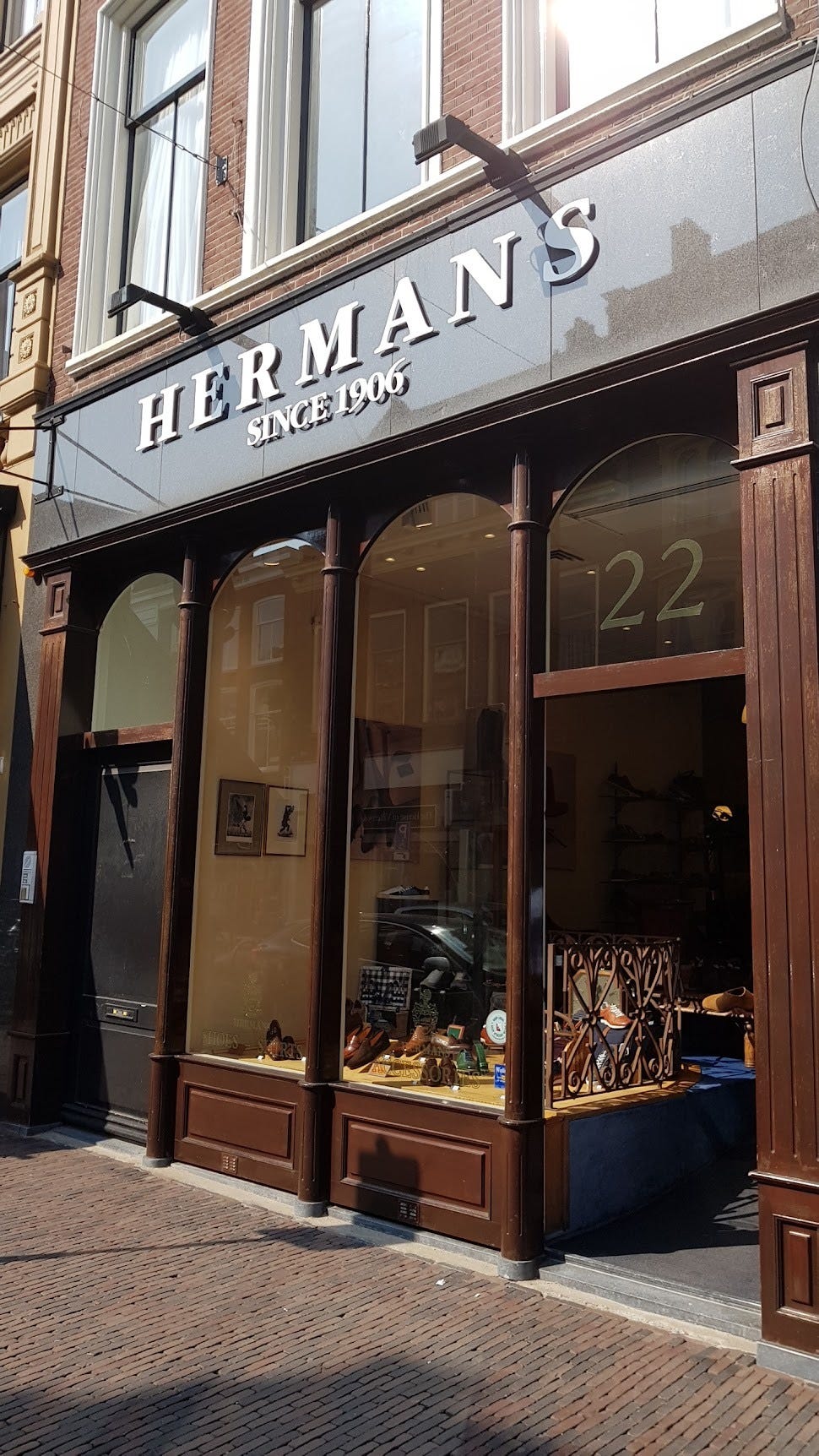
Hermans Schoenen opened in Utrecht in 1906. For 117 years they sold English Goodyear-welted shoes from their shop in Utrecht, about two minutes from the Dom.
The staff knew the construction, knew the lasts, and knew which shoe would fit which foot before the customer sat down.
They closed in 2023. Not because of bankruptcy, but because the new owners said the service they provided no longer connected with the younger generation. They were probably right. THEIR service no longer connected with the audience. The knowledge walked out with them.
See… Dungelmann, the chain that owned them before, went bankrupt in 2019. Eleven shops closed. Their founder knew what Goodyear welting was, knew about men’s shoes, could tell corrected grain from full grain by touch, and understood why a shoe needed to be fitted rather than sold. When his daughters took over, it all went to waste.
The retail infrastructure that transmitted this type of knowledge across the counter is almost completely gone in the Netherlands.
This is not just a Dutch problem… It is the same story in every country where luxury retail scaled, consolidated, and replaced product knowledge with brand training.
The person who once stood between you and the wrong purchase, who knew enough to tell you the shoe did not fit before you had walked ten metres, has been replaced by someone who knows the shallow brand’s history and the season’s colourways.
What remains is just the object. And some objects still tell the truth, if you know how to read it.
Wednesday’s essay traced how Ferrari, Porsche, Rolls-Royce, and Patek Philippe each reached the same structural moment.


The founding constraint: Enzo’s refusal, Royce’s aversion to incorrect work, and Porsche’s insistence on building only what he would actually drive. It stopped being enforced by a person and became a shallow narrative instead.
The standard moved out of the object and into the story the brand tells about the object.
That shift is not always visible from the outside… The name stayed the same, the history is still real, and the price is higher than ever… but the person who felt the wrongness of an incorrect answer in his body before he could formulate a verbal objection, the person whose discomfort was the standard, is no longer there…


What you are actually paying for, at this level, is the refusal. The question worth asking before you spend anything is whether it is still present… in most cases it is not. Most ‘luxury’ nowadays is slop…
Here is how to check what is still worth it.
The Living Standards Guide gives you the addresses. Members can read on…