


One of my readers recently asked: how do you sell tradition in a highly secularised society? The answer starts smaller than the question.
The word ‘tradition’ still sells, and that is the problem: it sells fastest when it is fake. So today I want to show how to make the real thing visible anyway, beginning with the people under your own roof.
When I worked at Hermans, I watched a Jaguar pull up outside one Friday in March. It was the year before the bankruptcy, before a new owner took over the lease. The customer who stepped out had been coming to us for more than eleven years. He had no interest in hearing about the Northampton last, the welt, or why the shoe would still hold its shape in ten years. He just wanted a shoe so that he could walk into his office without anyone noticing his feet.
We knew which pair he wanted, he paid, and he was gone within minutes. He trusted us to keep our promises. This was Hermans: the formerly most trusted shoe store in the Netherlands.


When the new owner took over, he chose to waste what he had inherited. His first move was to take 50% off every British shoe. It cleared the stock, and it destroyed in a few weeks the trust that loyal customers had built over decades. Once everyone had bought their discounted pair, he filled the shelves with Italian shoes that had been out of fashion since the 1990s.
Eighteen months later the shop was gone. The name and the building survived, but the business inside them did not. The staff who had learned the trade over decades left, and with them went the simple fact that a shoe bought there in 1986 could still be repaired in 2019. A hundred and seventeen years ended because the new owner did not know who was walking through his own door, and probably did not care.

The market did not kill Hermans. Men who want a proper shoe still exist in large numbers, and so does the longing for real quality. What ended was a line of people who knew why it mattered, running from the founder through every shopkeeper after him, until one man bought the building and threw away the inheritance.
The knowledge of Hermans should not be lost, that is why I put together a guide. Check it out here before you buy your next pair of shoes!
But my experience at Hermans is not really what this readers’ question is about, though. There is a real fear behind asking how to ‘sell’ tradition, and I do not think it is mainly about business. It is the worry that what you hope to pass on (whether that is you faith, a feast kept properly or a family trade) will not survive your partner’s patience, your son’s teenage years or your own tiredness.
Imagine it being a Tuesday evening: your car did not start this morning, your children are arguing over the last piece of cake, and grace is said in about four seconds because everyone is hungry. Of everything you meant to keep this week, grace felt the most optional, so it is the first thing to go.
This might sound vague, but the first way to ‘sell’ is not to the world outside of you. It happens at home, every week, to your partner and children: people who never asked for tradition and who can tell whether you are living it or lecturing about it.
This is a much harder sale than any shopfront or brand has ever faced, yet nobody warns you about it beforehand. Or learned you how to ‘sell’.
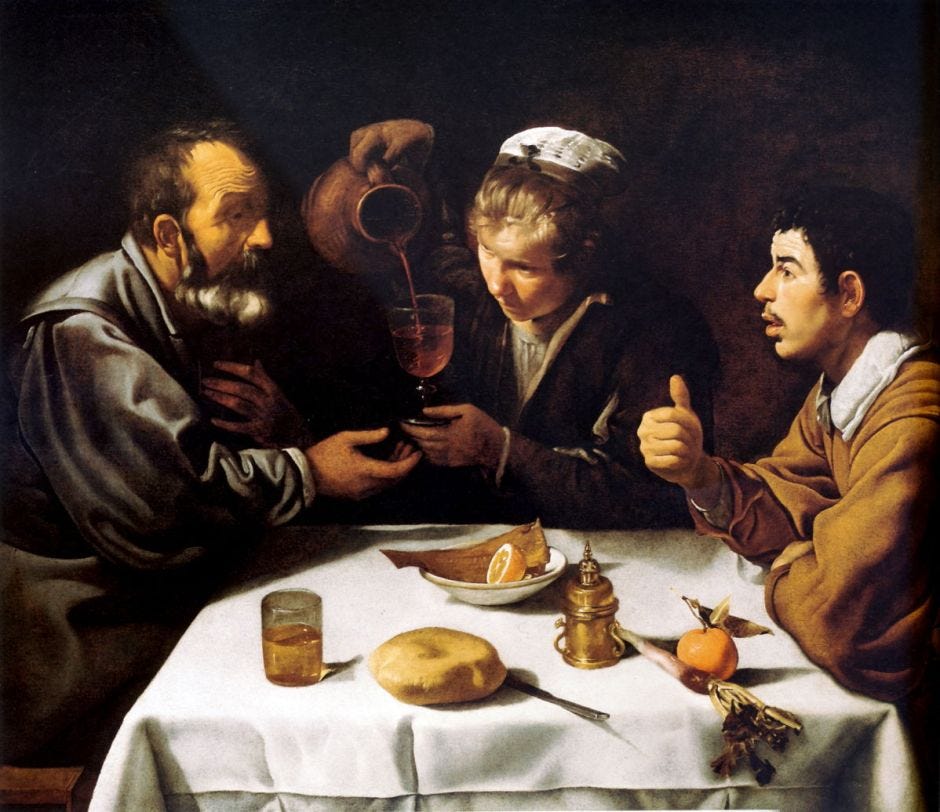
Out in the world, the word tradition has been worn thin. We now have brands with invented founding dates, labels promising ‘handcrafted since 1847’ on companies started two years ago, monastery aesthetics sold as a zen mood: they all have proved that ‘tradition’ and ‘heritage’ moves products.
The writer W. David Marx explains why: For years, status has come from broad taste rather than deep taste, so tradition became one more thing to sample, scrolled past in the same feed as a new pair of trainers and given the same six seconds of attention.
Judged that way, something a monk spent forty years learning and something an intern made in an afternoon become the same kind of object. And because a claim to heritage only impresses while it is rare, brands keep inflating it: ‘since 1847’ becomes ‘handcrafted since 1847’, then ‘handcrafted in small batches since 1847 by artisans’.
Most ‘trad-wives’ or people trying to live traditionally are the same, they live the kitsch version of this tradition.
But as a reader of Heritage Standard you are not in that race, and if you start sounding as though you are, your son will unknowingly put you in the same category as the brand intern.
Now compare that to a man who resoles his own shoes: he does not need to make a bigger claim this year than last. His practice stays the same size, and over time that is how his son learns how his dad operates.

The Edward Green customer understood what the new owner of Hermans never did. They bought a shoe made on a last that fitted their foot, and a recrafting service that let it outlive three fashions and two jobs, and it never dressed the shoe up as a lifestyle.
Edward Green made the object, kept to the rules for making it, and let the customer decide whether it was worth the price. Your home works the same way: The customers are your family, and they do not pay in money. They pay you in attention and patience, and show how much they value it in how they keep up practices when you are not watching.
One more thing before you decide whether to read on…
Your kid has probably seen you fail at what you are trying to teach him, not someday but probably this week in your own home. They unconsciously notice the gaps between what you say things mean and how quickly you rush through them when you are tired or distracted.
They are drawing conclusions from those gap right now, and which conclusion…. that depends on how they read your failure. If they decide it proves your ‘tradition’ was an act, they will file the practice under ‘things Dad pretended to believe’, and no argument later will change his mind.


In my opinion that is why the Catholic Church in the Netherlands could disappear so fast, and boomers somehow still have traumas of ‘those years’: the lecturing did not match the practice, and that it fuel cruel and hypocritical.
So if your kids read it rightly, a similar failure becomes the moment the practice turned from theatre into something real. And that is the thing most ‘traditional’ or traditional-minded families now struggle with. The (often young) parents have a gut feeling of being ‘unrooted’ and overcompensate that with being extremely ‘traditional’. But since they never lived it themselves, it is an act, and their kids notice this.
Which way you kid goes depends on one thing you do, or fail to do, in the seconds after you slip. And that is the part I have not told you yet, because it is the only part worth becoming a Heritage Standard member for…
