
How dressing badly became a personality
Why modern men can’t dress, and what it reveals about their convictions
Once every few years this Cary Grant meme (below) with a gay fashion lore next to it pops up again. Every time I see it, I have to temper my rage. Especially knowing how the guy who posted it dresses in real life. Hoodie, jeans, scuffed sneakers. And when they wear something formal for once, it’s some feminised suit on their brother’s wedding day.
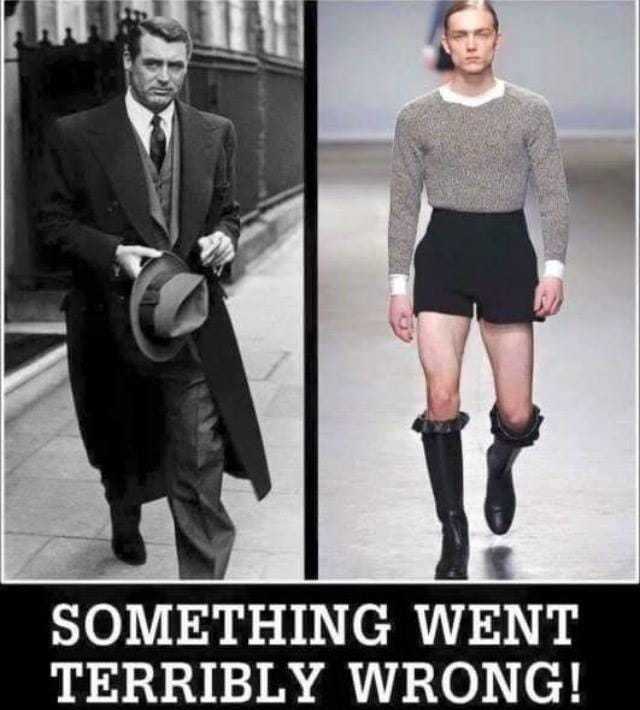
I’ve worked in luxury fashion for over five years and specialised in men’s tailoring and shoemaking at companies like Burberry, Zegna and Edward Green. That’s why one side I care so much about it, but also why I hate most fashion influencers with passion.
But sometimes they write something that’s true, like Jake Woolf did this week:
He’s completely right about how badly right-wing people dress. It’s not that left-wing people do it better, but the people who post about restoring the west and how they hate modernity can’t dress themselves properly.
Jesters like Jake will tell you most suit wearers are coping. That you should just wear what feels authentic. For Jake Ralph Lauren = style. Which is just as retarded as trad guys that get mad at me when I don’t wear a suit. Because you SHOULD!
Both are equally wrong in their vision on what fashion is, they both treat it as either:
pure self-expression (=narcissism)
pure signalling (=kitsch)
But neither of them understands the right balance between craft, fit and character.
Fashion has become metaphor for what people have become: reliant zombies with no inner dialog, no true convictions. But they sure love to opinionate, enjoy and express themselves in every way possible. That’s why fashion brands make the most retarded stuff nowadays, it’s to fill the void.
Vain or stylish?
Guys like Gabriele D’Annunzio, Yves Saint Laurent, or Theo Hiddema can be loud in their self-expression. That’s what people might think. And partly they’re right on that.
Take D’Annunzio for example, he was vain as hell. In his book Il Piacere, his alter ego Andrea Sperelli is the archetype dandy-aesthete. His life is an artwork.
He definitely was a narcissist dandy. But what separates him from modern fashion designer is that he knew his materials, fits, and crafts. His vanity came from a deep understanding, not cosplaying. So I’d argue in his case his flamboyance isn’t kitsch.
The distinction:
Modern trad guy: Badly fitted suit as signal, and no knowledge
D’Annunzio: Vain and theatrical, but understood tailoring and materials
Vanity get redeemed less if you’re competent. But ignorance makes everything kitsch.
So what does dressing badly mean?
When I say to fellow men that they’re better off not wearing a suit, they get mad. They see the suit as superior to anything else. Yet, wearing a navy turtleneck and white chino will always look better than whatever this is:
So there’s basically three types of badly dressed men:
The Conservative Signaller: They wear a cheap suit as ideological statement. Too tight jack, trousers to slim and long, awkward tie, contrasting shoes. He thinks buying a suit makes him traditional.
The Zesty Dandy: Every outfit screams “look how unique I am.” Pure narcissism disguised as taste. These are not D’Annunzio’s but the try-hards.
The ‘Whatever’ Dude: He would wear a hoodie and jeans to Church, weddings; everywhere. Not caring is his ‘authenticity’.
Your outfit doesn’t define you, but reveals your level of awareness and care. Just wearing a suit for no reason at all is not showing a genuine care.
It’s like the nouveau rich peasant buying a diamond skull for signaling his wealth in the most tasteless way. But it’s not much different from kitsch nationalism, which I touched on last week.
How men dressed before it went wrong
Men like Cary Grant, Frank Sinatra and even Gabriele D’Annunzio shared something: consistent restraint over time. They curated wardrobes that aligned with their character. Self-expression was none of their motives.
The fit, fabric, and context were the foundation. They master these and therefore thei character emerged naturally through their consistent choices that aligned with how they lived. Not as an they wanted to project.
They didn’t need to “find their style” or purpose. They already had a center and convictions. Their clothes merely followed that.
But today that inner structure is gone. Men no longer have that ‘rizz’ or build their identities. They just outsource them. For one man that means buying some expensive designer garbage to look “artistic,” for another to wear a suit to look “trad.” Both are costumes to cover the same uncertainty.
See, style is a visible discipline of invisible virtues like patience, restraint, continuity, and self-respect. Fashion today is just branding, whether that’s moral, aesthetic, or artistic.
When a guy like Cary Grant walked into a room, you wouldn’t notice his suit first. You noticed how he fits inside it. How his posture and tone completed to garment.
Men used to have coherence. Now everything is eclecticism, and that’s why everything is so ugly.
But coherence can’t be bought. It comes from an understanding of materials, proportions, context and yourself.
The Foundations of Men’s Style
You fail because you want to skip the foundation. Depending upon your budget you buy an expensive or cheap suit and follow the clown who dressed the mannequin. Because that’s who you take style advice from.
But €20.000 suit that doesn’t fit looks worse than a €500 suit that does. Trump’s style has improved, but his terrible looking suits were still Brioni’s.
How clothing should fit
Jacket length: Your jacket should cover your seat, not just your hip bones. And when you stand naturally with arms at your sides, the jacket should end where your hand curls. Never buy a jacket with too long sleeves: a tailor can’t adjust this without ruining the cuffs.
Shoulders: The seam where sleeve meets shoulder should sit at the edge of your shoulder bone. Not hanging off (= too big), not pulling (too small). No aggressive padding unless you’re built like a stick. If there’s a gap between your shirt and jacket: the should is too small.
A tailor can’t adjust the shoulders without ruining your jacket, so always make sure it fits, even when the rest is too loose. You can always tailor it later.
Trousers: I really hate the low-rise trousers they now offer. Trousers should sit at your natural waist, covering your belly button, not just your hips. The break (where the trousers meets shoe) should be slight or non-existent. No pooling fabric around your ankles. The fold should be straight at all times.
Shirt: Just ask the salesman to measure your neck and not look like a roulade while wearing it. Their should be no tention on the placket.
It’s fine to buy off the rack or on Vinted if you can’t afford bespoke or made-to-measure. But then find a tailor that can adjust it for you.
Shoulders and chest can’t be fixed, but sleeves, length, and waist can.
A tailor costs €20-50 per adjustment. It’s the difference between looking like you borrowed your father’s suit and looking like an adult.
What you’re actually paying for…
Brands charge for logos. Manufacturing and fabric quality are the only things you should pay for.
And don’t be boring by just wearing navy suits. Combine Houndstooth, Glenchecks, Prince of Wales, Herringbone’s and Shepherd checks with plain trousers.
I won’t recommend complete suits in these fabrics.
Natural vs. Synthetic:
Never buy anything synthetic: it doesn’t breathe, it shines and leeches microplastics. Stick with wool, cotton, linen and silk. These have texture, irregularity (character) and breathe. They also developed character over time, as they age well.
When a wool mix doesn’t specify the other fabrics it’s always blended with synthetics. Polyester, rayon, viscose blends look cheap immediately. They age badly and can’t be properly tailored.
Your grandfather’s wool suit can be restored. But a polyester suit from Zara will be trash in a few months.
Context: reading the room
The conservative signaller wears his suits everywhere as ideology. The slob wears hoodies everywhere because he’s ignorant. Both are morons who can’t read context.
There are five levels of formality:
Black tie means tuxedo, bow tie, shiny shoes. Weddings where they actually care. Galas. Events where showing up wrong gets you judged.
Business formal is dark suit, white shirt, silk tie, black leather shoes. Wear in court, funerals and meetings where money or respect is on the line.
Business casual is a jacket with chinos, a real shirt, leather shoes. Should be the default office uniform, and with dinners where people might remember you.
Smart casual is where most men fuck up. It still means wearing quality knitwear or a button-up. Dark jeans or chinos. Having clean leather shoes, and not your running trainers, or your work boots.
Casual is well-fitted jeans, plain tees or polos, boots or clean trainers. Not gym clothes.
Context isn’t hard. It just requires you to follow simple rules. If some boomer shows up in a polo-shirt at a wedding, don’t lower yourself to his standards.
Fred Astaire: An icon to emulate
The guy most would benefit from emulating (not copying) is Fred Astaire. Rather than any famous actor, influencer etc.
Fred Astaire mastered functional elegance. His wardrobe was designed for movement, as he was a ballroom dancer. The personality in his clothing came through his consistent restraint over time. Knowing what fits him and not shouting ‘self-expression’ like most dancers do now.
He wore variations on the same thing for 50 years. Because he understood what worked for his body and in his life.
This is what real style looks like. Style is not about following trends, ideologies, signaling, or a performance art. It’s making competent choices repeated consistently over decades.
-Robbert


In a culture such as ours, it’s still nice to see a man in a suit - although a badly fitting suit is just that - we have lost the intergenerational tutoring, and influencers - paid or otherwise has pushed FASHION over quality. Unfortunately, few can afford really well made clothing. At one time we ( who cared) bought vintage clothing from the 30’s-50’s to get that quality. Those pieces are now moth eaten. The standards for dress have gone downhill. But I do think at least trying is important. Making an effort to look put together. Many of the very young men wear their hair in a tousled coconut hairstyle and they think they look good. It’s the influence of TV, movies, sports figures and the like. Yes, the too tight suit is quite awful. But the man is trying. Don’t be so hard on them. They don’t know better. And the cost of a well made suit is astronomical. The sellers of the suits etc., today know little of fit and style themselves. The old Hollywood look was very expensive even at that time. Side note; that is NOT Fred Astaire. And he did dress quietly flamboyantly if I can say quiet and flamboyant in the same breath. He wore ties as belts. He was very lean which gave his bespoke clothing an elegance - he probably could have worn off the rack at that time due to better materials and cut.
A good alternative is to buy real materials first. Hard to find today.
Women are pressured to wear new, new, new. At a glance we may look nice but up close the materials are flammable. A new standard would be to buy less, but better. Hard today with all the pressure. Please understand that the young who are trying are learning. Their grandfathers probably didn’t dress all that well either. My experience as a woman born in the 50’s is that the rock n’ rollers really blew things up. The old R&B guys at least looked cool. My grandmother was my influence- so chic on a limited budget - she bought the best she could afford. Had only several outfits which she spruced up with accessories. Always had one amazing thing on, wore only Italian shoes - ( usually waited for sales at the end of the year at high end clothiers, etc) but those were the days when you could save for something wonderful. She couldn’t do it now.
You’re right about the luxury brands. They just aren’t as well made. I don’t understand the leather that looks like plastic.
If I could - I’d make my own clothing.
You've completely missed the most formal level of clothing - especially for weddings and funerals - which is morning dress for daytime events and white tie for evening events (obviously you're not going to have an evening funeral).
Black tie is traditionally known as "semi-formal" and should really only be worn after 6pm to a meal, rather than to formal events during the day like a wedding. Hence its name in the UK: "dinner jacket".
Your example towards the end of the article, Fred Astaire, is wearing white tie in the photo - why not take the opportunity to discuss it!