
Is the handwritten message dead?
Communication used to be an art of its own
I keep some of my grandmother’s letters in a shoebox. But I do not do the same with the WhatsApp messages my mother sent me. They are not deleted. They are unfindable, unsaveable, lost in digital noise.
Why does one have so much value whilst the other is a fart in the wind?
The University of Leiden digitised its medieval manuscript collection. You can scroll endlessly through densely written, meticulously neat pages. What strikes you is the regularity. Every s has the same curves. Every u the same thick belly. Often the colophon lists how many scribes worked on the manuscript. Sometimes two, often more.
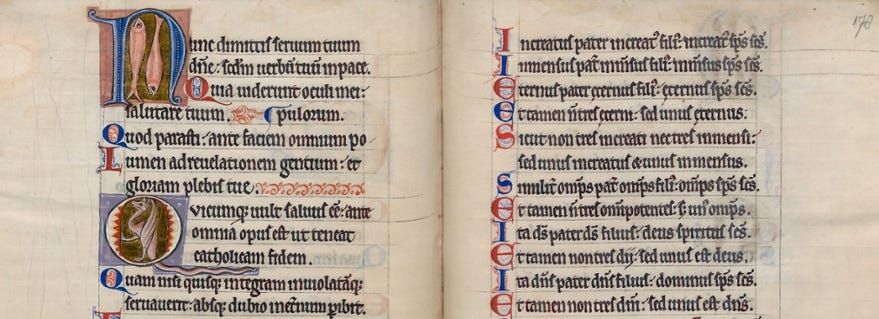
Writing was never solitary. It was collaborative work towards a shared goal: preserve and transmit.
Around 3500 BCE, people in what is now Iraq developed cuneiform script. Thousands of years of script followed. Countless variations of hand, pen, paper.
Now you are happy to receive a birthday card your family bought online at Hallmark. Often they just message you with ‘condolences’ or ‘congratulations.’ Journalists never carry crumpled notepads. Coincidentally they also do not produce quality reports anymore. All clickbait and rage bait. Job boards never mention ‘writing.’ It is ‘typing.’
This essay is about how handwriting went from collaborative craft requiring years of training to something we actively avoid. How the ballpoint killed cursive without anyone noticing. How AI now writes our emails whilst we forget how to form letters. And why your ability to think clearly depends on occasionally picking up a pen.
The ballpoint pen killed cursive without anyone noticing.
Introduced commercially in the 1940s, the ballpoint used thicker ink than fountain pens. You had to press harder. Fatal for cursive, which requires light pressure and smooth movement.
Within a generation, cursive disappeared from everyday writing. Teachers stopped requiring it. Why bother when ballpoints made it uncomfortable?
What was lost was planning. When you write cursive, you envision the entire word before beginning. Typing allows letter-by-letter construction. You can change your mind mid-sentence. Less cognitive load, but also less cognitive benefit.
In America, cursive is still taught at private schools. Children who learn cursive stop spelling out words letter-by-letter sooner. Connected writing challenges the brain more, creating more neural pathways.
Typewriters arrived, and handwriting retreated. Businesses adopted them rapidly. Handwritten business correspondence became ‘unprofessional.’ The typewriter separated composition from handwriting. You could type as fast as you could think, but misspelling meant redoing the whole thing. You still needed foresight.
The typewriter did not kill handwriting entirely. Personal letters remained handwritten. Notes, journals, drafts—all still pen and paper. Professional work went to typewriters. Personal life stayed handwritten. That division held for decades.
Then everyone got a computer in their pocket. A glowing QWERTY keyboard that corrects spelling, predicts words, switches languages instantly. Email became the default for everything.
University students wave their hands after ten minutes of handwritten exam answers. Their hand muscles are not trained for sustained writing.
Now AI writes most emails. A pen icon sparkles in your inbox. Built-in AI generates messages so you type less. Soon writers will be ‘prompt writers.’
But AI works only in good hands. Meaning: people who write well themselves. The quality of the user and the quality of the output correspond.
Good writers pause. Between words, between sentences, especially between paragraphs. That pausing is thinking. They evaluate what they have written and plan how to continue. They polish constantly. Bad writers are satisfied quickly and adjust less.
The tool does not make you a better writer. The tool only amplifies what you already are.
Goethe’s Werther carved a poem for his beloved into rock. He had to think carefully about what he wanted to say and how it would fit on stone.
This is not nostalgia. This is not about aesthetics or ‘the joy of fountain pens’ or lifestyle-magazine drivel. This is about cognitive discipline enforced through physical limitation.
Handwriting forces planning because revision is costly. You cannot endlessly tinker. You cannot copy-paste your way to coherence. You must think before you write, structure before you begin, commit before you finish.
Digital writing removes constraint entirely. And the lack of handwriting nowadays produces worse thinking. Which is why people nowadays only talk in mind farts. Never having any inner dialogue.
What you need is a fountain pen… a pen that provides resistance. The ink flows only with correct pressure and angle. Too hard and you damage the nib. Too light and nothing appears. The paper itself resists… meaning: you learn to write with intention because your carelessness is visible.
Typing provides no resistance. Press any key, any way, and letters appear. Delete is instant. Revision is invisible. Change the font and it looks like you put in the effort.
AI has even removed the requirement to type. Soon we will not write at all. We will only describe what we want written and a software will generate it.
This will be the final separation of thinking from expression.
The Platform Handschriftontwikkeling (Dutch Handwriting Institute) got handwriting listed as intangible cultural heritage. But calling it ‘heritage’ admits defeat.
Handwriting is not dead… yet. Children still learn it, but with less rigour. Adults can still write by hand, though most avoid it. Pens are cheap, paper is everywhere, and the skill is simple to relearn.
But what is truly dying is the habit, the expectation of written letters: The standards we used to have.
And standards, once abandoned, are impossible to restore.
The ballpoint killed cursive in a generation, and less than a century later young adults cannot write for ten minutes without hand cramps.
This matters beyond handwriting. We can apply this to anything. Women that can barely cook anything from scratch. People can’t read long books anymore. Have no sustained attention. And avoid physical labour.
Yet… skill requiring years of practice and discomfort during learning.
Handwriting is the canary. If you cannot maintain something as forming letters with a pen, what discipline can you maintain?
The Platform Handschriftontwikkeling wants handwriting taught properly in schools. They want to require students to master penmanship before they graduate. And want cursive restored, fountain pens recommended, standards enforced.
Sadly… I know they will fail, because the momentum is against them.
But the discipline is not deemd pointless.
So pick up a pen. Write a letter. Keep a journal. Take some notes by hand. It will not be faster or more efficient. But that is the point: it is slower and harder.
Do not do it for ‘mindfulness’, ‘the joy of analogue.’ or because grandmother did it.
Constraint forces clarity. difficulty builds capacity. And what requires effort to create is proof you mastered it.
Grandma knew this without needing to articulate it. She wrote by hand because that was how you wrote. The permanence of ink on paper meant you thought before you committed.
Time to reclaim it.
-Robbert


I am a fountain pen user, so I know exactly what you are feeling as you write this.
I am afraid I have a pen and ink obsession. Not to mention a paper fetish.
Naar welk adres stuur ik mijn reactie?