
The Age of Conceptual Masturbation
How fake depth replaced authentic experience
Everything has become a concept, a journey, and a feeling.
Art, hotels, restaurants, websites, fashion brands, cars, wellness, real estate, coffee: it’s all ‘a concept’ nowadays. I’m convinced that 80-90% of luxury goods and services in 2025 are like this.
I thought of the idea of conceptualist masturbation when a coffee brand ‘for aviators, by aviators’ followed me on Instagram this week. While a brand story in itself is not kitsch, this brand was horse shit packaged as uniqueness. Fake and forced, like every concept.
A concept is an idea or invention to help sell or publicise commodities.
Concepts give a sense of (false) belonging. People can ‘get’ the concept and its paradigm. I’m not a neurologist, but I know for sure this feeling is equivalent to a mental orgasm. I used to be the first one to visit every new restaurant, shop, hotel, etc. Concepts make people feel sophisticated and immersive.
But they’re not. Everyone’s using opioids, 100% convinced it’s better than being alive. The same happens in relationships. Platforms like the Hub and OnlyFans don’t necessarily cater to incels; the most avid consumers are people in relationships. The fake thing is better than the real thing.
Thinking about an experience has replaced the experience itself. Authentic impulses are getting packaged, abstracted, and sold back as premium.
Walter Benjamin hits the core problem of every CoNcEpT in his book ‘The Work of Art in the Age of Mechanical Reproduction’. Now, you might think a concept is not a mechanical reproduction. But conceptualism is over 100 years old already, and again, art has become stale because of it.
"Even the most perfect reproduction of a work of art is lacking in one element: Its presence in time and space." - Walter Benjamin
But we haven’t reached the peak of conceptual masturbation.
How did we end up in this situation?
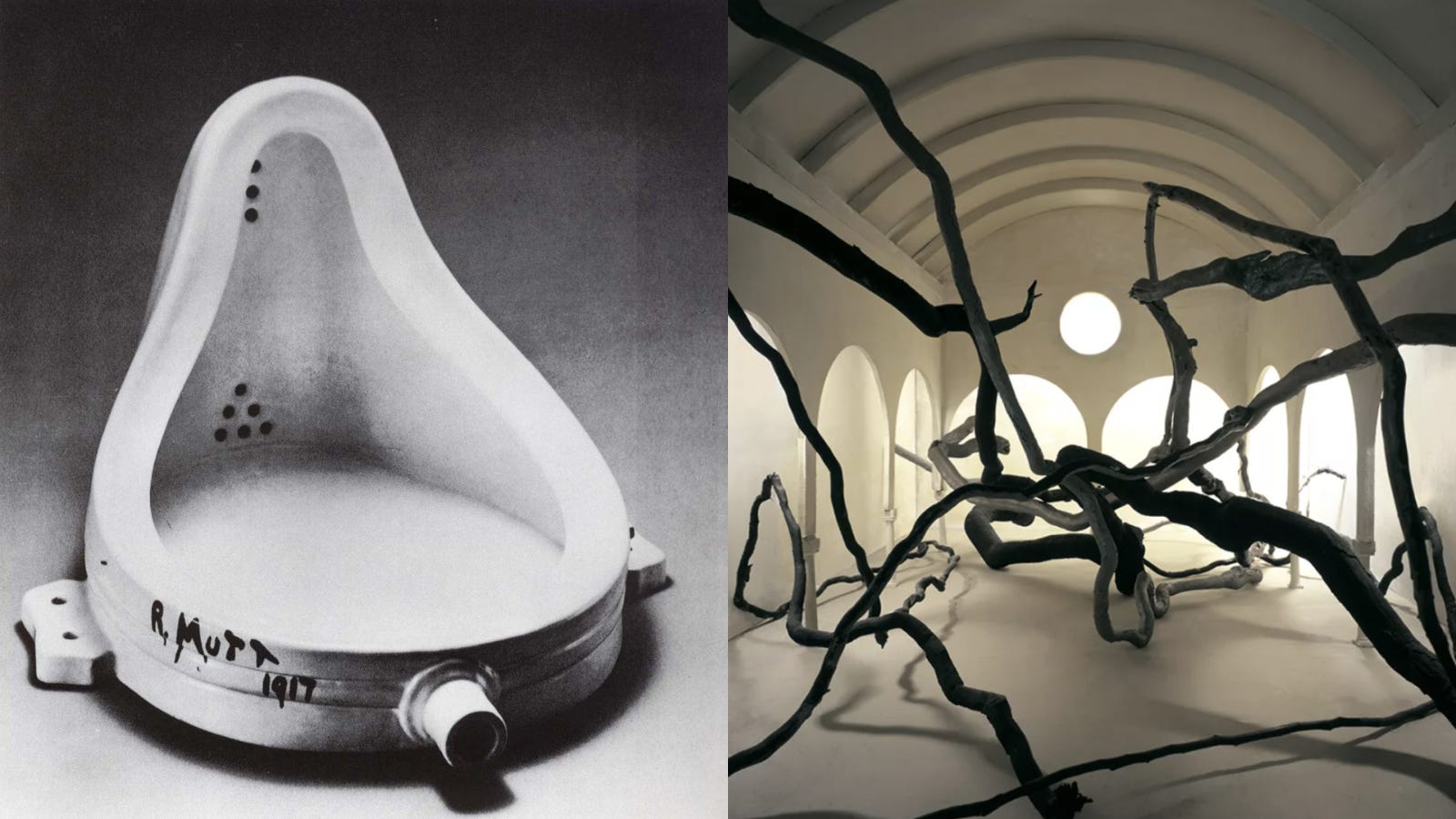
If you know a thing about modern art history (or hate it well enough), you’ll likely attribute the root of all modernist evil to Duchamp’s Fountain (1917). But many fail to realise he was a genius, not for his craft, but for his problem-solving abilities. Art at Duchamp’s time became stale. Everything was either a landscape painting, animals, or still lives. All had been invented already, until Duchamp decided to make a urinal into an art piece.
Duchamp is not the conceptual masturbator here. It was others who took his invention and made it into a formula. Sol LeWitt systematised conceptual art into repeatable instructions. Joseph Kosuth turned it into an academic theory. And The Art World Institution realised they could monetise concepts more easily than crafts. Leading to endless reproductions.
Duchamp tried to break the rules, but as a negative side effect, everyone started using his rule-breaking as a new set of rules.
Your brain is hijacked, here’s how:
Researchers found that seagull chicks can instinctively spot red spots on their mothers’ beaks. All seagulls look alike, except for these spots. So when researchers showed them a stick with the same, yet exaggerated, stripes as their mother, they responded to it more strongly than the real thing.
This is ‘peak shift’, our brain’s tendency to want exaggerated stimuli over authentic originals. And modern culture willingly exploits this biological vulnerability.
The wellness concept offering 17 obscure Tibetan healing modalities triggers you more than getting some rest. The ‘deconstructed’ garment triggers you more than looking like a normal person. The experiential art installation with interactive elements triggers you more than a painting.
Society has hijacked us to preferring fakeness over authentic experiences. And your biology is to blame.
Reality has become unrecognisable to most people
Conceptualist thinking creates a catastrophic feedback loop. Real beauty becomes boring, and you lose the ability to be moved by the simple and present.
Not only does it kill beauty, but resources flow toward conceptual junk instead of quality. Cultural sophistication gets reduced to consumerism, and people become dependent on external narratives.
Everyone's getting high off their own Instagram stories. Convinced that their curated self-image is real, they fail to realise that the concept evoked the (shallow) feeling or opinion.
Researchers found that brain-damaged patients can’t recognise their mothers, as familiarity made them unreal. Modern-day brainrot is the same: people can no longer recognise authentic experiences. Artificial Intelligence will only make this worse (again: we haven’t reached the peak yet).
Escaping the simulation
Everything has been turned into a concept. We survive on a conceptual basis, but life itself is not a concept.
Deep down want the thing itself, not the ad for it. We seek the taste, not the tasting notes. And we want to touch it, not read the brochure about the touch.
Kitsch fakes the feeling, and concepts fake the depth. Both are scams, and both make us forget the real.
The cure is simple: touch all that resists. Wood, stone, flesh, songs. Everything that fights back and refuses to be a pitch deck.
Stop swallowing pre-chewed taste. Eat the raw meat to not to fall for the simulation. Sit in the silence.
We need presence over packaging and reality over conceptualism.
-Robbert


