
The joke that is eating culture
How we traded civilisation for food
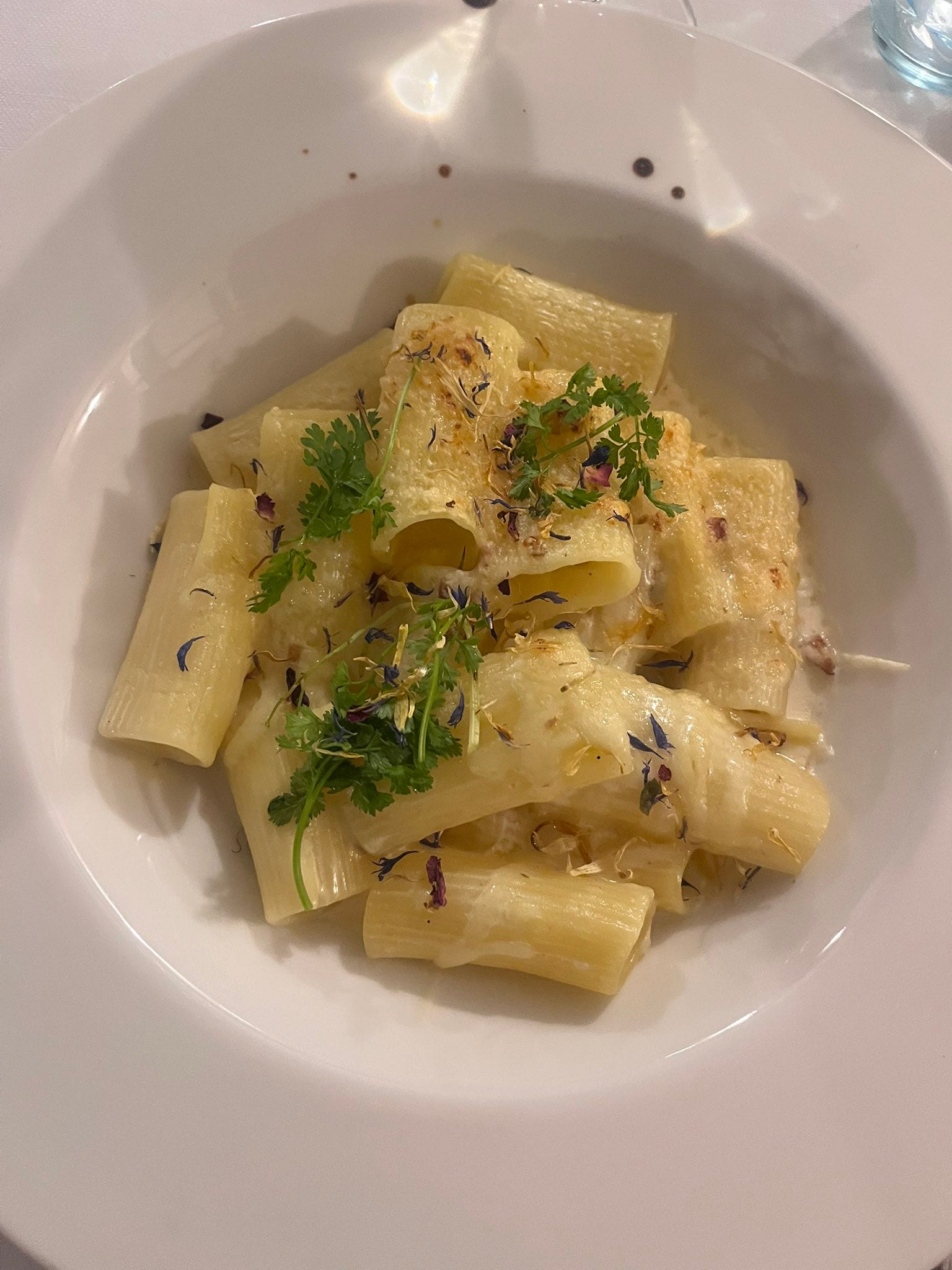
Last week I sat in a praised restaurant in Chamonix. The Pasta Carbonara arrived as if it was microwaved. A dash of parsley on it. No guanciale to be found.
They asked €30 for it, but it was absolute shit. Meanwhile the restaurant has 4.3 stars on Google.
And this is not the first time I had food this bad in France: ‘Zhe’ Capital of Fine Food, they say.
The same France that loves to bash the Dutch about not having a food culture.
This essay is about how food became the last acceptable identity marker for people who have abandoned every other element of their culture. European civilisation built cathedrals, universities, legal systems, and global empires. But we cannot talk about any of that. So we pretend knowing the right spice blend makes you cultured.
The Retreat to the Plate
When someone says ‘I am Italian,’ what do they mean?
Ask someone in 1850, they would tell you about the Papal States or the Kingdom of Sardinia, about Latin Mass and feast days, about guild traditions and regional dialects. They might mention that Florence gave Europe the Renaissance, that Rome gave it law, that Venice controlled Mediterranean trade for centuries.
Ask the same 2026, and they will tell you about pasta, pizza, and no cappuccino after 11 AM.
Our faith became oppressive, language exclusionary, history problematic, and architecture elitist. So people retreat to the one identity marker nobody can criticise: food. It is a BuzzFeed type of identity.
Because food is safe, since it is consumable, it does not require you to believe anything. You cannot be called a bigot for preferring cassoulet. Food asks nothing of you except that you eat it.
Food can compensate for all the problems immigration is causing… since kebabs are good we should have more immigrants from kebab countries.
Multiculturalism is to blame for this weird obsession we got with food.
So nowadays Italian identity contracts to pastas. French identity contracts to wine and cheese. Dutch identity contracts to stamppot and cheese. These become the last things you are allowed to defend.
And even then, half the time you apologise for them being bad, or not being as good as the ‘exotic’ foods.
What actually matters
You cannot raise children on recipes. And cannot build a marriage on knowing the difference between Neapolitan and Roman pizza. Nor can you maintain a civilisation on the basis of having good cheese.
But this is where we are.
Italian identity is not carbonara. It begins with Rome: roads, aqueducts, and legal foundations that still structure Europe. The Catholic Church preserving learning through collapse. Dante forging a shared Italian language. Guilds that built Florence. Maritime republics that dominated Mediterranean trade. Architectural tradition every Western city still imitates. Latin as the language of diplomacy, science, and theology for a millennium.
French identity is not cassoulet. It is Charlemagne and the Frankish inheritance. Cathedrals that took centuries to complete. A court language that became Europe’s diplomatic standard. Versailles, the Académie Française, and a Civil Code that reordered law across a continent. France understood itself as a civilisation with form, continuity, and authority.
Dutch identity is not dry bread with cheese. It is medieval art and a revolt against Spain. A trading empire built by the VOC. Painters like Rembrandt and Vermeer. Land reclaimed from the sea with engineering still studied worldwide.
The Netherlands is a civilisation shaped by trade, real tolerance (not the modern caricature), and technical mastery.
The food was a side effect of all of this. Efficient, meant to nourish the body while you built cathedrals and global trade networks. Not a masterpiece of culture itself.
We built empires, while others made chicken with rice. These are not equivalent.
What is dead
The civilisation that built our cathedrals is dead. Our faith that sustained it is gone. The apprenticeships that were a continuation are dead. The taverns that fed communities for generations are not there anymore. And the confidence that allowed us Europeans to say ‘this is ours and it matters’ is dead
What remains after all of that is food. And eventhough that is mostly garbage served to tourists that believe they are experiencing something authentic.
So tourists photograph our €12 Stroopwafel. And worship cuisines they do not understand. We pretend knowing spice blends makes us cosmopolitan. We reduce thousand year civilisations to their lunch options.
And we call this our culture.
-Robbert


I remember starting to read ‘De Onzichtbare Maat’ by Kinneging and thinking about how little we are taught in school about the actual foundations of Western and European cultures.
I’ve now been reading as much as I can on it so as to end my days of being a cultuurbarbaar as soon as possible. “The Ancient City” by Fustel de Coulanges is a really good one for that.
I am now living in Venice. I cook most of the time using traditional Italian recipes. When I go to a restaurant, I make sure it’s mostly locals who love it, not tourists. It’s increasingly difficult because of Instagram culture. In the end, we will all have to cook at home if we want real food, delicious food. When I lived in Amsterdam from 1994-2008, I cooked a lot at home. And I made really good erwtensoep using traditional recipes. There was a guy in my neighborhood who had a small traiteur and green grocer where I bought my vegetables. He also made boerenkool met stamppot which was so good. When that neighborhood became touristy, he moved to another part of Amsterdam.