


In the previous essay of this guest series for Heritage Standard, Hilary White, founder of The Sacred Images Project outlined the rise of the modern sovereign state and the successive crises that forced the Catholic Church into a prolonged survival mode.
In Part II she continues the account, showing how nationalising governments, the French Revolution, Napoleon and the loss of the Papal States drove the nineteenth-century Ultramontane response and the definitions of Vatican I: producing a papacy of formally unlimited jurisdiction that had, almost simultaneously, lost the last of its temporal power.
Attempts to nationalise the Church
While nationalism was developing its own sacred symbols, martyrs, ceremonies and myths, the Catholic Church was confronting political entities claiming an unprecedented monopoly of authority over their populations.
The discussion over the nature and limits of the primacy of the Bishop of Rome is ancient, and medieval popes made very large claims indeed for the authority of their office. Without getting into the weeds over the Investiture Controversy1, the eleventh-century Gregorian Reform2 had already produced some extraordinarily exalted accounts of papal power. But medieval papal monarchy existed inside the same complicated world of overlapping jurisdictions we have already described for secular rulers.
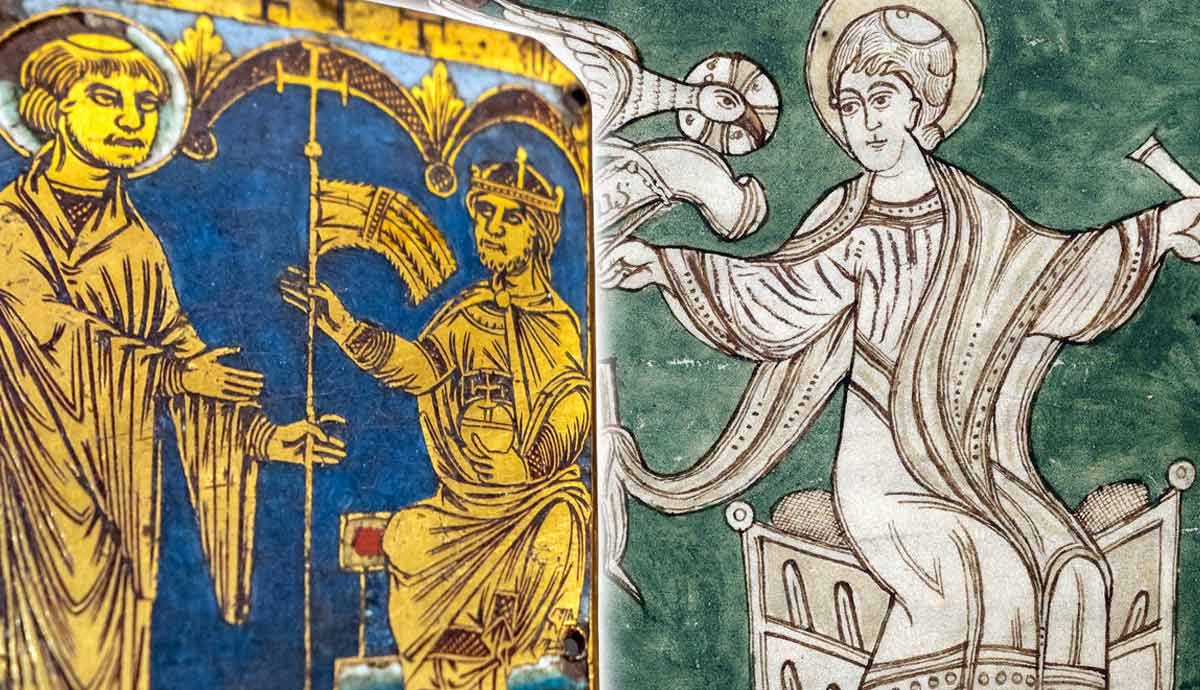
The Pope stood at the summit of an immensely complicated ecclesiastical organism. He did not operate anything resembling a modern centralised bureaucracy. Bishops today are treated like local branch managers appointed and supervised by Rome, but in medieval Europe they, and monastic abbots, were legitimate powers of their own that were respected by king and pope alike. The layers included the rights and duties of cathedral chapters, monastic hierarchies and religious orders and a multitude of ecclesiastical entities most of us have never heard of today.3
Kings and princes claimed rights of nomination or investiture, with varying degrees of opposition or acceptance from the Church. Local churches maintained their own liturgical uses, calendars, customs and legal traditions. Universities and theological faculties constituted centres of authority and influence in their own right.
But at the start of the Early Modern period, European monarchies became more centralised and rulers became increasingly unwilling to tolerate an international Church exercising independent authority. Even kings who wanted their countries to remain Catholic, as in France, sought to bring the Church under nationalised management. Gallicanism4 was the attempt to defend extensive powers for the Crown and the local Church against Roman intervention.
Similar movements elsewhere attempted to subordinate ecclesiastical institutions to the emerging sovereign State. The details varied from country to country, but the direction was increasingly the same: governments were becoming unwilling to tolerate an international Church possessing independent authority, property and institutions, what amounted to a parallel state, within their borders.
The Revolution and Napoleon make the question unavoidable
The French Revolution demonstrated what this new understanding of sovereignty meant when carried to its logical conclusion. The Church could no longer be permitted to exist as an independent society within the State, possessing its own property, laws, hierarchy and sources of authority. If the Nation was sovereign, then the Church in France must ultimately belong to the Nation too. Gallicanism was reworked into a state entity, with priests as government employees, an idea that has remained a favourite of ideological totalitarians ever since.
In the Civil Constitution of the Clergy of 1790 the ancient dioceses of France were reorganised to correspond with the newly created administrative departments, bishops and parish priests became salaried public officials, and the clergy were required to swear allegiance to the new constitutional order. The result was a catastrophic rupture within French Catholicism between those who took the oath and those who refused it.
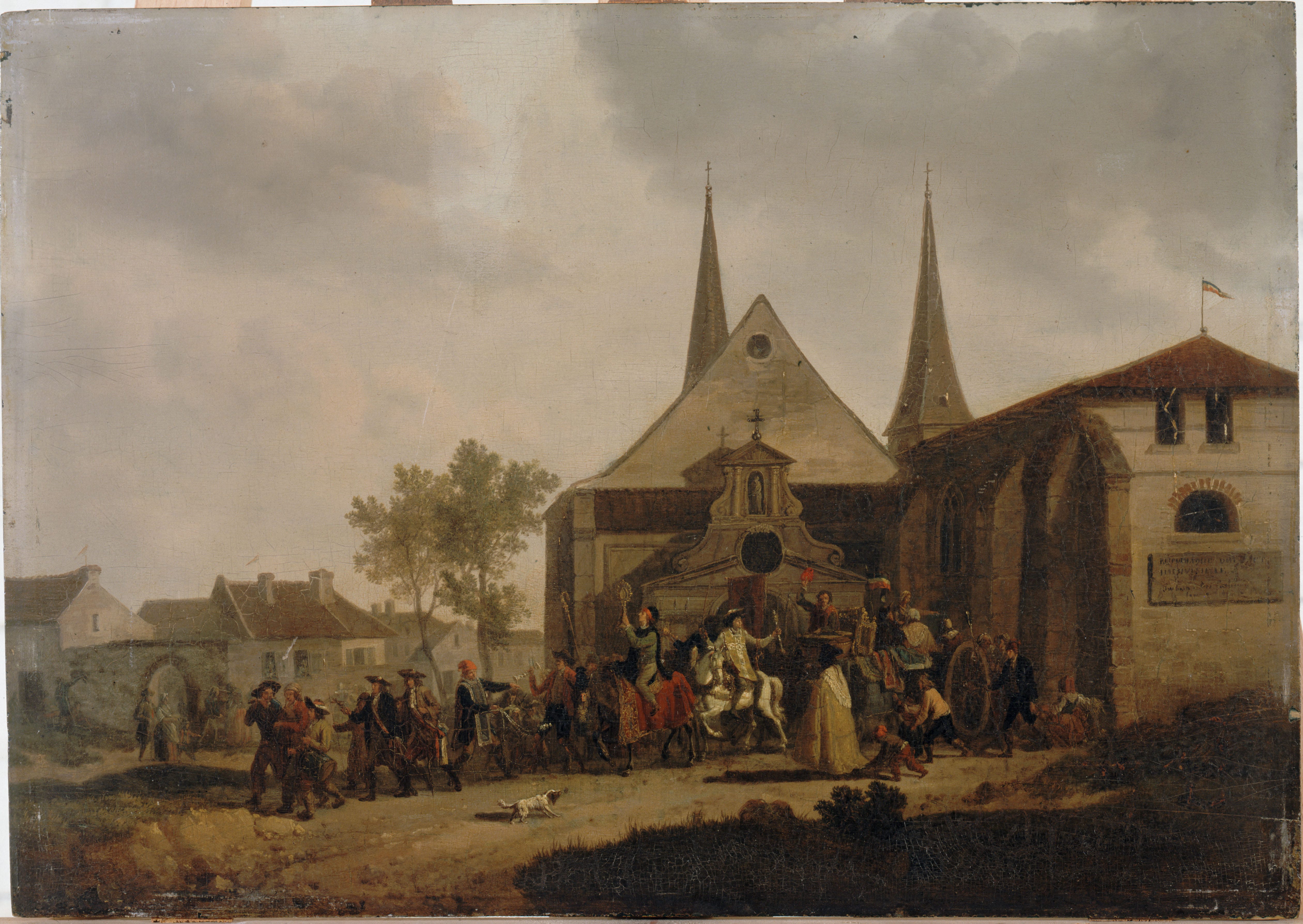
Of course, Rome strenuously rejected this new settlement, and thousands of the refractory clergy who refused the oath were eventually imprisoned, deported, driven underground or killed. Church property had already been nationalised, monasteries suppressed and religious vows abolished. Within a few years the revolutionary government had moved beyond controlling the Church to an explicit campaign of dechristianisation.
The lesson could hardly have been clearer. The new European order based on the sovereign State entirely rejected the old medieval idea that the Church possessed an authority of its own which the temporal power was obliged to respect. There could be no independent jurisdiction within the Nation because sovereignty, by definition, was indivisible.
The rise of Napoleon brought little relief. He restored a measure of normal Catholic life through the Concordat of 1801, but the reconciliation lasted only as long as papal independence remained politically convenient to his essentially military mind. In 1798 French troops had occupied Rome, proclaimed a republic and arrested Pius VI, an elderly and seriously ill man who was carried away into exile and died a prisoner the following year.
When Pius VII refused to cooperate with Napoleon’s continental policies, French troops again occupied the Papal States, annexed Rome and arrested the Pope in 1809. He too was carried off into captivity, remaining Napoleon’s prisoner until the collapse of the Empire allowed him to return to Rome in 1814.
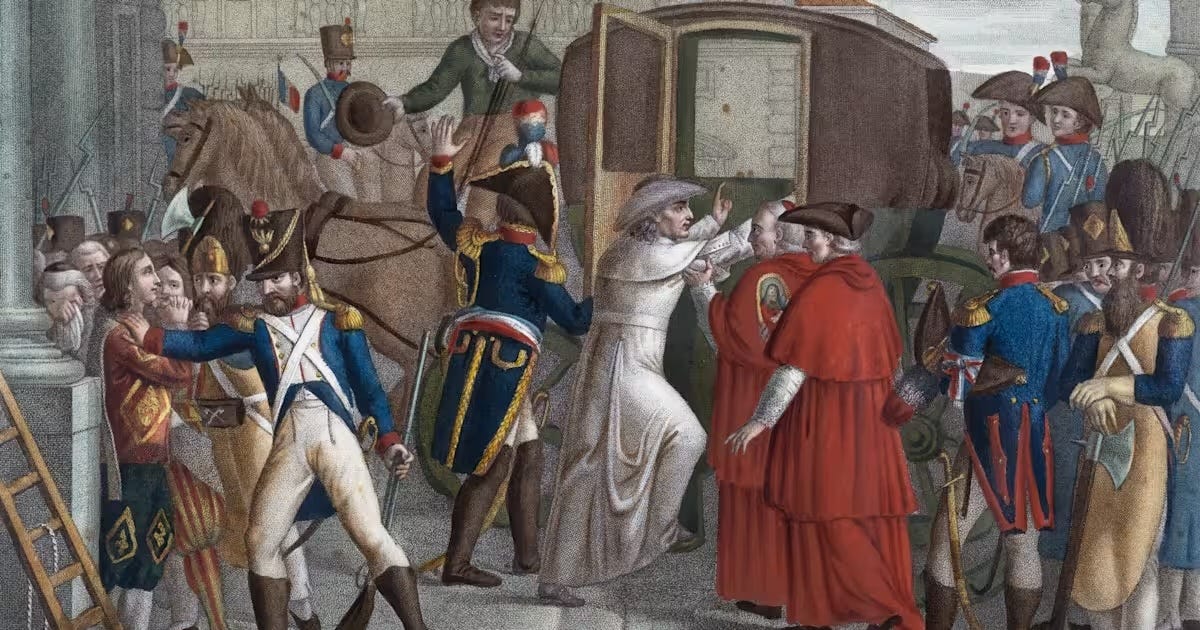
Within little more than a decade, therefore, the supposedly sovereign head of the Catholic Church had twice been physically seized by the new brand of secular power, and one of those popes had died in its custody. It was this grave shock to the Catholic world that placed the Church on its inevitable course. Catholics learned that national churches were vulnerable, while Rome represented an authority the State could imprison but could not absorb. The nineteenth-century Catholic response would be to turn with unprecedented intensity toward Rome and the Pope.
Looking beyond the mountains
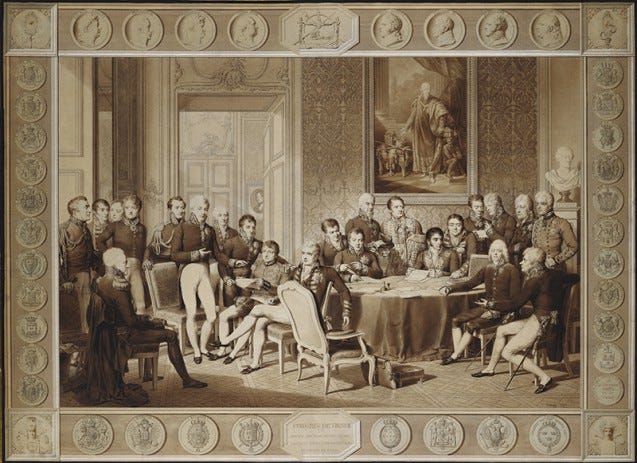
1815 did not restore the old world. The Congress of Vienna5 put many of the old rulers back on their thrones, but liberalism, nationalism, secularisation and the sovereign State survived the defeat of Napoleon. Pius VII returned to Rome in triumph, but there was no restoring the world that had existed before 1789. Italy especially was to suffer under the new paradigm. The Bonapartes were gone, but the revolutionary political ideas and methods they had helped establish in Italy survived them.
Over the following decades these currents fed into the Risorgimento and the creation of the Kingdom of Italy in 1861. Religious houses were suppressed by the laws of 1866 and 1867, ecclesiastical property confiscated and ancient institutions dissolved as the new State extended its authority up and down the peninsula. At the same time the Papal States, which had given the popes an independent territorial base for more than a thousand years, were progressively swallowed by the new kingdom. The political movement celebrated by modern histories as the “unification of Italy”6 therefore appeared from Rome as the latest and most successful stage of the same revolutionary process that had begun in France.
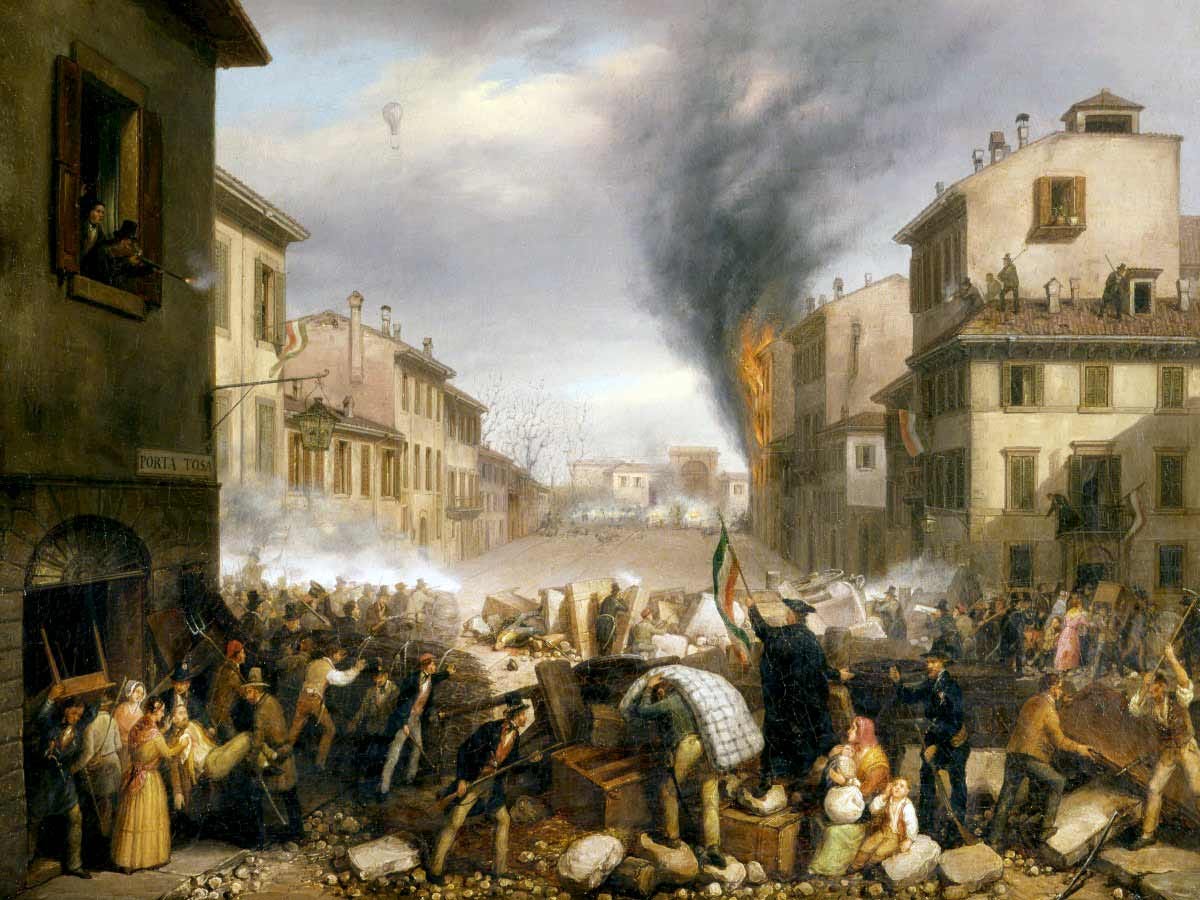
For the Church, every attempt by a national government to absorb the Church into the machinery of the State strengthened the argument for an ecclesiastical authority that transcended national borders. If bishops could be intimidated or controlled by governments, religious houses suppressed by parliamentary decree and centuries-old ecclesiastical rights abolished by ordinary legislation, then the independence of the Church seemed increasingly to depend upon Rome.
Until this time, Ultramontanism mostly existed as a theoretical argument of those who favoured stronger papal authority over the claims of national churches and secular rulers. In the nineteenth century it developed into a powerful international Catholic movement centred upon the Pope as the visible guarantor of the Church’s unity and independence. Ultramontanism had enormous popular appeal. Catholics had watched governments nationalise churches, confiscate monasteries and brutally drive out contemplatives, imprison and murder clergy, drive bishops into exile and arrest two successive popes. As the sovereign State became more powerful and intrusive, a powerful papacy increasingly looked like the only institution capable of standing outside it.
1848 to 1870: Rome builds its own absolute monarchy
We teach and define as a divinely revealed dogma that when the Roman pontiff speaks ex cathedra, that is, when, in the exercise of his office as shepherd and teacher of all Christians, in virtue of his supreme apostolic authority, he defines a doctrine concerning faith or morals to be held by the whole church, he possesses, by the divine assistance promised to him in blessed Peter, that infallibility which the divine Redeemer willed his church to enjoy in defining doctrine concerning faith or morals.
Therefore, such definitions of the Roman pontiff are of themselves, and not by the consent of the church, irreformable.
So then, should anyone, which God forbid, have the temerity to reject this definition of ours: let him be anathema.
First Vatican Council, Session 4, July 1870, chapter 4, “On the Infallible Teaching Authority of the Roman Pontiff”
The revolutionary convulsions across Europe of 1848 confirmed Rome’s worst fears about the direction of the new European order. Violent revolutions broke out across the continent, governments fell, nationalist movements surged with anticlericalism at their centre. In Rome itself Pius IX was forced to flee and a republic was proclaimed again.
That republic was short-lived. Pius appealed to Catholic powers for intervention, and a French army besieged and captured Rome in July 1849, crushing the republican forces and forcibly restoring papal rule. Pius returned to the city in April 1850, but he was a changed man, no longer interested in appeasing or conciliating the new ideologies.
Before 1848, Pius was known for his liberalising tendencies, introducing administrative and legal reforms. Following the trauma of his exile, that was accompanied by the assassination of his prime minister, he abandoned these experiments. He concluded that modern liberal institutions were structurally incompatible with the independence of the papacy. What followed was an absolute theological and structural re-consolidation as a matter of institutional survival.
With the papacy under literal siege and the independent institutions of Catholic Europe steadily being weakened, nationalised or destroyed, Rome’s response was increasingly to answer the centralising sovereignty of the modern State with a centralising sovereignty of its own.
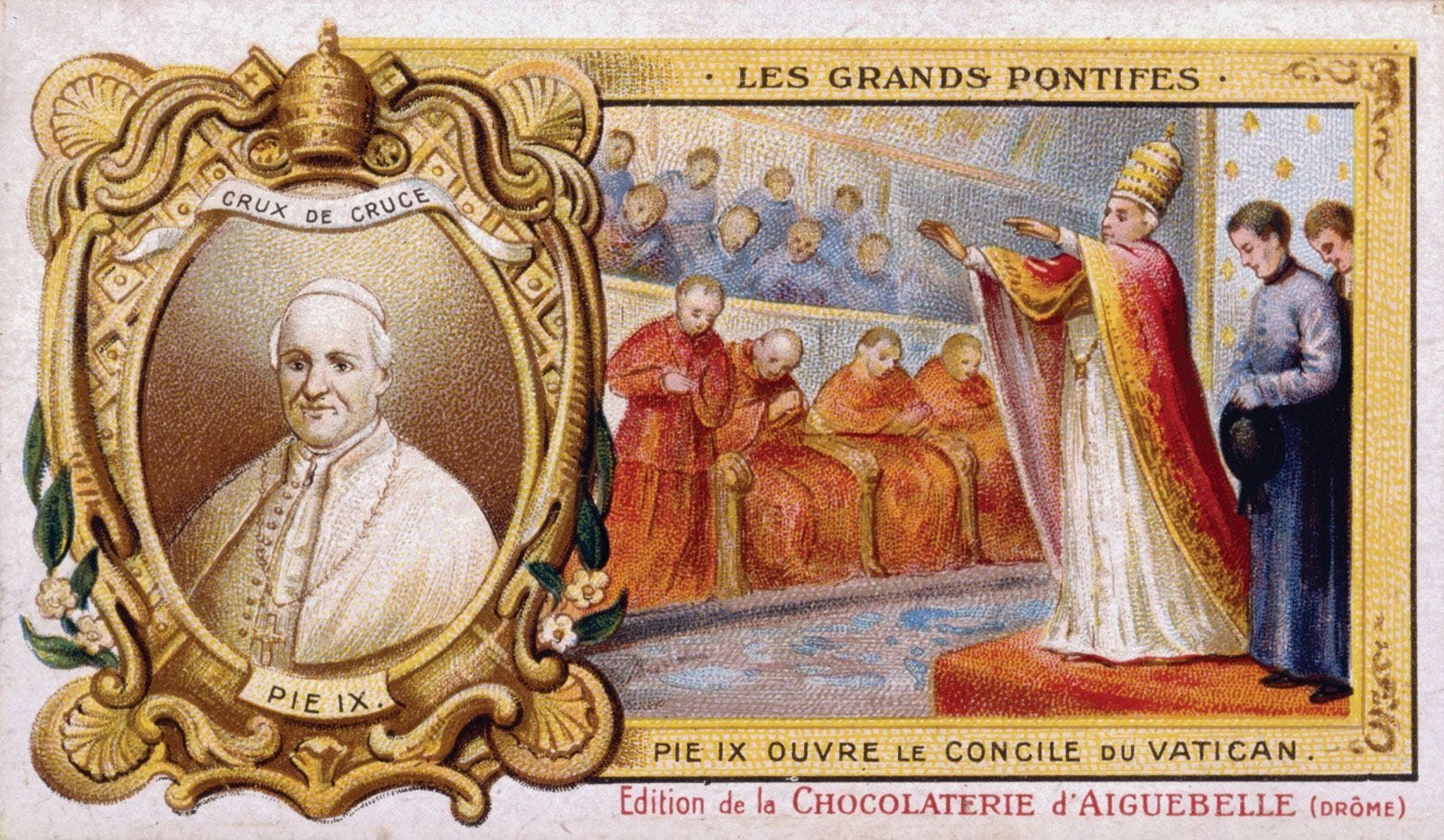
Meanwhile, Ultramontanism was transforming the internal culture of Catholicism, drawing Catholics away from the older world of strong local churches and reliable institutions and toward Rome as the indispensable guarantor of Catholic independence and orthodoxy. The Pope was increasingly seen as the visible centre around which Catholics could rally against governments claiming ever greater authority over religious life.
These tendencies and political movements finally hardened into an explicit confrontation with the modern political order. The Syllabus of Errors of 1864 condemned a catalogue of propositions associated with rationalism, religious indifferentism, secularisation and the expanding claims of the State.
The First Vatican Council was convened in 1869 amid all these political upheavals. Its work was cut short by the capture of Rome in 1870 by the Royal Italian Army, but not before Pastor Aeternus formally defined papal primacy of jurisdiction and papal infallibility under specific conditions.
The Pope’s “full and supreme power of jurisdiction over the whole Church” was solemnly defined with the specific conditions under which his teaching is infallible. The effect of the Council was the complete triumph of the Ultramontane understanding of the papacy.
It was almost immediately followed by one of European history’s greatest ironies.
Two months after Pastor Aeternus, troops of the new Kingdom of Italy breached the walls of Rome at Porta Pia. The Papal States disappeared and the Pope lost the temporal sovereignty that had guaranteed his political independence for more than a thousand years. At almost the same historical moment, therefore, the Pope reached the nadir of his power as a European prince and the zenith of his formally defined authority within the Catholic Church.

Next week, in Part III, Hilary examines what followed: how a carefully limited doctrine of papal infallibility, the post-conciliar collapse of intermediate institutions, and decades of weakened catechesis hardened into the practical assumption that the pope cannot meaningfully be wrong.
The result is the “papal positivism” (or Mottramism) visible today. An outcome no one at Vatican I intended, but one that follows with grim consistency from the historical path the series has traced.
The Investiture Controversy of the eleventh and twelfth centuries was a prolonged struggle between the papacy and secular rulers, especially the Holy Roman Emperors, over who possessed the authority to appoint and invest bishops and abbots. It became a much larger contest over the independence of the Church from secular power and produced some of the medieval papacy’s strongest claims to universal authority.
The movement, associated especially with Pope Gregory VII, to free the Church from secular control, suppress simony and clerical marriage and establish the independence of ecclesiastical appointments from kings and nobles. Its struggle against lay investiture, where a secular ruler installed a bishop or abbot, usually to extract revenue, greatly strengthened the institutional papacy and produced some of the strongest medieval assertions that spiritual authority, centred on Rome, stood above secular rulers in the ordering of Christian society.
They include, non-exhaustively: collegiate churches, archdeaconries, ecclesiastical courts, confraternities, military orders, hospitals and charitable foundations, canonries, autonomous abbeys, priories, and various endowed benefices. Many possessed property, customary rights, exemptions or some degree of jurisdiction.
Articulated in the Four Gallican Articles of 1682 under King Louis XIV, Gallicanism maintained that secular monarchs were entirely independent of papal authority in temporal matters, and that the decrees of a Pope were subject to the consent of the universal Church and regional councils. It was opposed to Ultramontanism which sought total papal centralization. The dispute was effectively extinguished in 1870.
The international diplomatic summit held in Austria to redraw the political map of Europe after the downfall of Napoleon Bonaparte. Its primary goal was to restore conservative monarchies, establish a lasting balance of power, and prevent future imperial aggression.
The Risorgimento (“Resurgence”) was the nineteenth-century nationalist and revolutionary movement that sought to unite the numerous territories of the Italian peninsula into a single sovereign state. Beginning in the aftermath of Napoleon and culminating in the annexation of Rome in 1870, it created the modern Kingdom of Italy while destroying the Papal States and suppressing or confiscating many of the Church’s independent institutions and properties.

Insightful, compelling, salutary. Thank you for writing this. But if I was an Anglo Catholic, I'd be saying something like, "Well, this is what we've been saying all along. Through various historical contingencies, none of which have necessarily been the Pope's fault, the role and status of the Holy See has become inflated and quite far removed from what it was in the first millenium and prior to the Reformation/Counter Reformation. We respect and revere the Petrine Office, but we long to return to a time when there was a wider spread of powers and things weren't such a 'one man show.'"
Something like that. I'm not an Anglo Catholic btw. I'm a Roman Catholic like yourself, but this history does seem (to me at least) to lend weight to their claims.
Looking forward to Part 3.
True enough. And this is an excellent historical summary. But after getting this history right (I bet there are some westerners who still think the Donation of Constantine was real and made up), the next steps are adjudication (what is good, what is less good but perhaps tolerable, what is bad that perhaps is tolerable, and what is bad that must rectified) and then prescription (what should we do about the truly bad). And finally, prediction (You have diabetes, your processed food and white sugar intake is killing you, so stop eating Frosted Flakes and drinking soda, else you will die a slow, painful death at 68 you could have avoided). I read very few people who make predictions, so here's mine: if Pastor Aeternus is not rejected by those who despise Vatican II, is reforms and the Novus Ordo, all that they hate and despise will continue unabated for generation after generation. Pastor Aeternus is the problem, and so must die.