


Every week, hundreds of Catholic prayer books, crucifixes, rosaries, and family bibles appear on Marktplaats, the Dutch equivalent of eBay, where the contents of cleared houses go to die. I buy most of them for under five euros.
The grandchildren who listed them often do not know what they are selling. The buyers are antique dealers, curious strangers, and people like me. Nobody decided to abolish Catholic inheritance in the Netherlands. Grandma died. The house needed clearing. Her children had no idea what her handwritten prayer book was worth to her…
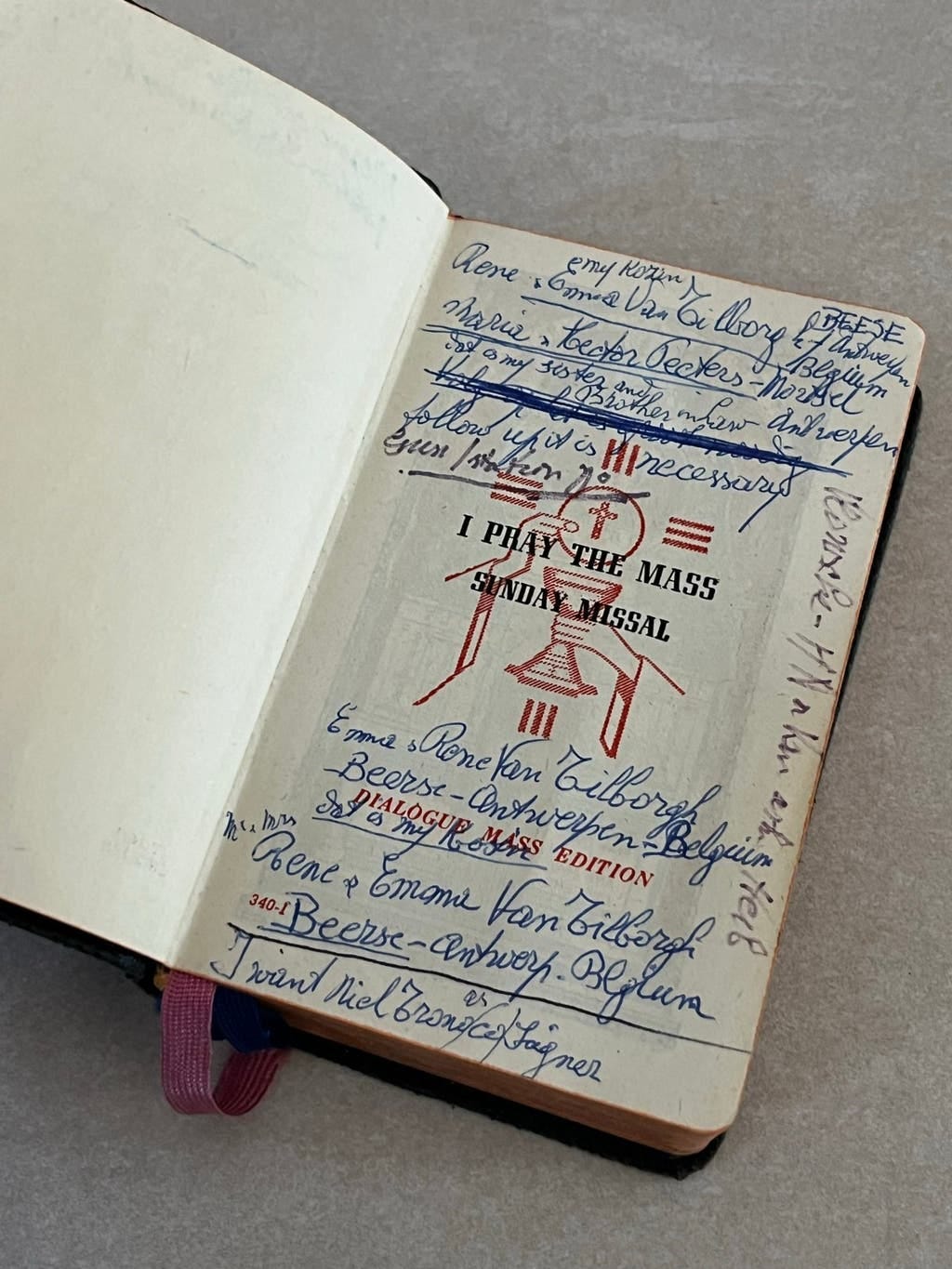
That is not a story about religion per se. It is not just religion that broke down, but als the transmission mechanism. Both broke down so completely that the heirs cannot recognise what they received.
Inheritance is not just being taxed to death, but is being abolished in every way imaginable. It comes in four directions simultaneously, and none of them are coordinating. But the result is the same: the chain breaks, and what was supposed to be passed forward disappears.


What inheritance actually was
In 1650, a Dutch water board functionary in the Beemster polder carried specific hydraulic knowledge built across two generations: which dikes held, which sluices failed, and which combinations of water pressure and soil composition had killed men before him. When he died without transmitting it, the polder was at risk. Not in any sentimental sense, but in a literal sense: The water came back.


After the Alteratie of 1578, Amsterdam’s city government turned Protestant and banned public Catholic practice. The faith did not disappear. It went into the upper floors of canal houses. Ons’ Lieve Heer op Solder on the Oudezijds Voorburgwal was a fully functional church concealed inside three adjoining buildings from roughly 1663 onward. The families who maintained it did not survive through heroism. The father showed the son where the entrance was. The mother showed the daughter what the liturgy required. Generation after generation. That is all it took.


Willem Dreesmann, born Amsterdam 4th of July 1885, was the son of Anton Dreesmann, co-founder of Vroom and Dreesmann. He became a Knight of the Order of Saint Gregory the Great from 1912, and a Papal Count from 1926. His father built the largest department store chain in the Netherlands on a single principle: fixed prices, cash payment, no exceptions. Willem received it and treated it as an obligation.
His commercial inheritance and his Catholic inheritance were not separate things to him: You receive, you hold, you pass forward.


Three examples of the same mechanism. Tradidi quod et accepit: I handed on what I also received.
We are not just speaking of wealth transfer, but transfer on a civilisational level.
The Four Destructions of Inheritance
1. The state
In June 2023, the Dutch Count Sander Schimmelpenninck published a column in de Volkskrant: ‘Inheritance tax is the most decent tax that exists; you do not abolish it.’
His argument is familiar. Inherited wealth is unearned, and inequality compounds across generations. His solution: raise inheritance tax and use the revenue to give every 25-year-old in the Netherlands a starting capital of €100,000. The argument sounds reasonable in the way all redistribution arguments sound reasonable if you accept their premise.
But that premise is that your inheritance belongs to the state before it belongs to your family.
The double-taxation objection is correct and documented. Under current Dutch law, a child inheriting from a parent pays 10% on everything above the €26,230 tax-free threshold, rising to 20% to 40% on amounts above €158,669.
The money being taxed was earned, taxed as income, saved, and is now taxed again at the moment of transmission. This is a structural penalty on the act of passing something forward. But the deeper problem is not the rate, but rather what the rate expresses.
When the state taxes the act of transmission, it asserts a prior claim. It says: before this can belong to your children, it must pass through us. That is not a fiscal arrangement, but a statement about who the family is in relation to the state.
The family is permitted to transmit: conditionally. Since the state decides the conditions.

Schimmelpenninck calls this ‘decent’, Karl Marx called it necessary. In his Communist Manifesto of 1848, he listed abolition of all right of inheritance as one of the ten measures required for the transition to communism.
2. The billionaires
In August 2010, Warren Buffett and Bill Gates announced the Giving Pledge. Signatories publicly committed to giving away the majority of their wealth rather than passing it to their children. By 2025, 256 individuals, couples, and families had signed. They have been celebrated, consistently, as the most virtuous people alive.
In July 2025, the Institute for Policy Studies released ‘The Giving Pledge at 15.’ The report examined what actually happened.

Of the 32 original American pledgers who remain billionaires, collective wealth increased by 166% after adjusting for inflation since the moment they signed. Only 8 of 22 pledgers who have died actually fulfilled their pledges.
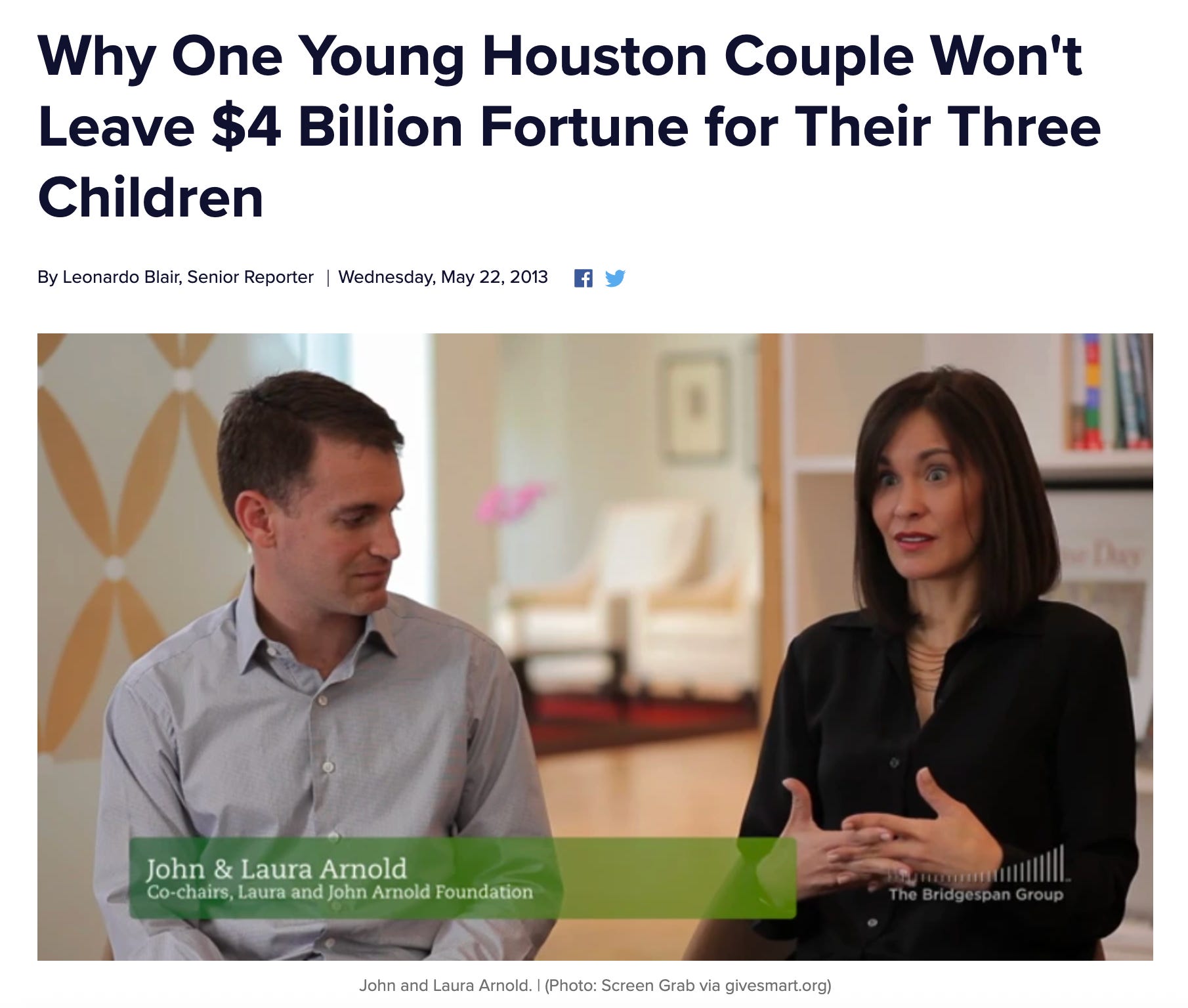
An estimated 80% of total giving by original pledgers, approximately $206 billion, went not to operating charities but to private foundations and donor-advised funds that the pledgers and their families continue to control. The Institute found only one couple among all original pledgers to have genuinely fulfilled the commitment: John and Laura Arnold.
The Giving Pledge is not, in practice, a mechanism for giving wealth away. It is a mechanism for moving wealth away from your children and into entities you and your descendants control for generations. The money does not go to the poor. It goes to the foundation. The foundation is run by the family. The family retains the cultural authority, the social capital, and the political influence that the money generates. The children do not inherit the wealth directly. They inherit the foundation behind it.
The cultural signal the Pledge transmits is more important than the financial mechanics. It has told Western parents that leaving wealth to your children is selfish. That giving it to institutions you control is virtuous. And the highest expression of success is the public renunciation of dynastic ambition.
That norm is now filtering downward through Western culture. Not just as policy, or law, but as a virtue. The founder who will not build a family business because he intends to sell and donate. The professional who decides that leaving anything to his children perpetuates privilege. The Dutch graduate who reads Schimmelpenninck and concludes that his instinct to pass something forward is morally suspect.
None of them signed The Giving Pledge, but have absorbed its premise.


3. The demographic replacement
Transmission requires a recipient population. The water board knowledge passed because there were sons willing to learn the polders. The schuilkerk practice survived because there were Catholic families in the same streets, the same parish, and had the same network of obligation, generation after generation.
The mechanism of transmission is not abstract. It is local, embodied, and dependent on continuity of population in a specific place.
‘Your universe has no meaning to them. They will not try to understand. They will be tired, they will be cold, they will make a fire with your beautiful oak door...’
― Jean Raspail, The Camp of the Saints
In 1900, the Jordaan housed approximately 80,000 people: working-class Amsterdam Catholics, the families whose faith had survived 200 years of prohibition, whose grandfathers had kept the schuilkerk practice alive in these streets.
By the 1970s the original population had dispersed to Almere and the outer suburbs, replaced first by artists and students, then by a professional class with no memory of what had been transmitted there. The parishes that maintained practice through the Alteratie, that rebuilt openly after 1795, that produced the dense Catholic institutional life of nineteenth-century Amsterdam, are now tourist attractions or half-empty.
Not just because their faith was suppressed. But because the community that carried it was replaced with a group that had no connection to what had been transmitted there for four centuries.
My argument is not about whether immigration is good or bad as a policy. It is an observation about what transmission requires structurally.
A cultural inheritance is not a text or theory. It is a practice embedded in a community. When the community disperses faster than transmission can occur, the knowledge does not migrate automatically with the individuals who hold it. Most of it simply ceases to be.
Consider what the Jordaan’s Catholic transmission network actually consisted of: the parish registers going back to the 1660s, the charitable confraternities that maintained schools and almshouses, the family networks that referred each other to the same builders, the same physicians, the same framework for understanding obligation: all of it structured around the same liturgical calendar, the same fast days, the same feast days.
That network was dissolved by the departure of the people who constituted it. Rapid demographic change at scale and legal suppression kill a community. The parish closes not by decree but by arithmetic. The transmission environment disappears and the inheritance has no recipient.
The result is a double dispossession:
A Dutch family loses the neighbourhood in which their inheritance was embedded.
The newcomer arrives in a place stripped of the institutional density that might have helped him build one.

4. The heirs themselves
This is the villain nobody names, because naming it requires looking at people who were never taught what they were deciding.
The grandchildren who listed grandma’s crucifix on Marktplaats for €4.50 made a perfectly rational decision. They were not victims of state policy. They were not influenced by Buffett. And probably did not live in the Jordaan. They simply did not know what they held. Nobody told them, or gave them the framework.
Grandma’s house needed clearing, and here children sold the house ASAP, to get the money.
Eventhough we have a 400,000-unit housing shortage and grandma’s property, almost no heir in The Netherlands thinks: ‘Let’s pass this house to my own children.’
Grandma’s house is ‘just’ an unnecessary liability. Her objects had no obvious function, so Marktplaats is a practical of getting rid of ‘the garbage’.
There are 300,000 family businesses in the Netherlands, representing ~30% of all Dutch employment. Every year, a portion of them dissolve because the children want jobs in Amsterdam, and nobody has had the conversation about what the business represents beyond its revenue.
The succession crisis is documented and quantified. But the analysis focuses on tax structures and legal transfer mechanisms. It never asks what is lost when the knowledge inside the business has no successor.
Maison de Bonneterie, my favorite store, was founded in 1889 by Joseph Cohen and Rosa Wittgenstein in the Kalverstraat/Rokin in Amsterdam. It had a Royal warrant, four generations of the same family, and surived two world wars, occupation, and recessions.
But in August 2014 it closed in a controlled dissolution. The buildings remained. The name did not. One hundred and twenty-five years of accumulated relationships, taste, and institutional knowledge were dispersed in a single announcement.


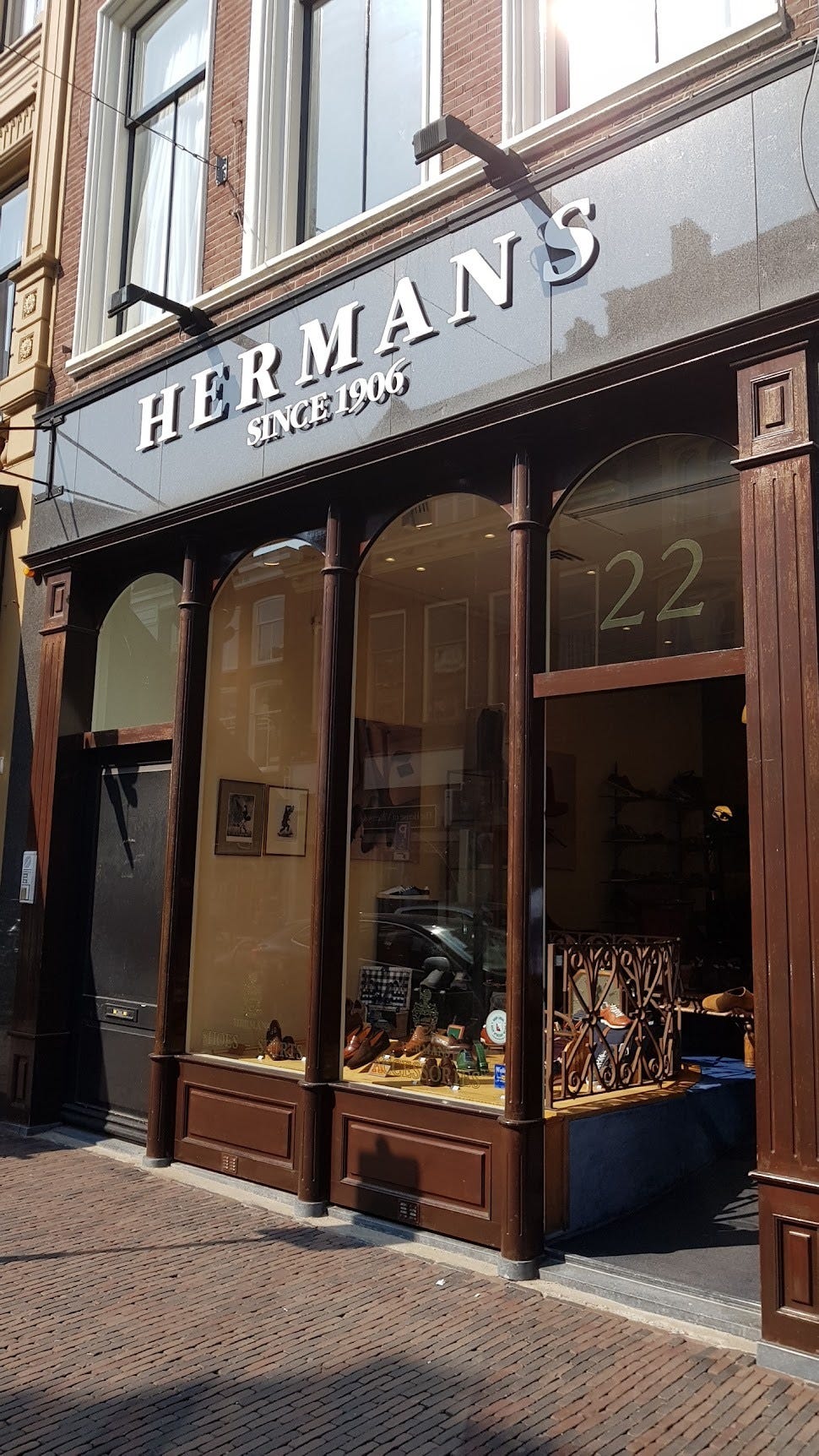
I spent two years at Hermans Schoenen in Utrecht, founded in 1906 by two sisters who wore size 44 and could not find decent shoes anywhere in the city.
For 117 years the shop carried Crockett and Jones and Edward Green.
It knew its clients by foot shape. It worked closely with a master shoe repairman. Stocked Bowhill and Elliott house shoes with the Hermans coat of arms. But when the parent company Dungelmann collapsed in 2019, a bankruptcy buyer acquired it and immediately stocked brands that had nothing to do with the clientele.
The clients drove Jaguars. The new owner bought shoes and even clothing he liked himself. He changed the interior to beige and gray. The institution, unsuprisingly, was gone within years.
But the market did not disappear, the buyer simply know what he was buying anymore.
The Catholic family whose faith survived 300 years of prohibition dissolved in two generations, because nobody decided to transmit it.
The artisan’s workshop closes because he never found the moment to teach. The Dutch nobleman sells the estate his family maintained since 1712 because he cannot explain to his children why maintaining it even matters.
This is the most common destruction of the four and the least discussed. It requires no formation failure from the outside.
The chain ends because nobody taught the heir that he was holding one…
What was actually lost
What was lost was not money or objects. It was the framework for recognising what you received and what you owe the next generation.
Hilaire Belloc saw this with precision in 1912. In ‘The Servile State’ his argument was direct: when the family cannot transmit property, it cannot transmit independence. The worker without property depends on the employer. The family without assets depends on the state. Belloc was describing early industrial capitalism. We are living the sequel. The state and the billionaire class have aligned, through tax and through social norm, to ensure that families cannot transmit independence to their children.


The state tells you that passing things forward is taxable. The billionaire class tells you it is selfish. Demographic replacement dissolves the transmission environment before the decision can be made. The surrounding culture teaches you nothing, because nobody told you that what you received was an obligation.
The result is a generation that senses it was supposed to receive something and cannot name what it was. Or a generation that has built something and senses it will not survive them.
You are likely the last person in your line who still feels this. Heritage Standard is where that recognition begins.
Saint Norbert of Xanten received a civilisation in 1120 and built an institution that transmitted it across a continent for 800 years without interruption.
Saturday’s Member essay is about exactly how he did it, and what the mechanism looks like applied to anything worth passing forward today. Become a member —>
The chain breaks, and does not repair itself. Someone has to decide to repair it.
That decision is what Heritage Standard is about.
-Robbert
I remember the Maison de Bonneterie. What an elegant place to shop! I didn’t realize that a lot of Catholics lived in the Jordaan. The last of them were still alive in the mid-1990s when one of the most famous, a woman who was the pillar of the neighborhood boldly declared, “The only way I will leave the Jordaan is horizontally.” Indeed she died there and was carried out of her house.
I remember a popular brown cafe on the Prinsengracht where locals would show up in the evening for a biertje and sing all the Jordaan songs. It was wonderful. How friendly they were too, genuinely warm and welcoming people. I had just moved to the Netherlands and my command of the Dutch language was spotty. But they were kind.
This article reminds me of Carl Schmitt’s idea that politics is fundamentally defined by struggle. In his view, a polis is formed—and homogenises, to use a modern term—through shared conflict. Yet today, modern liberal attitudes have depoliticised society to the point where the contemporary European can no longer think in terms of "us" or "them". All that remains are scattered individuals, driven not by struggle but by the pursuit of comfort.
This vacuum has allowed the serpent of money to coil around all desire. It is absurd to suggest that people would die for economic reasons. Billionaires inspire no loyalty; they cannot rely on people, only pay them, deceive them, or coerce them.
But when the hour of decision arrives, no one will defend this order. It enslaves, corrupts, and disenfranchises. Its Tower of Babel will fall—the only question is whether it will take an entire civilisation down with it.