


Malcolm Caldwell flew to Cambodia in December 1978 to meet Pol Pot.
He had spent twenty years studying Southeast Asia. He had written dozens of books on imperialism, development, and revolutionary movements. And believed Cambodia was the first serious attempt to implement the Marxist model he had spent his life refining.
By every measure available to him, he was the most qualified person in the room.
Pol Pot had him killed that night.

Mark Manson tells this story well. His diagnosis is mostly correct. Intellectuals build models. They are rewarded for those models. Over time, their model becomes their identity. And once it becomes identity, it is protected from reality.
Caldwell might be the most extreme case, but the pattern is familiar.
Behavioural scientists who cannot predict whether people go to the gym. Hedge fund managers who cannot beat the market. Diversity trainers who increase the hostility they claim to reduce.
Manson’s conclusion is straightforward: Hold your opinions lightly, engage with reality, and seek evidence that you are wrong.
This is where he loses the argument…
Not because his advice is that wrong. It is fine advice, as far as it goes. But it belongs to the same category of thinking that produced Caldwell. It is a model about how to think, offered by an intellectual jester, to be adopted voluntarily by individuals who will then protect it like any other model.
Manson has diagnosed the disease, but prescribes more of the pathogen.

The layer he cannot see
Manson’s world contains two things: The individual, and reality.
The individual forms a view. Reality eventually corrects it. His solution is to improve the individual: More open, reflective, and willing to update.
What his model does not contain is the layer that historically sat between the individual and reality. Institutions forced correction early, publicly, and competently. Without requiring the individual to be virtuous.
The old world built these institutions. They were not theories, but mechanisms.


The Dutch water board
In 1255, the Hoogheemraadschap van Rijnland was formally established in the County of Holland.
It maintain the dikes, canals, and sluices that kept the land from flooding. It governed roughly 1,100 kilometres of waterworks. Entire towns and farms existed on the assumption that it functioned.
Its structure was precise. The dijkgraaf presided, and several heemraden held defined sections. Each man was responsible for a specific stretch of earth and water.
The system ran on inspection: Dikes were walked, measured, and opened where necessary. Weak points were marked and repaired. Nothing was assumed to hold. It had to demonstrate that it held.


The biggest difference with heemraden and modern day bureaucracy was that failure was immediate and visible.
When a dike broke, the water entered at once, the fields flooded, the houses were lost, and livestock disappeared. There was no ambiguity about what had failed.
The responsible man answered for it: Not in writing, delegation or in the newspaper. But in a room with other men who had held the same responsibility and could trace the failure to a specific section, a specific decision, a specific omission.
They did not ask what he intended to do, but asked what happened. Their judgement was technical, and did not depend on a media-trained explanation.
Such structures did not require some staged ‘humility’. They removed any possibility of avoiding it.
Because a man could believe his section was secure. Yet… the water tested that belief, his board evaluated the result, and the consequence followed.
Correction was not a virtue in the participants. Correction was a property of their system.


I always like the example of guilds: Guilds operated on the same logic, in a different domain.
In sixteenth-century Antwerp, admission to the guild of painters required a meesterstuk; a masterpiece. The candidate paid for his own materials, and worked under observation. His finished object was examined by masters who had already passed the same threshold.
The criteria it was held to were not interpretive: Proportion. Technique. Material execution. Finish.


If the work failed, the painter could not enter.
There was no appeal to intention. No discussion of effort or understanding. And nod soppy stories and ‘convincing’. His object either met the guild standard or not.
Apprenticeships extended the same principle over time. Five to seven years under a master, residence in his household, and work under direct instruction. There was no independent practice until personal competence was demonstrated.
Contrary to what most think, this system did not assume virtue. It created virtuous people.


What these systems actually did
Guilds are too often described in terms of economic arrangements: Barriers to entry, trade regulation, and pre-modern inefficiencies that were replaced by modern merit.
But those descriptions miss the function such institutes had: They were correction systems.
The old-world institutes ensured that judgement was tested against reality by people competent enough to judge it, before failure became irreversible.
The craftsman was corrected before he sold defective work. The water board member was corrected before his weak judgement became a breach. The apprentice was corrected before he could mistake exposure for competence.
Caldwell had no equivalent, and neither does any bureaucrat.
He submitted his ideas to colleagues who shared his assumptions. To journals that rewarded his theoretical elegance. And audiences predisposed to agree.
Every structure around him was a circlejerk, that rewarded the model. But none of them examined the object.

The destruction was deliberate
These systems did not fade, they were deliberately dismantled.
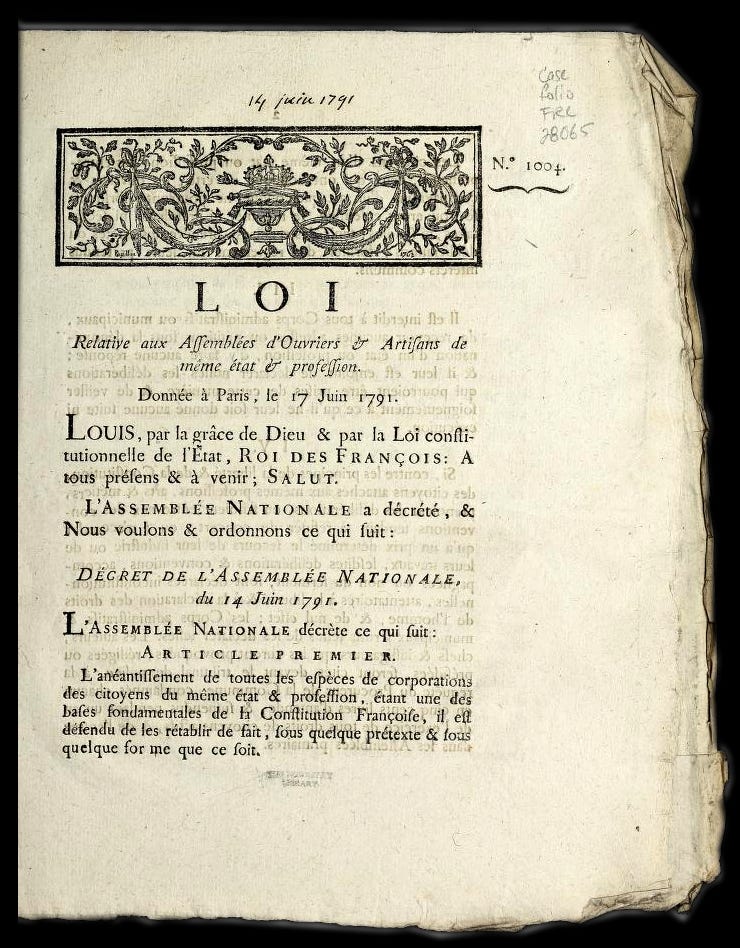
On 14 June 1791, the French National Assembly passed the Le Chapelier Law. Guilds were abolished across France. All worker associations were declared illegal.
Their justification was: liberty. Guilds, it was argued, restricted competition and blocked merit. Within a generation, the requirement for external examination of craft by qualified peers had disappeared.
In Britain, the Statute of Artificers of 1563, which had governed apprenticeship and labour standards for over two centuries, was repealed in 1814.
In the Netherlands, French occupation between 1795 and 1810 dissolved guild structures that had existed since the thirteenth century.
Across all countries, the logic was consistent: Remove any constraints, free the individual, and let merit emerge.
In practice no constraints disappeared, but correction did.


What replaced them
The new systems preserved the appearance of evaluation while removing its function.
Apprenticeship became credentialing. Years under a master were replaced by examinations conducted within the same theoretical framework.
Guild examination became market signalling. The object no longer had to pass technical judgement before entering circulation. It only had to satisfy buyers who could not assess its construction.
Public accountability became distributed responsibility: Committees replaced named men. Working groups replaced obligation. Consequence became diffuse. SDGs became virtue signals.
The form remained, but the mechanism is gone.
What should have been correction became a performance of ‘quality management’.


The modern version of humility
Into this gap enters ‘intellectual humility’.
The insufferable teachings of Mark Manson, the Dalai Lama and Pope Francis alike. It presents humility as a personal virtue. A way of relating to one’s own beliefs.
‘Just be open’
’Just flexible’
’Just be willing to update’
This is a private attempt to solve a structural problem. It assumes that attitude can replace enforcement, but it cannot.
You can choose to be open-minded. But you cannot choose to be corrected. Correction is nasty, mean and judgemental.
Correction requires something external: A standard, a judge, and a consequence.
Without that, humility becomes language about belief rather than a condition imposed on it.


The world you actually operate in
Day-to-day we make decisions that are never examined by anyone more competent than you.
If your work is reviewed, it is often reviewed by people who share your assumptions, or lack the ability to challenge them.
(They sometimes cancel you for it, because that is their only way of showing contempt, and that you are ‘not like them’.)
Your incentives reward coherence, not correctness.
You can be wrong for years and still succeed, provided that your errors are legible within the system that evaluates you.
There is no point at which your judgement is subjected to a standard that cannot be negotiated, in front of people who understand it better than you, with consequences you cannot avoid.
There is no equivalent of the dike in most of our lives nowadays.
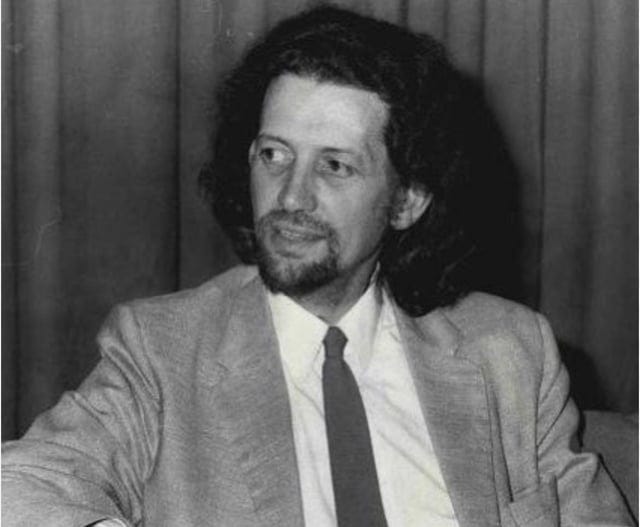
Caldwell’s first real encounter with reality came in a room in Phnom Penh in December 1978. It was also his final.
The systems that once enforced earlier correction no longer exist in his world or yours.
In their place is the instruction to be more reflective. More ‘self-aware’. and more ‘open to being wrong’.
But this is not a serious answer. It is how an NPC (non-player character) operates.
Our world asks the individual to recreate internally what once had to be enforced externally. It replaces structure with good intentions.
‘Hell is full of good intentions and wills’
Saint Bernard of Clairvaux
What was actually lost
What disappeared was not the knowledge or the tradition.
It was the condition. The condition in which a man could not avoid being corrected. In which his ideas were tested against reality before his failure became irreversible.
In which judgement came from those with technical authority over the work, not those with shared assumptions about it. In which consequences followed outcomes, not narratives.
You do not live with that condition. You live in a system that allows models to be built, defended, and refined without serious external correction.
You can be wrong in ways that remain invisible until reality enforces a correction that cannot be argued with.
By then, it is no longer instructional. When that happens it is costly in a way that cannot be reversed.


The absence is easy to miss because it never announces itself.
There is no moment in your live where you are told: here is where you would have been corrected. We ar left only with the absence of correction.
We have no master, no board, and no examination by those who know.
Only our peers, incentives, and the assumption that someone would have intervened if you were wrong.
This Saturday’s paid essay gives you the 5 structures that enforced correction in European life, and a practical framework for rebuilding them in your work so your decisions are tested before reality tests them for you.
If you are waiting for reality to correct you the way it corrected Caldwell, you will not like how it arrives.
—Robbert
That was good, but this "Mark Manson, major retailer of NPC books" was hilarious
A captain of a ship or aircraft had ultimate responsibility as well as ultimate authority. That has been eroded