


Carl Frithjof Smith painted a crowd leaving a church in 1892. Girls in white dresses walk out among older relatives dressed in black. One girl near the front meets the viewer’s eye. Nobody around her is performing for the canvas, and nobody is holding anything up to record the moment, because the only proof anyone needed that day was standing in the street.
That fact alone is now the strangest part of the painting.
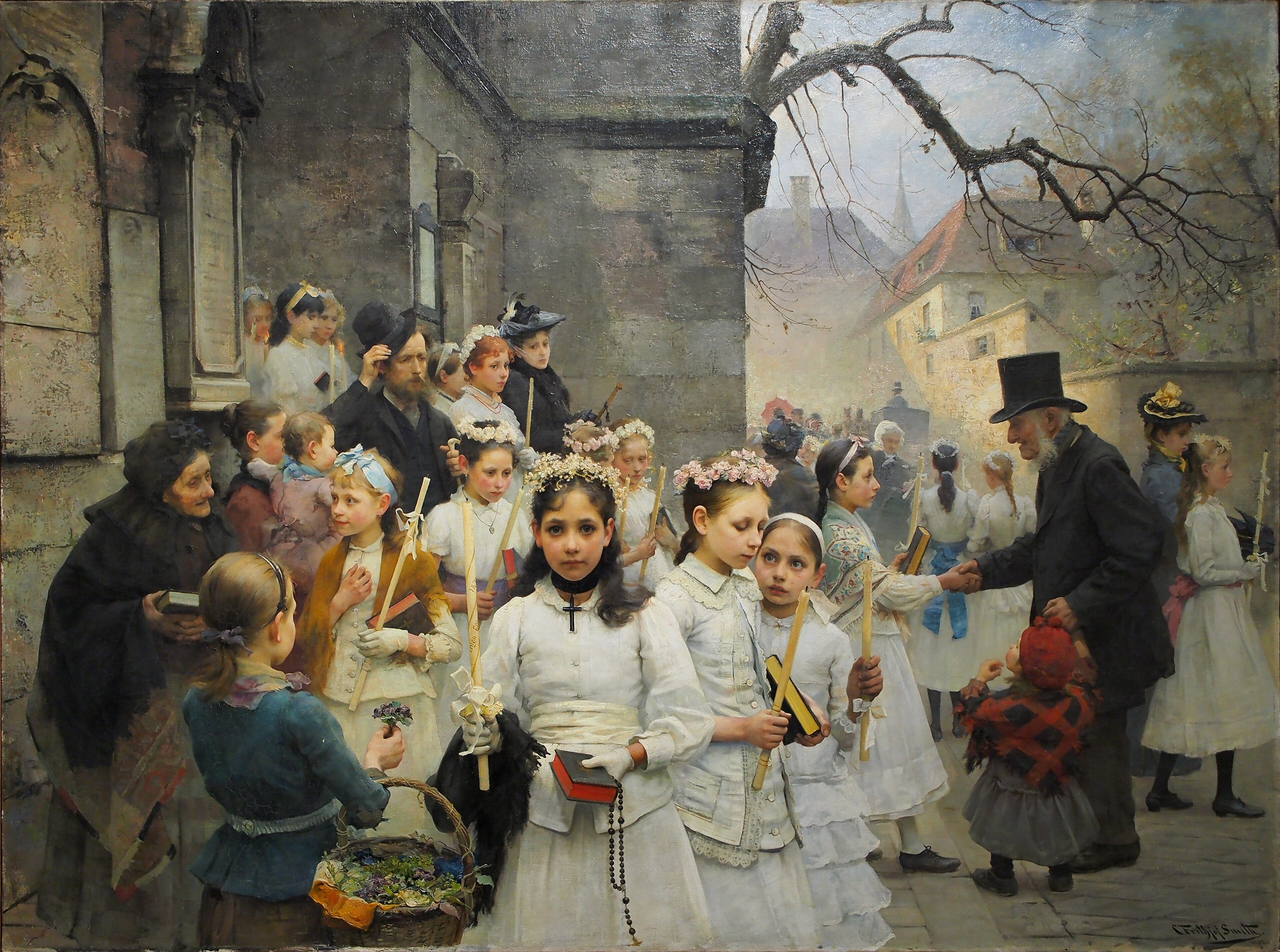
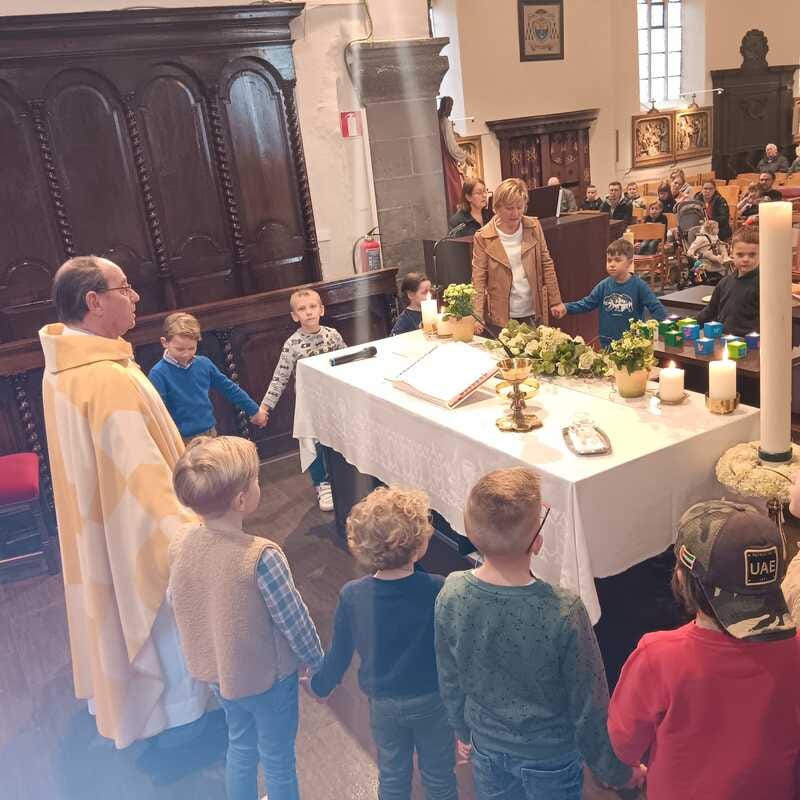
Now contrast Smith’s crowd with a modern First Communion. Microphones hum. Music fills every pause. Phones glow in half the pews. The party after runs longer and costs more than the sacrament before it. The distance between the two is not just a matter of style, they are are a different kind.
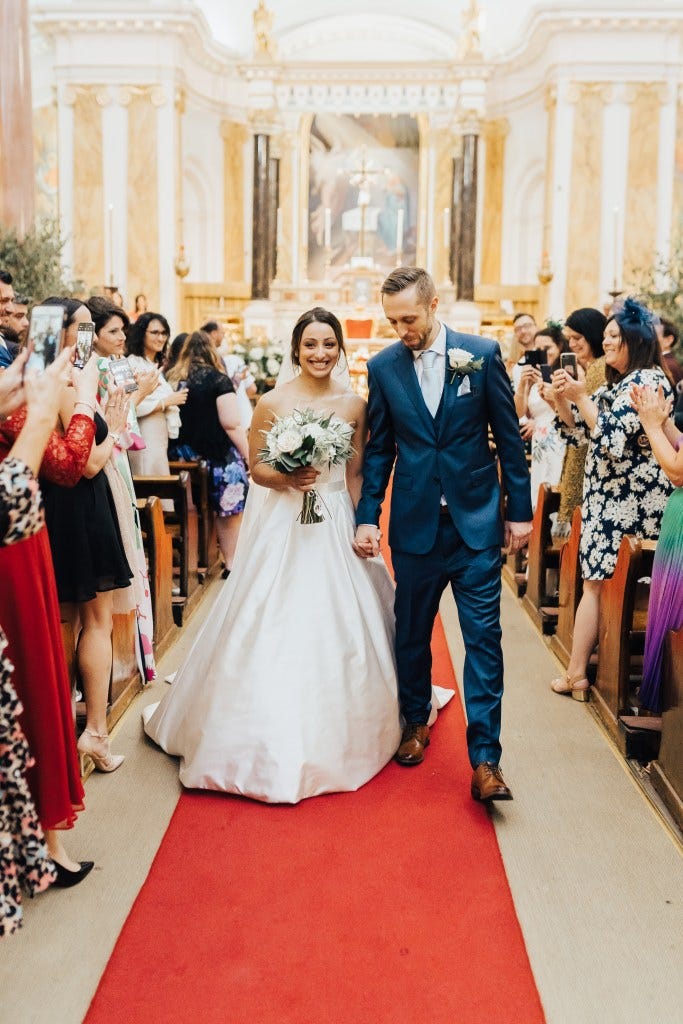
The same thing happened at a wedding I once attended. The bride walked down the aisle behind a wall of raised phones. Nobody in the pews was watching her cross the room. They were watching a screen record her crossing it, ready to post before she reached the altar. The threshold still happened, but almost nobody in the room was actually inside it. A hundred people stood a few feet from an irreversible moment and chose to experience it the next day on a feed.
Silence and undivided attention used to cost nothing and belong to the whole room. Somewhere in the last hundred years both became priced, timed, and switched off by whoever bought them. I have paid to sit in a quiet room in an airport. I have downloaded apps that promise ten minutes of calm on demand. Noise is everywhere, and now so is its opposite, sold back by the hour.
Max Picard called silence the one phenomenon that resists being made useful. The instant someone tries to improve it, it has stopped being silence. He argued the loss of it had changed man more than printing or compulsory education ever did, altering not one habit but his whole structure. It did not start with an app. The collapse started long before phones existed.
What was built into stone…
Romano Guardini said the sacred act becomes vain without silence. Cardinal Robert Sarah, citing St John of the Cross, put the same law in six words: God is silence, the devil is noise. Neither man was describing the mood of the room. Both were describing a discipline, and a discipline held by one man alone rarely outlasts him.


Saint Benedict solved that problem in 529. He founded Monte Cassino and bound his monks to stabilitas loci, a vow that fixed a community, not a person, to one ground and one rhythm of prayer. The silence was never carved into anything. The permanence was, and permanence is what let the practice survive one monk’s death, then the next one’s, for centuries.
Lombards destroyed it in 570. Saracens destroyed it again in 883. An earthquake brought it down in 1349. French troops sacked it in 1799. Each time, the monks rebuilt, and each time the vow outlasted the ruin.
On 15 February 1944, Allied bombers destroyed the abbey a fifth time, acting on a report that German troops held it. The report was false, a fact the British official history later admitted. The monks rebuilt again. Pope Paul VI reconsecrated the abbey in 1964, and Benedictines live there still.

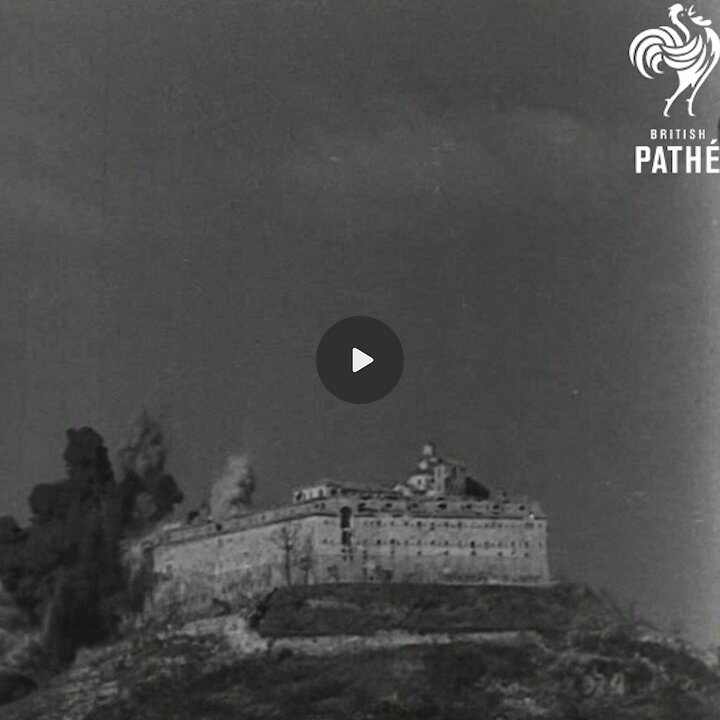
Four disasters and a world war could not end what Saint Benedict began at Monte Cassino…
In the Netherlands the property market finished the job without a single bomb…


No bombs needed…
Monasteries and convents across the Netherlands that once held living communities have been sold across the decades since, converted into apartments, offices, event halls, while the street outside stays swept and the canal beside it stays clean.
Nobody rebuilt these. Stabilitas loci does not survive a change of ownership, and unlike Monte Cassino, no community came back to reclaim the ground once it changed hands.
The bombing at Monte Cassino followed a mistaken military calculation. The sale in the Netherlands followed an economic one, a market asking the one question war never had reason to ask: what is this place actually worth?
Saint Thomas Aquinas would have called that question malformed. He held that goods, in the old sense of the word, meaning anything worth choosing, exist in an order, and that a life spent in contemplation ranks above a life spent producing, because some things are not means toward anything further. A monk at prayer generates no return that could have gone somewhere more useful instead.
Force every hour to answer for its output and that order does not bend. It disappears, and a monastery ends up worth exactly what an apartment block on the same plot would fetch.
G.K. Chesterton called religion the soul of a civilisation, not a decoration laid over the top of it. A soul does not get reinstalled once the body has been sold for parts, and nothing that fills the gap afterward arrives free of a price tag.


The app, the pod, and the retreat
A meditation app sells ten minutes of quiet that I can cancel the moment it becomes inconvenient. A corporate office installs a soundproof pod and calls it a wellness initiative. A weekend retreat sells a digital detox at a price that guarantees the phone goes back on the moment the invoice is paid. A newly renovated church can be acoustically flawless and still fill every pause with music before it settles.
Money buys the pod. It does not buy the silence that used to belong to a whole congregation at once. Money restores the façade of a monastery turned into flats. It does not restore the unbroken chain of psalms that made the stone different from an ordinary wall. Money stages a wedding photograph timed for the perfect light. It does not recreate the threshold that photograph only records.
The invaluable was never a luxury good with a higher price tag.
The paid essay gives a working rule: one fixed hour a week, phone in another room, one act that produces nothing measurable, and the same measure Aquinas applied when he ranked a monk’s prayer above a man’s labour, used afterward to tell whether the hour held.
What the frame cannot show
The girl near the front of Smith’s crowd will never be photographed the way this generation photographs its weddings and its Sundays, staged twice over until the light looks right and posted before anyone has finished the moment it claims to hold. She crossed her threshold once, in a street full of neighbours who had not yet learned to fear silence, and nobody standing near her knew the world that made that street possible would not last.
A parish that skips the microphones is choosing the older rule over the easier one. A couple that asks its guests to leave their phones at the door before the vows is doing, on a smaller scale, what Saint Benedict did with considerably more stone. A monastery not yet sold is still, for one more season, a place where the vow and the ground have not been pulled apart. None of it needs to be reinvented. It only needs to be chosen, in one particular room, at one particular hour, by someone who decides that hour is not for sale.
—Robbert
Wonderful essay; beautiful read. Silence is something we choose to enter. We are as bombarded with noise and distraction as Monte Cassino was with bombs. They rebuilt the monastery. We can rebuild silence in our lives. Those lost monasteries will never be rebuilt. Still, God can raise up others, if He finds the men and women who dare to embrace the silence. Regular meditation on Sacred Scripture and the writings of the Desert Fathers is a good starting point. So is leaving the phone off, in the other room, or in the car. The antidote to the fear that arises when we turn off the noise is the encounter with the God who is Love awaiting us in the desert we create for meeting him. Worship in the quietest church you can find, at its quietest Mass. Pray the breviary. Make a visit. Go to Adoration. Live the Faith. The formula has never changed.
Such an authentic painting! My own first communion almost 50 years ago was in a country parish in Australia, and the girls looked like this. We boys had white shirts, trousers and ties. I still remember the reverent awe that came from the strict preparation, the discipline of dressing, the first confession the previous week, and the joy of communion. We drank cordial with the priest afterward and it was recorded in a single photo in a family album.