
You cannot save Christian heritage without Christianity
What the Amsterdam church fire reveals about the hollow heritage obsession of secular people
This essay is about why secular people cannot preserve Christian heritage while rejecting Christianity. Culture is inseparable from the spiritual. You cannot have Gothic architecture without Catholic theology, Latin mottos without believing them, feast days without fasting, or Christian civilisation without Christ. Secular heritage lovers have turned churches into museums, nightclubs, and apartments. Better to burn a church to the ground, than further desacralisation.
On the night of the 1st of January the Vondelkerk (a former church) in Amsterdam burned. Within hours, secular Amsterdammers flooded social media with grief about ‘our heritage’ and their ‘cultural tragedy’… by the kind of people who never attend Mass and give a €1 donation once every few years.
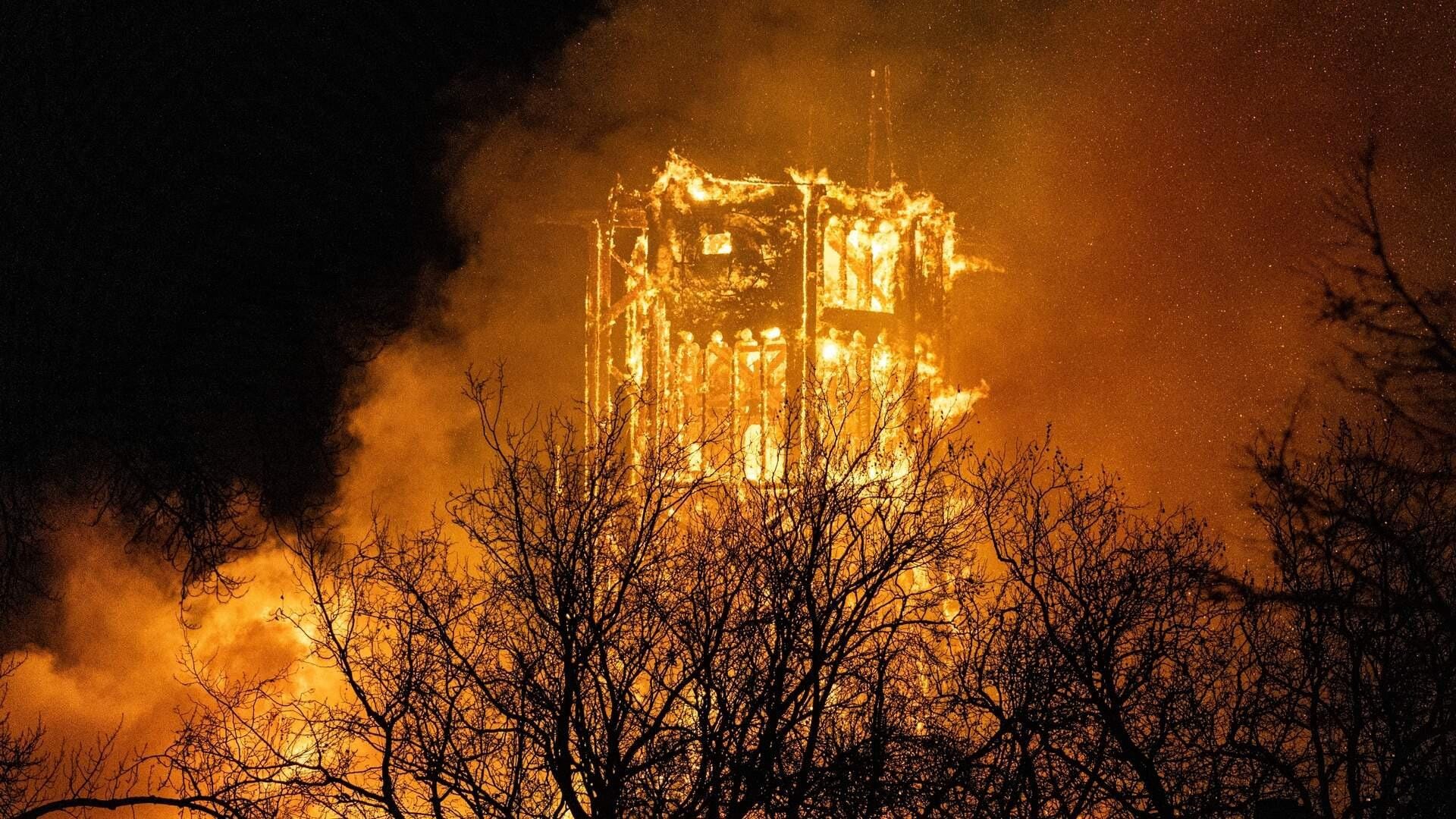
But the building that burned was not a church anymore. It only has the shape of it. In 1979 the Diocese of Haarlem-Amsterdam sold it for 1 guilder to a real estate investor. And was followed by decades of desecration: squatters in the 1980s, event venues from the 1990s until now, and finally Liberty Church: an American-style Protestant ‘worship community’ with PowerPoint screens and pop-song Christianity.
The famous architect Pierre Cuypers designed the Church in 1865 and serve as his home parish on his own street in Amsterdam.
“A tower must be high, a low tower is an absurdity.”
-Pierre Cuypers
He built a fifty-meter spire pointing toward heaven. Built in Neo-Gothic style serving Catholic liturgy. A sacred space designed for transcendence.
The fire did not destroy THAT church, but the event venue that happened to occupy its corpse.
The Death of the Vondelkerk
Pierre Cuypers established himself in Amsterdam in 1865, where he built the Vondelstraat (street) on his own land. A personal project in his neighborhood, and his architectural vision for Catholic Amsterdam.
The Church was neo-Gothic revival at its peak. Cuypers understood that architecture is theology in stone. Every element pointed upward, and the tower proclaimed God’s transcendence over the city. Its vaulted ceilings drew eyes toward heaven. Neo-Gothic style architecture was a rejection of the horizontal, the earthly, and the comfortable.
His vision on tower height was a theological conviction. Cuypers believed a church tower announces to the surrounding neighborhood that something greater exists. It breaks the skyline as God breaks into human existence.
For over a century, the Vondelkerk served its purpose. It had Daily Mass, confession, weddings, confirmations, funerals… The rhythm of everyday Catholic life in Amsterdam before WW-II and Vatican II.
But then came on October 23, 1969 ‘De Maatschappij der Nederlandse Letterkunde’ (Foundation of Dutch Literature), in collaboration with VPRO (TV-Station), hosted a televised program in the Vondelkerk honoring Gerard Reve, winner of the P.C. Hooft Prize. The program was deliberately blasphemous. Reve’s homosexual Catholic mysticism performed as spectacle in a Catholic church building. Desecration as entertainment.
By August 1978, the Diocese of Haarlem closed the building citing structural decay. Nine years of declining attendance, deferred maintenance, and the post-Vatican II collapse of Dutch Catholicism had gutted the parish. On October 12, 1979, the diocese sold the Vondelkerk for one guilder.
One guilder…
But the diocese could not even give it away properly. They handed Cuypers’ masterpiece to a real estate investor for the price of a coffee. The building was immediately squatted. For years, it housed anarchists, drug users, and Amsterdam’s countercultural drift.
Eventually it became an event venue. Weddings for people who wanted Catholic aesthetic, without the commitment. Corporate parties, fashion shows, art installations, profane concerts. And The Liberty Church a Protestant worship community, who holds Sunday services with projection screens and worship bands.
This is what secular Amsterdammers are mourning. Not a church, but a pile and an event space that means nothing to no one.
Post-Vatican II Clearance SALE
But the Vondelkerk is not unique. Across Europe, bishops asset stripped thousands of church buildings. They have been profaned into museums, nightclubs, bookstores, luxury apartments, restaurants, and even mosques.
Bishops in Western-Europe are in a perpetual clearance SALE since Vatican II.
In the Netherlands alone, over 700 Catholic church buildings have been deconsecrated since 1970. Some became cultural centers, some demolished, or became apartments. And many stand empty, waiting for a buyer.
In England, the pattern repeats. The Church of England closes an average of 20 churches per year. St. Peter’s in Liverpool became luxury apartments. Pitcher & Piano chain operates in converted churches across Britain. The Circus nightclub in London, a former church, advertises ‘divine decadence.;
In France they become mosques. The Saint-Éloi Church in La Chapelle-sur-Erdre was sold to Muslims in 2017 despite local Catholic protests. The Church of Sainte Rita in Paris became a mosque. Bishop Dominique Rey warned in 2022 that up to 5000 French churches face closure or conversion by 2030.
Germany’s Catholic Church closed over 500 churches between 2000 and 2020. Many became Protestant churches first, then secular venues, then nothing.
The justification is always the same:
‘Better to preserve the building than let it decay.’
‘Buildings always served multiple purposes.’
‘At least it remains in community use.’
‘We must adapt to changing times.’
That is cowardice disguised as pragmatism.
Profanation is worse than demolition
The Catholic Church has always distinguished between sacred and profane space. Once a bishop consecrates a church building, it is set apart for divine worship. The consecration prayers invoke God’s presence. The altar is anointed with chrism. The building becomes, in a limited but true sense, a holy ground.
Canon Law specifies that consecrated churches must be used for divine worship or they must be formally deconsecrated. Canon 1222 of the 1983 Code explicitly addresses this: if a church cannot be used for divine worship and cannot be repaired, the bishop can relegate it to ‘profane but not sordid use’, but only through formal episcopal decree after consulting the presbyteral council.
In the past 60+ years the asset stripping done by dioceses is highly questionable, as information on formal decrees of deconsecration often lack. Instead, they use bureaucratic language like ‘aan de eredienst onttrokken’ (withdrawn from worship). The Dioceses treat churches like nothing but inventory. Often parish councils are usurped by real estate investors. With no proper canonical procedure, or formal revocation of its sacred character.
Its post-Vatican II laxity at its worst. I’m sure the Dioceses have violated Canon Law, but certainly violated the spirit of it: treating consecrated churches as property transactions.
For the Vondel Church is has been forty-six years of desecration. Every profane use compounded the original betrayal. The fire did not destroy anything sacred. The sacredness was murdered decades ago. The fire just cremated the corpse.
Honest destruction is always preferable to lingering humiliation.
The Vatican II Hypocrisy
The mourning over the Vondelkerk reveals a deeper hypocrisy. The clergy now crying about fires destroying ‘our heritage’ said nothing when the Church itself demolished its sacred interiors.
Vatican II wreckovations destroyed more Catholic heritage than any arsonist or muslim terrorist could ever do. Between 1965 and 1985, dioceses across Europe ripped out high altars, demolished communion rails, whitewashed baroque frescoes, discarded medieval statuary, and threw centuries of sacred art into skips. Entire church interiors were sledgehammered to make room for versus populum tables and felt banners.
Relics of Church interiors from that these are still for sale in thrift shops and on eBay.
The Dioceses of the Netherlands initiated this process enthusiastically. No fires needes, their own modernist liturgical committees and clergy did the demolition.
Carved wooden reredos, marble tabernacles, gilded altarpieces, Monstrances, ancientChalices: All gone, sold or littered. It was replaced with concrete tables and abstract art. The ‘spirit of Vatican II’ accomplished in twenty years what Protestant iconoclasts spent centuries attempting: a systematic destruction of Catholic liturgical art and concept of Sacrality.
The secular heritage lovers were silent. They do not actually care about sacred heritage. They care about vibes and Pinterest. Beautiful things they can photograph.
Strip out the baroque altar and replace it with a concrete slab? Move on with the times!
Their sentimentalism is hollow. Mourned nothing when liturgical committees demolished ancient church interiors throughout the 1970s. Said nothing when bishops sold artefacts to fund ‘renovations’. Were absent when the Church destroyed its own heritage in the name of aggiornamento.
But now a building burns and suddenly they care about ‘our culture’. Yet they do not, they like the aesthetics divorced from meaning. The exact kitsch I inquisition with this newsletter. Heritage as a museum piece, not living tradition.
The Notre-Dame Lesson
Notre-Dame burned in 2019. And within days, over a billion euro was pledged for reconstruction. Secular France (LVMH, Kering, L’Oréal, Total, JCDecaux, BNP Paribas etc.) rallied around ‘our heritage’. And the whole world watched.
The cathedral reopened in December 2024. The Gothic exterior looks magnificent. Billions spent on restoration.
The interior now looks like a Freemasonic lodge. The 19th century stained glass window, which were not damaged in the fire, will be replaced with an atrocity depicting ‘modern France’. The worship of migrants and diversity. A sacred atmosphere stripped away in favour of ‘inclusive space’ that offends no one, yet also inspires no one.
This is how secular heritage preservation operates: preserving beautiful shells, yet housing nothing. Everything is a multipurpose space. Exteriors are maintained for tourists while the sacred purpose is erased.
The French government could have spent €500 million restoring an actual church. With Notre-Dame Style Latin Chant, golden vestments, and transcendent worship. The things that made Notre-Dame worth building.
Instead they spent the astronomical amount of donations by French globo corps to rebuild a tourist trap. Secular Europeans want aesthetics without Catholicism. Heritage without the faith.
But you cannot have one without the other.
Culture Proceeds from Cult
The word ‘culture’ derives from ‘cult’, specifically from the Latin cultus, meaning worship. And cultura and colere, meaning: to cultivate. Nowadays just etymological trivia. But it used to be the foundational truth on which Europe was built.
Culture is downstream from religion. Always, and everywhere.
European civilisation did not produce Christianity as one cultural expression among many. Catholicism produced European civilisation.
The universities, hospitals, orphanages, schools, legal systems, artistic traditions, architectural styles, musical forms, literary genres, and philosophical frameworks that define Europe all emerged from Christian worship and Christian theology.
Gothic architecture exists because medieval Europeans believed churches should lift hearts and minds towards God. The great cathedrals of Europe were built by people who believed the physical structure could participate in divine beauty.
Latin was preserved through the ‘Dark’ Ages because monks copied manuscripts. Universities emerged from cathedral schools, and the scientific method developed from Christian theology’s insistence that the natural world reflects divine rationality. Representative government grew from Christian anthropology’s emphasis on human dignity and the limits of political authority.
Remove Christianity and you do not just get neutral culture, but a zombie culture. With empty forms: traditions practised as a custom, not with understanding, buildings maintained without purpose, and holidays celebrated without meaning.
Keep churches Catholic or burn them down
The Diocese of Haarlem-Amsterdam faced a choice in 1979: maintain the Vondelkerk as a Catholic church, or close it permanently. They chose a third option. Sell it for one guilder and let others desecrate it.
The worst possible choice.
If Catholic life in a parish has genuinely died: no one attends, no priests are available, and the building cannot be sustained, then close the church honourably. Deconsecrate it, remove the sacred objects, demolish it or give it back to nature.
Never profane it into an event venue. Or let Protestants hold PowerPoint worship services on Catholic grounds. We should never turn altars designed for Christ’s sacrifice into stages for corporate networking. Or allow the sacred to be degraded into entertainment.
All the secular heritage preservationists will object. ‘But the architecture! The cultural value! We cannot let these buildings disappear!’
Yes, we actually can. And maybe even should.
Better demolish the Vondelkerk equivalents than become nightclubs, mosques, or luxury apartments. Our ancestors spent every last cent of their savings to build this churches, using them for anything else is spitting on their graves.
Culture that rejects its spiritual foundation is nothing but vain kitsch. Beautiful looking forms emptied of meaning.
Pierre Cuypers built a church, not a multipurpose event venue. His churches were consecrated to divine worship, designed to lift our hearts towards God, and meant to house the sacrifice of the Mass.
But when Amsterdam abandoned the Faith, it lost the right to Cuypers’ church.
The fire was just God’s sign for their Apostasy.
-Robbert


