


Your day starts before you have decided what it is for.
By the time you have checked your phone, answered two messages, and made coffee, an hour has passed and nothing has been chosen. This is not laziness. It is the absence of a structure that used to be given to you.
The modern productivity industry noticed this problem and built a market around it. Time-blocking, deep work, morning routines, the Pomodoro technique. All of them treat the day as a problem to be optimised. None of them ask why the day feels formless in the first place.
The answer is not a better system, but a structure which gave the day its shape. This structure has been removed from our lives, and nothing coherent replaced it.
What monks actually built
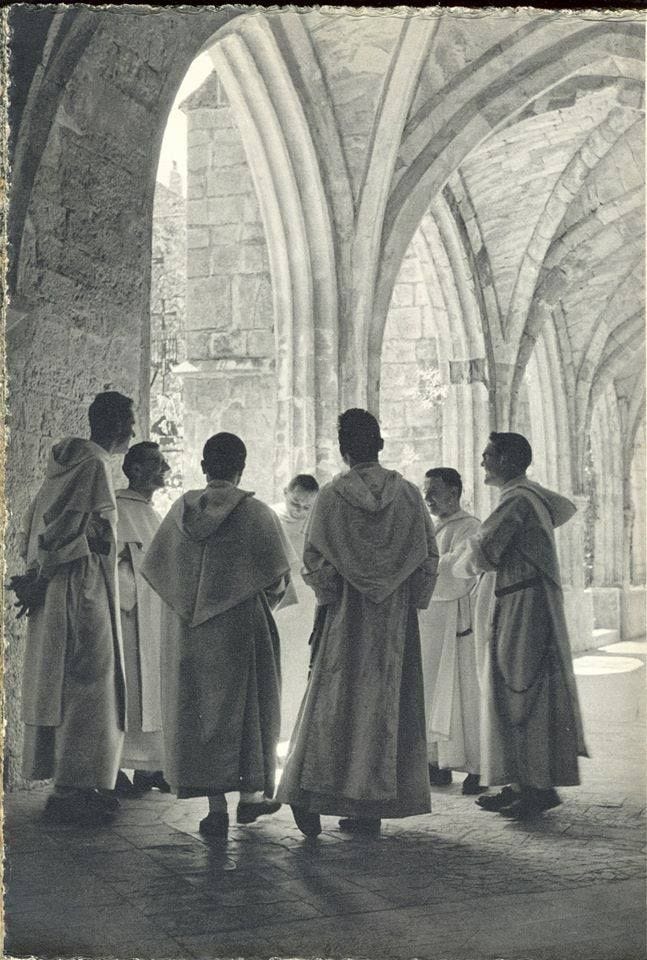
Benedict of Nursia wrote his Rule in 530 AD at Monte Cassino, a hilltop in central Italy. The Rule is 73 chapters. It governs everything: how to receive guests, how to correct a brother who fails, what to do when a monk laughs at the wrong moment. But its architecture rests on one thing: the hora.
The hora divided the day into eight fixed prayer offices. Matins at approximately 2 AM. Lauds at dawn. Prime at 6 AM. Terce at 9 AM. Sext at noon. None at 3 PM. Vespers at sunset. Compline before sleep. Each office lasted fifteen to thirty minutes. Each was preceded by a bell. Each had a fixed structure of psalms and responses that did not change according to the monk’s mood.
Between the offices, the monk worked. What did not vary was the structure within which the work sat.
The bell interrupted the work, which was the point.
The monk did not finish the sentence and then pray. No, he stopped immediately and went to the choir. There he prayed, and after he returned, he picked up the sentence where he had left it.
Such an interruption was not an obstacle to the work. It was what kept the work from becoming the whole of life. The anti-grindset that is, funny enough, more productive.


What this produced
By 800 AD, Benedictine monasteries were the primary centres of literacy, medicine, agriculture, and craft production in Western Europe. They preserved the manuscripts that survived the collapse of Rome. They developed the techniques that transformed European viticulture, brewing, and farming.
This was not incidental, but structural.
A community of people who interrupted their work eight times a day to remember that the work was not the point produced, paradoxically, better work than communities that did not. The interruption forced a relationship with time that optimisation destroys. You cannot treat an hour as a unit of output when a bell will ring in forty minutes regardless of what you have produced.
Cal Newport published Deep Work in 2016. He described fixed time blocks, single-tasking, and the elimination of distraction. Benedict wrote the same structure in 530 AD and embedded it in a community that held you to it whether you felt like it or not. Newport’s version requires individual discipline. Benedict’s version required only that you live there.
This is the difference between a system and a structure. A system is something you adopt. A structure is something you inhabit.


What destroyed it
The dissolution of the English monasteries between 1536 and 1541 under Henry VIII transferred 900 monasteries and approximately one third of all cultivated land in England to the Crown and the Protestant gentry.
With the monasteries went the bells. The monastery bell had structured the day for surrounding communities for centuries. Farmers worked to it. Markets opened and closed by it. The day had a shape audible to everyone within earshot.
What replaced it was the clock. The clock measures time. The bell called you to time’s meaning. They are not the same instrument.
By the nineteenth century, industrial time had completed the transformation. The factory whistle replaced the bell. It called workers to production, not to prayer. The Pomodoro technique, invented by Francesco Cirillo in the late 1980s using a kitchen timer, is the logical end of this. Twenty-five minutes of work, five minutes of rest, repeated. The interruption serves output. It has no content beyond efficiency.
Benedict’s bell interrupted work to name what the work was for. The Pomodoro timer interrupts work to protect the capacity to do more of it. One produces a formed person. The other produces a more efficient one.


The hora cannot be transplanted directly into a working life in 2026. You do not have a community, a bell, or eight fixed offices. What you have is the logic behind it: the day requires fixed points that interrupt work and name what the work is for. Without them, work expands to fill all available time.
The six-part framework below translates that logic into a working week. Each point has a purpose, a duration, and a specific act. Apply it for one week without modification. Do not adjust the times. Do not skip the points when the work is going well. The discipline is not incidental. It is the point.
Without the framework, you already know what happens… The day starts before you have decided what it is for. And ends the same way…
The six-part framework
Point 1 — The Opening (06:00–06:20) Matins equivalent. Purpose: set the frame before the day sets it for you.
Before email, before phone, Substack, and anything that arrives from outside…
Read one page of something serious: not the news, or essays like this, not anything connected to your work. A Psalm, a passage of history, a page of philosophy. You are establishing that the day begins with something you chose, not something that chose you.
Then write one sentence: what is today’s work directed at? Not as a task list or Eisenhower Matrix. Just one sentence naming the specific person or thing that today’s work serves. If you cannot write it, the day has not started. It has merely begun.
