


In the spring of 470, the ground around Vienne would not stop moving.
The city, then capital of the Burgundian kingdom in what is now southern France, had endured months of earthquakes. Fires broke out without warning. Volcanic eruptions in the surrounding hills scattered ash across the fields. The harvest failed. And people fled into the streets convinced judgement had arrived.
The bishop of Vienne, (Saint) Mamertus, did not offer an explanation. He just told the people a procession was coming.
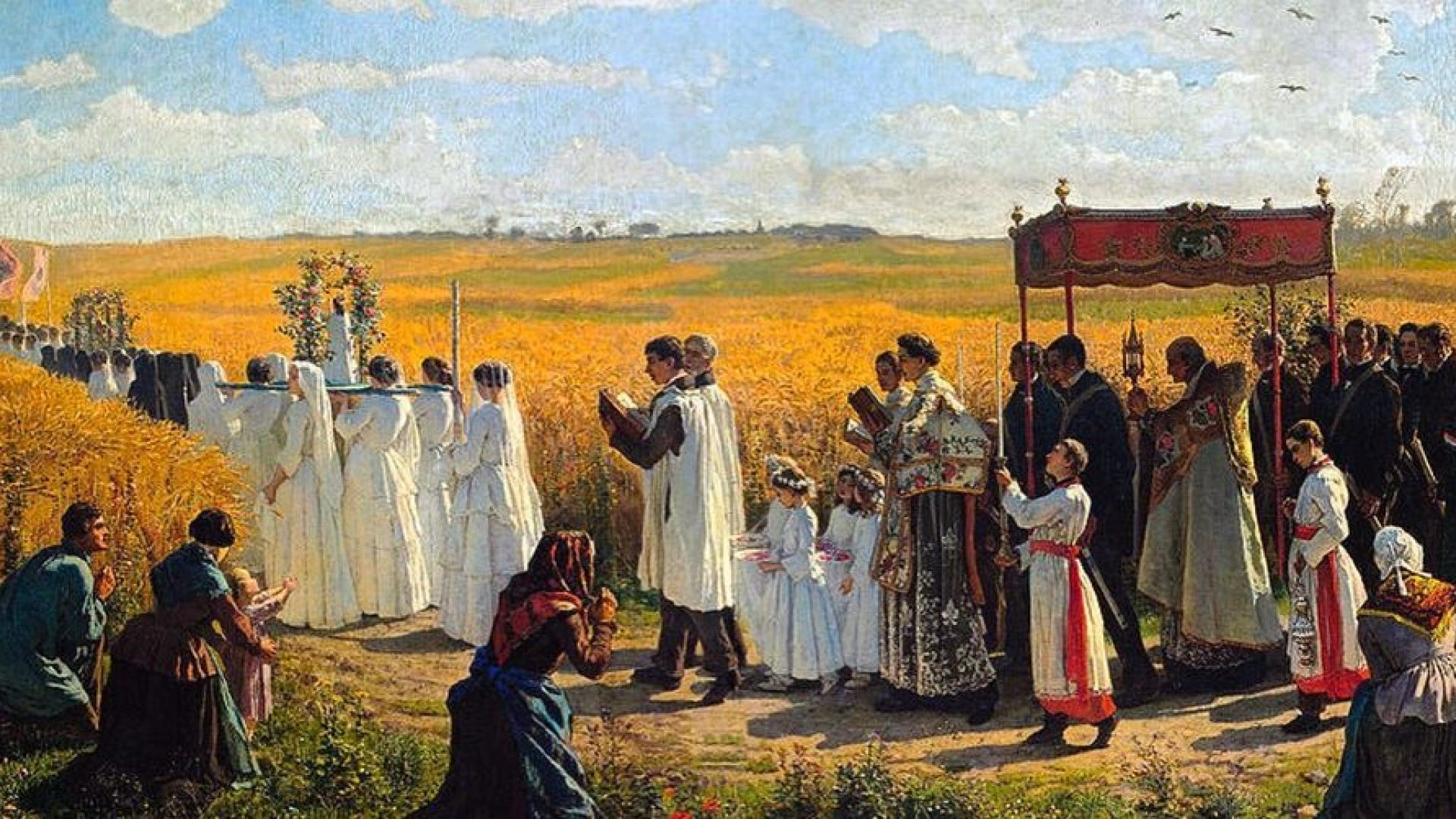
On the three days before Ascension Thursday, Mamertus led the population out beyond the city walls and through the surrounding fields. Clergy, farmers, children, magistrates: all walking together while fasting, singing the Litany of the Saints, and praying for deliverance.
The procession moved through the land that sustained the community. It named the fields, and traced the edges of the inhabited world. But most importantly: it asked God to preserve both.
Then… the earthquakes stopped, and the harvest returned. Whether that was providence or coincidence depends on what you already believe.
What matters historically is something simpler: the practice worked.
Within decades, the Rogation procession spread across Gaul. In 511, the Council of Orléans formalised it. By the ninth century, it had become universal throughout the Latin Church. For the next 1,500 years, every spring, Catholic communities across Europe walked the boundaries of the places they belonged to.
Then, in 1969, the practice disappeared from ordinary Catholic life.
Almost nobody noticed.
What vanished was not merely a religious custom, but one of the oldest systems Europe possessed for teaching ordinary people where their world ended, who belonged inside it, and what they owed one another.
The Rogation Days were not devotional decoration.
They were infrastructure.


The Rogation procession
The word Rogation comes from the Latin rogare: to ask, to beseech.
There were traditionally four Rogation days in the Western Church. The Major Rogation fell on 25 April. The Minor Rogations occupied the three days before Ascension Thursday. All involved fasting, penitential processions, and the chanting of litanies.
Their stated purpose was straightforward: to ask God for protection from disaster and for fruitful harvests.
But the deeper function of the Rogation procession was geographical.
Before cadastral surveys, satellite imaging, GPS systems, and administrative databases, the boundary of a parish existed primarily in human memory. A village knew where its fields ended because people had walked those limits for generations.
Every spring, the priest led the entire parish along the boundary line itself.
The procession crossed streams, climbed walls, passed through fields, entered forests, followed hedgerows, and stopped at boundary markers: old stones, ancient trees, bridges, gates.
At each marker, prayers were said. Then came the part modern people remember because it sounds strange: The children were beaten.
In England, the custom became known as Beating the Bounds. Boys of the parish were struck lightly with willow rods at every important boundary marker so that they would remember the location physically.
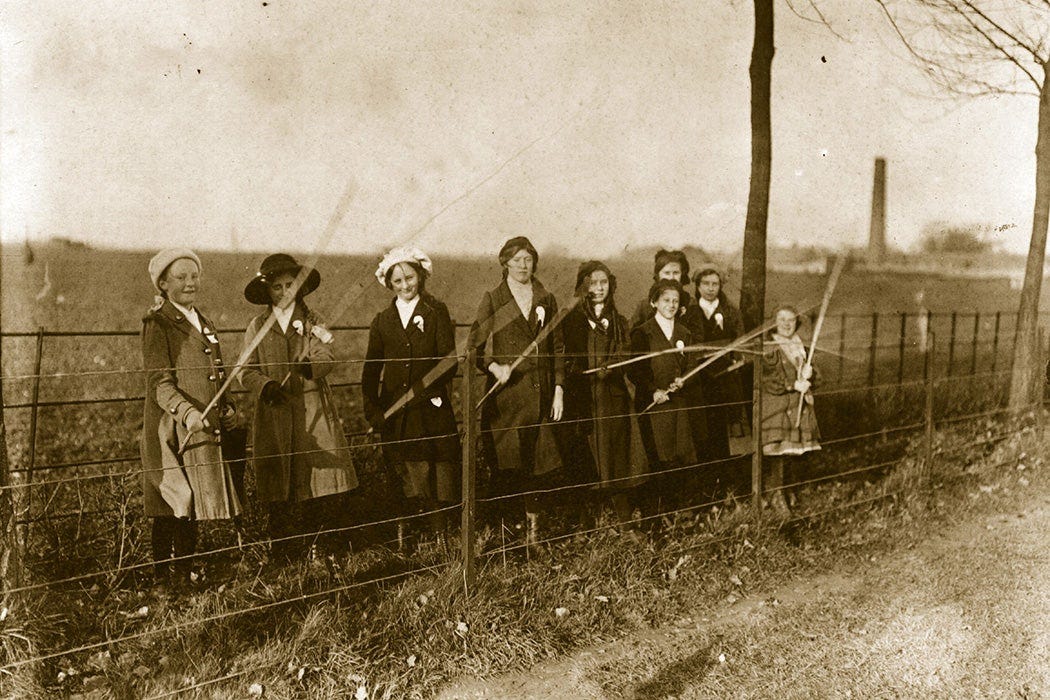
The point was not to punish the boys, but for memory.
The boundary had to survive even if written records disappeared. So the community installed geographical knowledge directly into the bodies of its children.
The boys were often rewarded with coins for enduring it. But the real payment was something more valuable: permanent orientation.
English courts in the seventeenth century regularly accepted the testimony of elderly parishioners in land disputes because those men still remembered where they had been beaten as children fifty years earlier.
A seventy-year-old labourer who remembered a stone beside a stream from a Rogation procession could settle a contested boundary.
The procession was not symbolic. It preserved territorial knowledge in living memory.
Knowledge carried in the body
Modern people think of maps as external objects.
The medieval parish treated the map differently. The map existed inside the community itself.
The Rogation procession taught people the shape of the place they belonged to through repetition, movement, prayer, and physical experience.
You did not merely know where the parish boundary was, but had walked it.
You knew which field belonged to which family. You knew where the stream bent north. You knew which road marked the edge between your obligations and someone else’s.
This mattered because a parish was not simply an administrative district, but the basic unit of social responsibility. The people inside the boundary were YOUR people.
The parish baptised them, buried them, married among them, shared harvests with them, Lent tools to them, defended them in court, and prayed for their dead.
The annual procession renewed awareness of that fact.
It made the community legible to itself.
The Rogation Days were therefore doing several things simultaneously:
blessing the land
preserving territorial memory
teaching children the shape of their world
reinforcing social obligation
embedding the parish into bodily experience
Modern institutions preserve fragments of these functions separately. Maps preserve coordinates. Registries preserve ownership. Schools preserve civic history. None of them produce the felt obligation that came from walking the boundary itself.
The parish as a physical world
The Rogation procession was not confined to agricultural villages.
Urban parishes observed it too.
In London, processions crossed bridges, entered alleyways, navigated dense streets, and sometimes passed directly through buildings where the parish line demanded it.
The boundary of St Martin-in-the-Fields moved through what later became central London. The boundary of the Tower parish crossed the Thames.
The procession followed the border regardless of inconvenience. That detail matters, and the point was accuracy.
Every member of the community was meant to possess a physical understanding of the territory they inhabited together.
The modern parish still technically has boundaries, but most Catholics could not tell you where theirs are.
They attend a Church, but do not inhabit a parish, which is a distinction that matters more than modern Catholics usually realise.
The reform and the disappearance
The Rogation Days survived plagues, wars, famines, revolutions, and the collapse of empires.
What weakened them first was not persecution, it was administrative reform.
In 1969, the Vatican issued the General Norms for the Liturgical Year and Calendar as part of the post-conciliar reforms following the Second Vatican Council.
The document did not formally abolish the Rogation Days. Instead, it transferred responsibility for them from the universal calendar to local bishops’ conferences.
This sounds minor… in practice it was fatal.
A universal obligation survives through repetition. A discretionary practice survives only where someone chooses to maintain it. But most bishops did not.
Within a decade, Rogation processions had effectively vanished across much of the Catholic world.
A tradition observed continuously for fifteen centuries disappeared not through theological condemnation, but through bureaucratic diffusion.
Nobody was ordered to stop, but also nobody was required to continue.
The end result was identical.
The logic behind the reform was understandable. Many liturgical planners viewed the Rogation Days as remnants of a pre-industrial agricultural society.
Modern urban Catholics, they assumed, no longer needed rituals tied to crops and harvest cycles.
The diagnosis misunderstood the practice completely. Agriculture was the setting. Community memory was the function. The procession did not exist primarily because medieval people feared bad weather.
It existed because human beings require repeated contact with the boundaries of the world they are responsible for.
The reformers saw rural piety. They did not fully see what the practice had been doing.
The English example
England offers the clearest example.
During the Reformation, Protestant authorities attempted to preserve the boundary-walking while stripping away its Catholic theology.
Archbishop Edmund Grindal argued that the Rogation procession should become a civil exercise rather than a sacred one.
The 1563 Book of Homilies reframed the custom as useful for maintaining lawful boundaries and neighbourhood order.
The litanies disappeared. Saints disappeared. Blessings disappeared.
What remained was the walk, and this turned out not to be enough.
Without the religious framework, the procession gradually lost authority and meaning. Oliver Cromwell suppressed even the reduced form during the seventeenth century. Later revivals treated it as folklore: charming, historical, picturesque.
But a picturesque walk cannot perform the work the original procession performed.
The medieval Church understood the land itself as spiritually charged: Fields were blessed because they mattered. Boundaries were prayed over because obligations were sacred.
Children remembered the route because the continuity of the community mattered before God.
Once that framework disappeared, the practice hollowed out. What survives today in some English villages is usually heritage culture.
The original Rogation procession sustained a particular kind of communal memory.
What disappeared with it
The disappearance of the Rogation Days removed something modern societies no longer know how to produce.
A felt sense of local belonging. The modern person knows his location abstractly.
He knows his postcode. He can navigate with GPS. He can zoom out infinitely on a digital map.
Yet he often has no embodied knowledge of the territory he inhabits.
He could not walk the boundaries of his neighbourhood from memory. But does not know which families have lived there longest. And does not know where his obligations begin and end.
The Rogation procession answered this problem annually. It turned territory into memory, and memory into responsibility.
That is why the loss matters.
The modern parish still exists canonically. But for many Catholics it functions primarily as a service provider.
People attend Mass there. But they do not necessarily belong there.
The old procession reinforced belonging physically:
You walked beside your neighbours.
You crossed the same fields your grandparents crossed.
You stopped at the same stones.
The boundaries became inseparable from memory itself.
No website can replicate that, and no parish app can replace it.
What Mamertus understood
Mamertus did not invent the instinct behind the Rogation procession.
He baptised it.
Human societies have always marked and walked the boundaries of the world they inhabit. Romans performed the Ambarvalia processions around fields centuries before Christianity. Other cultures developed their own equivalents.
The Church preserved the practice because it understood that communities survive through repeated acts of collective memory.
A boundary nobody walks eventually becomes meaningless.
A people who never physically encounter the limits of their world eventually stop understanding what they owe to it.
This is larger than liturgy: Modern rootlessness is partly geographical:
People live everywhere and nowhere simultaneously. Their obligations become abstract. Their loyalties become emotional rather than territorial. They know causes, identities, preferences, networks. But they often do not know place.
The Rogation procession trained people to know place.
That is why its disappearance matters far beyond Catholicism.
What disappeared was not simply an old religious custom, but one of the mechanisms by which European communities remained conscious of themselves.
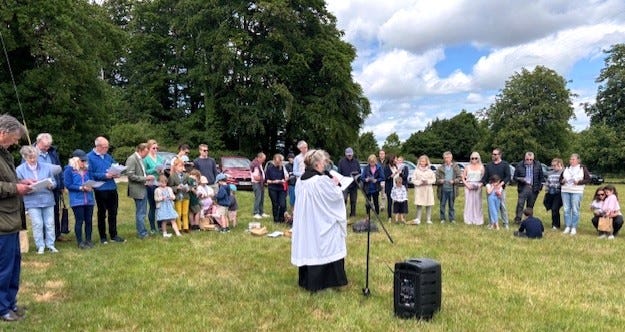
The tradition survives in fragments. Some traditional Catholic parishes still observe the Rogation Days according to the 1962 Missal. In parts of England, Beating the Bounds continues as a local custom. A few processions still leave churches each spring and trace ancient routes through fields and streets.
But the wider logic has vanished.
Most people now live inside boundaries they have never physically encountered. Mamertus understood something the modern world struggles to recover: a community that does not walk its boundaries will eventually forget it has any.
And once that forgetting sets in, belonging itself becomes harder to sustain.
— Robbert
The Member essay this Saturday: how to apply the Rogation logic to modern life: the four practices that create real local belonging, and the one exercise you can begin this week. Become a Member →
This is still a tradition in the Eichstãtt diocese of rural Bavaria. My sons are altar boys and led the processions Monday and today.
A crossroads two miles from our house splits our community into 4 parishes. A chapel or a field cross marks the boundaries of each one. The boundaries of our parish are the destinations of the first three processions. Today's stops were the boundaries of the main village.
People here (old farming families) are still very loyal to those within their parish boundaries. Now I know why!
A good article and reminder. The revolution of 1960's killed the Rogation Days. In Poland, where I come from, even ten days before the "council" (1952) the secretary of Polish Bishops wrote to communist authorities: "Among the most traditional processions, which have been held for centuries, are those on the Feast of St. Mark (April 25) and on Rogation Days (this year on May 19, 20, and 21); our people are very attached to these processions, and they also have a social character, as they are held with the intention of imploring God's blessing for the future harvest" - it was in the context of demanding that the authorities cease to disturb the above piety.
Just several years later the same Bishops forced upon the same faithful (with NO calendar) abandoning of Rogation Days.