


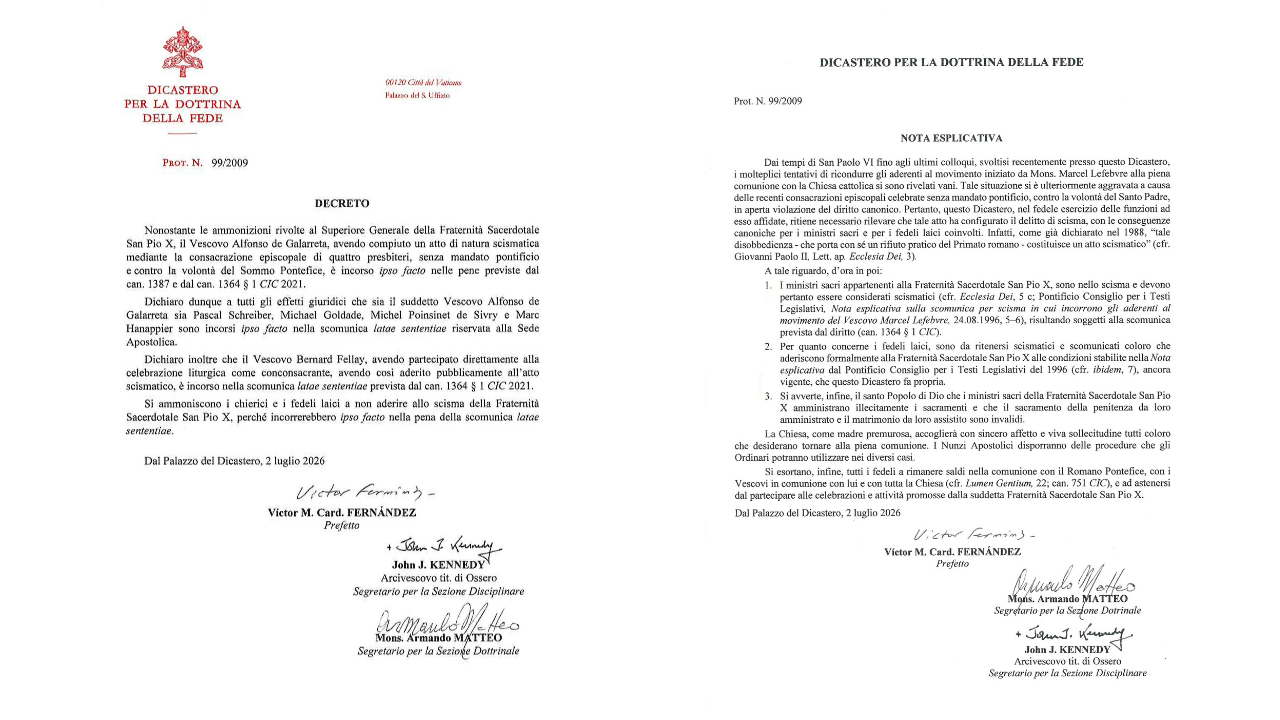
As already expected, on the 2nd of July 2026, the Dicastery for the Doctrine of the Faith issued a decree concerning six bishops of the Society of Saint Pius X.
But Canonists already disagreed within the same day about what the decree actually does. Some read it as excommunication. Others pointed out that the Society has never withdrawn its recognition of the Pope, and that withdrawal of submission, not mere illicit conduct, is what schism has always required in canon law.
The document named the offence before the offence had been settled.
And exactly this is worth pausing on, because this is not just a story about Rome and a small traditionalist society. It is a story about what happens when institutions change words before they have decided what the word now means.
And that story is considerably older than any decree issued last week…
Open a missal printed before 1965 and your Creed proceeds from belief ‘in the Holy Ghost, the Lord and Giver of Life.’
Now if you open one printed last year, and you will see the same clause reads ‘Holy Spirit.’ Nothing in the Latin language has changed. Spiritus Sanctus is still Spiritus Sanctus in every edition. What changed was the English word chosen to carry it.


English speakers have two words for the same Latin term, and a translator has to choose one. ‘Ghost’ in older English retained a sense of something that could unsettle a room: a presence that disturbed complacency, that carried weight, that inspired something closer to fear than comfort.
‘Spirit’ had drifted, by the 20th century, toward something interior and gentler: mood, morale, a category on a wellness questionnaire, a vague life-force. The translators chose the gentler word. And they were not without reasons, yet the reason was never put to the people in the pews. The wording simply changed underneath them.
This was not an isolated translation decision. It was one small accommodation in a pattern visible across the post-conciliar liturgical books, catechetical materials, and devotional language across the second half of the 20th century.
The outward structures remained. But that words that filled the books were made smoother, less confrontational, and less demanding of reverence. Each change might have seemed reasonable in isolation… but not a single one has been reversed.
Deliberate vagueness
George Orwell already wrote about how the English language was changing in 1946: in political prose rather than liturgical translation. His argument in ‘Politics and the English Language’ was that a language can be made to think for you, so that by the time you reach for a word the conclusion has already been reached on your behalf.

And no, he was not describing propaganda in the sense of a lie told on purpose. What Orwell meant was that language has become pre-loaded, so that certain phrases arrive already carrying their verdict, and a speaker who reaches for them inherits the verdict without doing any of the thinking.
His most specific target was vagueness: the habit of using many words where few would do, of reaching for the long Latin derivative instead of the short Anglo-Saxon one, of burying a simple claim inside a construction so padded and indirect that the reader finishes the sentence without being able to say what it contained.
A writer who cannot be pinned down cannot be held accountable for what he wrote. Yet vagueness is not imprecision by accident. In our culture precision deliberately avoided, so that a conclusion arrives without an argument to defend it.
This mechanism runs through secular language with the same efficiency it ran through the Creed. ‘Gay rights’ and ‘women’s rights’ are, on this reading, two of the most structurally successful pieces of pre-loaded language of the past century.
The underlying claims are not necessarily false or true, but because the word ‘rights’ forecloses an argument before it begins. A right is, by the ordinary sense of the word, something owed regardless of majority opinion.
When you attach ‘rights’ to a contested claim and you have moved that claim out of the category of things reasonable people may debate and into the category of things only a bigot would question. The word does the arguing. And the listener is left to agree or to be positioned as the kind of person who does not, so you become a ‘Nazi’ or a ‘fascist’ if you do no agree with Women’s RIGHTS (aka abortion on demand).
Orwell’s point was not that this vagueness was unique to any political faction. It is now available to anyone who understands that controlling the vocabulary controls the conclusion, and that the most durable way to change what people believe is to change what words they reach for before they have had time to think.

G. K. Chesterton saw the far end of this process a century early and named it more precisely than either the theologians or any linguists ever managed to. Chesterton’s complaint was not that modern man had become wicked. It was that modern man had lost the proper vocabulary that let him locate his own wickedness, causing his guilt to remain, while the word that used to explain it was vanished.
A man could still feel that something in him had gone wrong. But he no longer had ‘sin’ available as a word that named his wrongness precisely. A word that gave it a shape he could confess and be absolved of.
What replaced it were categories that distributed the fault, and we now see in personal development: brokenness, dysfunction, systemic failure, the wounds of one’s upbringing, the matrix, etc.
None of these are lies per se, but all offer a different conclusion than ‘sin’ did. What they do is solely locate the wrongness outside the person, or worse: dissolve it into conditions beyond his control, and even convert it into something therapeutic rather than something moral.
The guilt still lingers, and the accountability evaporates. What is left is a diffuse, wordless unease with no ritual attached to it. And this is a considerably worse position than the one it replaced, however uncomfortable the old word had been.

Coming back to the Episcopal Consecrations: people now call me (and maybe even you) schismatics… but do not ever start speaking about chastity or actual doctrine… as they will feel visibly uneasy when you do that. They rather hide behind a vague ‘submission to Rome’ than revealed truth. Because the truth hurts others.
And exactly the same counts for the filing off of ‘Ghost.’ The softening of sacrificial language into communal-meal language.
The replacement of ‘sin’ with ‘brokenness.’
None of these changes required a direct vote or decree, because none of them were announced as the revolutionary acts they were. They arrived one by one as a pastoral accommodation, a sensitivity to contemporary idiom, or a desire to meet people where they were.
But the cumulative effect was to lower the awareness of an entire civilisation’s moral and spiritual vocabulary by several degrees, so gradually that no single generation could name the exact moment it happened.
That is why it is silly to blame a single event for all that is wrong in the world: The French Revolution, Vatican II, the Sexual Revolution etc.
The only event to blame it on is when Adam and Eve ate the fruit.


Gustav Mahler is credited, more often than the historical record can support, with the observation that tradition is not the worship of ashes but the preservation of fire. Whether or not he said it in those words, the distinction is exact.
A tradition that keeps its old words, even the frightening ones, is tending a fire.
A tradition that keeps the building, but quietly changes the substance inside it is tending ashes, and telling itself the fire still burns because the shape of the room stayed the same. But only the room is preserved, and the fire is not. So you are living in a museum.
And these are not the same thing, and no decree resolves the confusion between them.

This is what makes the DDF document of the second of July so difficult to take seriously as the final word on anything.
For me it is just a fart in the wind, because canonists are arguing over boundaries in terrains that language already conceded.
At the time Rome was debating whether six men were in schism, the more consequential arguments had been settled two generations earlier. Things like: what word English-speaking Catholics would use for the third Person of the Trinity, how frightening or comfortable the Mass would feel, and which moral vocabulary the faithful would still permit themselves to use with full force.
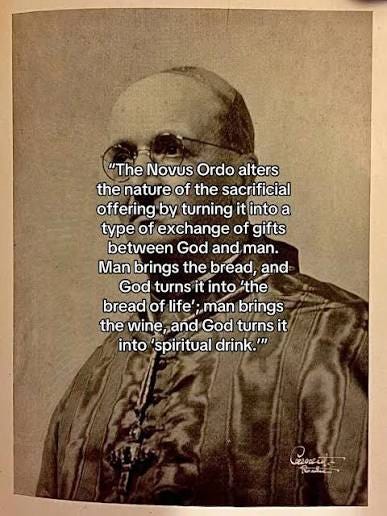
In the Netherlands they do not speak of a Holy Mass (Heilige Mis) anymore, but a ‘Eucharistic Celebration’ (Eucharistieviering).
Most of this nonsense was not decided by decree. Nobody was asked, nor did the people ever demanded these changes.
The law now arrives after the word has done its work. It names an offence on ground that language already conceded. And draws the line where the line no longer matters.
You have just read how we are being played through language.
-Robbert
‘On Saturday I will publish a completely separate, standalone essay for paid subscribers: ‘Restoring the Fire in Daily Life — A Practical Framework.’
It will move beyond diagnosis to offer concrete, immediately applicable tools for your own prayer, family, reading, and parish life.’
You have brought the cliche “words matter” into focus in a big way, Robbert. Thank you.
“For me it is just a fart in the wind.” Couldn’t be better said.