


On occasional Sundays Heritage Standard will pick cultural or Catholic traditions that used to be ordinary and are now mostly gone.
Our civilisation was held together by the collection of these small and grand ideas. Vestments, processions, customs, recipes, crafts, feast days observed in one place and nowhere else. Most of them faded or stopped being taught.
Not everything will come back. Some things ended for pragmatic reason. But you cannot decide what to want to keep or let go if you have never even heard of it.
For over four centuries, two figures stood closest to the Pope during his most solemn appearances: a layman of ancient Roman blood on one side, an a bishop robed in cope and mitre on the other. Both duties were abolished in 1968. Casualties of a Church remaking itself for the modern world.
Their story is really the story of the papal nobility itself…
The Prince Assistant to the Papal Throne
The office of Prince Assistant (Principe Assistente al Soglio Pontificio) was the highest honour available to a layman anywhere in the Papal Court. It was created in the early sixteenth century, not as an act of favour but as a peace treaty: Rome’s two great baronial houses, the Colonna and the Orsini, had spent generations locked in feud, and the papacy needed a way to seat both at its right hand without reigniting the quarrel.
Pope Benedict XIII settled the arrangement by decreeing that the title would alternate between the heads of the two families, a compromise that held from 1735 onward. Whoever bore it took his place beside the papal throne at every consistory, state reception and solemn liturgy, ranking in precedence just below the College of Cardinals.
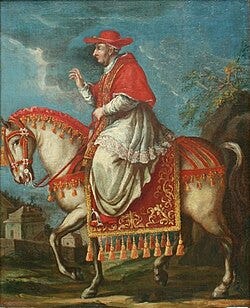
The Orsini line ended in scandal. In January 1958, Pope Pius XII stripped Filippo Orsini of the title after a very public extramarital affair ended in a double suicide attempt.
Pope John XXIII tried to restore the old symmetry in 1962 by naming Alessandro Torlonia, Prince of Fucino, to stand alongside the Colonna.
It was a last gesture before the office was overtaken by events. Aspreno Colonna, the final Colonna to hold the post, and Torlonia were each allowed to keep the title personally until their deaths, but by then it carried no function.


The Assistant to the Papal Throne
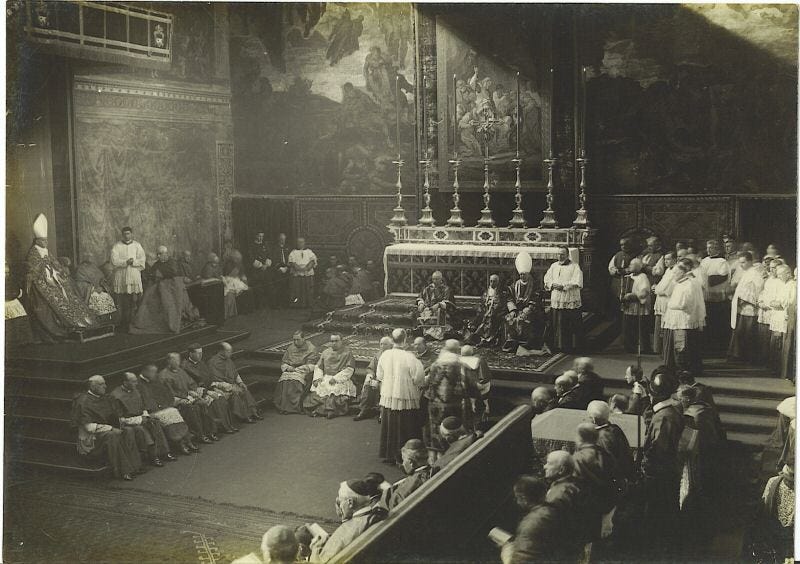
Parallel to the lay princes stood their ecclesiastical counterparts: a small number of patriarchs, archbishops and bishops formally attached to the Papal Chapel as Assistants to the Papal Throne. Where the Prince Assistants represented the nobility, these prelates represented the wider episcopate, and the honour carried real privilege.
Holders were automatically created Counts of the Apostolic Palace and were entitled to specific pontifical vestments.
During solemn functions they encircled the papal altar and chair, a visible guard of honour standing immediately below the cardinals in rank.
The Black Nobility
Both offices drew their lay membership from a distinct class of Roman aristocrats known as the Black Nobility. The name dates to 1870, when the Kingdom of Italy seized Rome and Pope Pius IX withdrew into the Vatican, declaring himself a prisoner within it.
The families who shut their palace doors in solidarity and refused to recognise the new Italian state, among them the Colonna, Orsini, Borghese, Barberini, Chigi and Massimo, became the Black Nobility, distinguished from the ‘White Nobility’ who had thrown their support behind the House of Savoy. It was the Black Nobility who continued to hold the papacy’s hereditary offices, and the 1929 Lateran Treaty formally recognised their papal titles as equivalent to Italian noble rank.


1968: The End of the Papal Court
The turning point came on 28 March 1968, when Pope Paul VI issued the motu proprio Pontificalis Domus. The document abolished the centuries-old Papal Court outright and replaced it with a leaner Papal Household.
The Noble Guard and Palatine Guard were dissolved, the hereditary civil and military titles of the Roman aristocracy lost their function, and the Assistant to the Papal Throne was absorbed into the general body of bishops.


The reform reflected the wider mood of the decade: Vatican II had unsettled inherited structures across the Church, and a court modelled on Renaissance precedent sat uneasily beside a papacy trying to present itself as pastoral rather than princely. What survived was largely symbolic: men who had earned the titles under the old system kept them until death, but no successors were named.
Nothing quite like it has existed since. The Colonna and Orsini remain prominent families in Rome, and the Palazzo Colonna now opens its galleries to visitors most weekends. But the office that once placed their heads at the pope’s right hand closed with the men who last held the titles.

An Afterlife: Princess Elvina Pallavicini
The Black Nobility did not simply disappear once its court offices were abolished. The instinct that had defined the class for a century, standing by the older order of the Church against a state or a reform it judged illegitimate, outlasted the abolition of the titles themselves. Some of its members went on to shelter the resistance that Vatican II itself provoked.
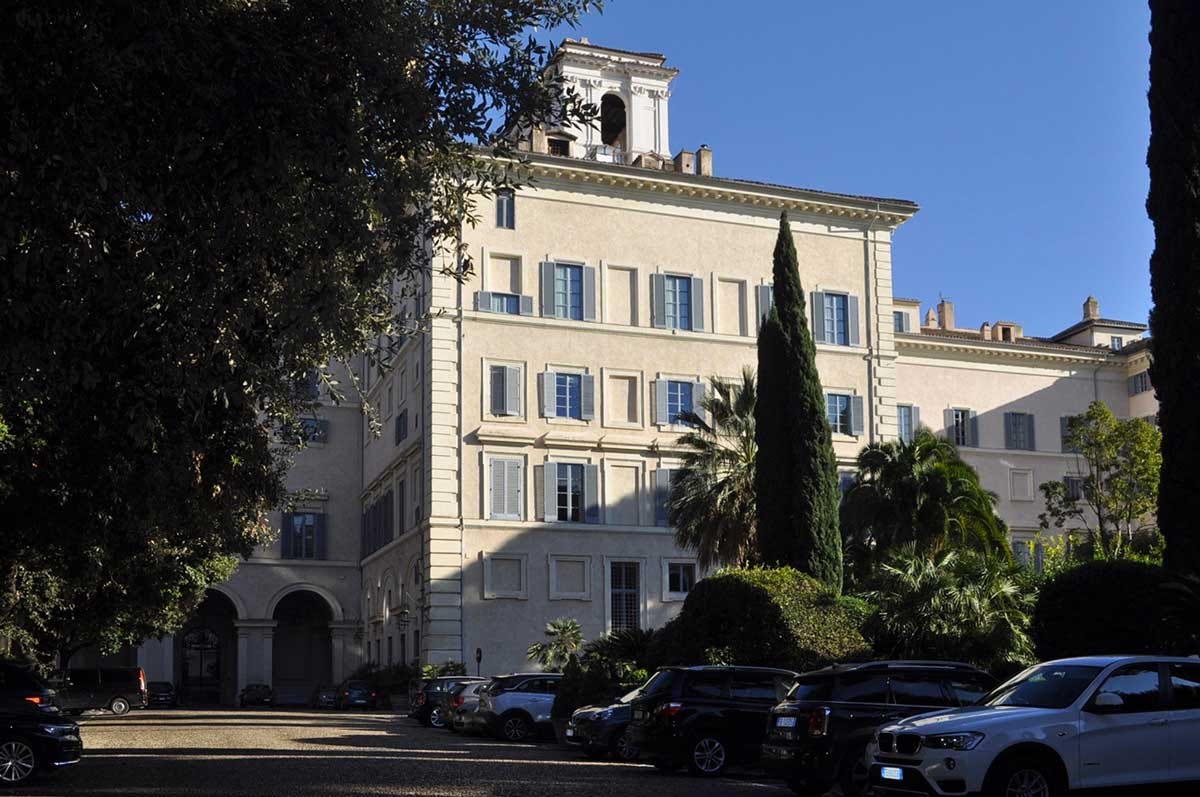
Princess Elvina Pallavicini, of one of Rome’s old aristocratic houses, was among them. On 6 June 1977 she opened the Palazzo Pallavicini to Archbishop Marcel Lefebvre, hosting the conference at which he set out his critique of the post-conciliar Church under the title ‘The Church after the Council.’
Mgr. Lefebvre had spent the preceding years arguing that obedience to the Church’s lawful authorities did not extend to cooperating with reforms he believed were eroding the Faith he had received, and the Roman palace of a Black Nobility family provided him a platform to make that case in the city where the reforms themselves had been decided.


It was a small gesture with a long memory: A Roman palace once used to seat princes beside the pope’s throne, at the very centre of the pre-conciliar Church’s public ceremony, now sheltered a bishop arguing that the throne’s own reforms had gone too far.
The families who had once stood at Rome’s summit by hereditary right had, by the 1970s, no offices left to hold. What remained was their older instinct that had built those offices in the first place: a conviction, however contested, that continuity with the Church’s past was worth defending even after the institutions built to embody it were gone.
We have had so much of our Catholic heritage taken from us by churchmen. May their names be forever forgotten.
I believe the Alta Vendita is responsible for the subversion of the Catholic Church!