


In the seventh century, a duchess in Alsace spent her days washing other people’s clothes.
Her name was Hunna. She was the daughter of a Frankish nobleman, married into a household with land, servants, and rank. Nothing in her position required physical work, and nothing in her social world would have expected it of her.
Yet this is how she was known. She carried water, scrubbed cloth, and returned clean linen to neighbours who could not do it themselves. The sick, the poor, those without the strength or the means to keep their own households in order.
The people around her gave her a name: die heilige Wäscherin.
The Holy Washerwoman.
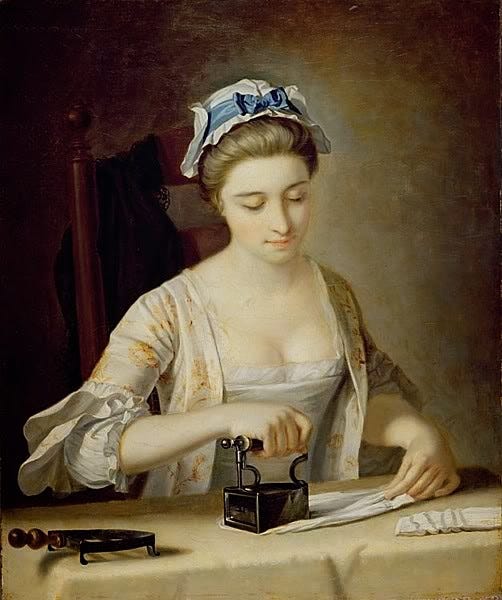
It is difficult to read this now without translating it into a language that did not exist when she lived: Humility, service, compassion; these come easily. They feel like explanations.
Yet, they do not describe what was happening…
A noblewoman doing laundry appears, to the modern reader, as a gesture. A deliberate lowering of oneself. An act meant to signify something beyond the act itself.
That assumption is the distance.
But Hunna was not making a statement. Neither was she performing humility, nor engaged in an exercise in character.
The work was the thing. It was directed at a person, required a specific skill, and ended when the task was properly done. The cloth was either clean or it was not. The neighbour either received it or did not.
Nothing needed to be added to this.
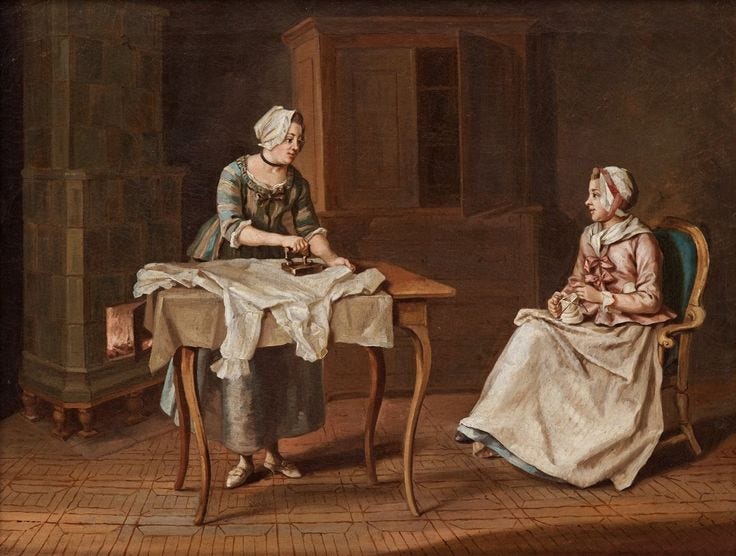
The world she inhabited had a way of understanding work that no longer survives in a coherent form.
In the monasteries that shaped the culture around her, work and prayer were not separate activities. The formula was simple: ora et labora. Pray and work.
A man copying a manuscript and a man baking bread were not understood as doing different kinds of work. Both were applying disciplined attention to material, for the sake of others, in the time given to them. The question was not what the work meant about the person doing it. The question was whether the work was real.
Whether it was done properly.
Whether it reached its object.
Hunna was not a nun, but nothing about her practice would have seemed unintelligible in that world. Washing cloth belonged to the same order as feeding the hungry or tending the sick.
The act did not point beyond itself.
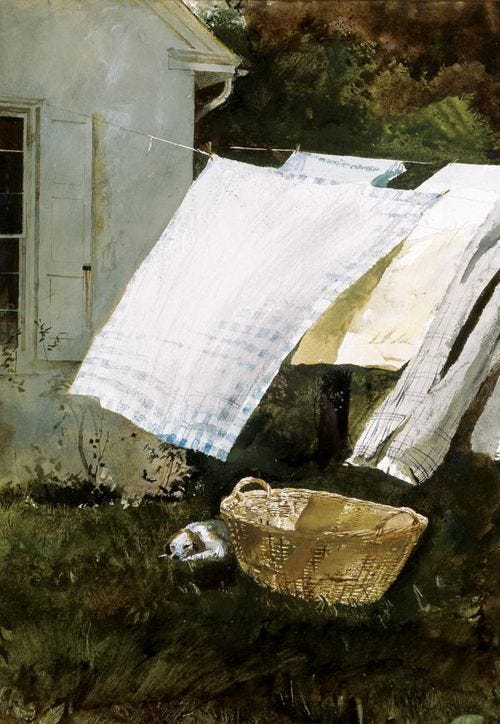
Her status makes this clearer, not less.
A duchess doing laundry is not a contradiction. It is a clarification of what rank was for. Position did not remove obligation. It made it visible.
The question was not what the work said about her. The question was whether the work had been done.

This way of understanding did not disappear gradually. It was altered decisively in the sixteenth century.
The Protestant reformers did not remove seriousness from work. They changed its direction.
Martin Luther’s translation of the Bible into German used the word Beruf to describe both occupation and calling. It had previously belonged to monastic life. It was now applied to ordinary labour. A shoemaker, a farmer, a merchant: each could understand his work as a calling before God.
In Calvin’s Geneva this developed further. Economic discipline, steady labour, visible order in one’s occupation were increasingly read as signs of spiritual standing. Work remained moral. But it no longer pointed primarily toward the neighbour who needed it. It pointed back toward the worker.
Max Weber later described this as a structural shift. The details vary, but the direction is consistent.
Work ceased to be directed outward. It became evidence.

From this point, the change is no longer theoretical.
Once work becomes evidence of the self, it can be measured, compared, and extended beyond necessity. It no longer requires a specific person in front of it. It can circulate.
The named neighbour becomes a category. The category becomes a cause. The cause becomes a system.
The act remains, but the object shifts.
In the twentieth century, this was given a new vocabulary.
The term ‘servant leadership’ was coined by Robert Greenleaf in 1970 while working at AT&T. He describes it as a model in which leadership is defined as service to those being led.
The language sounds continuous with older moral traditions. But his structure does not.
Service, in this setting, is evaluated by outcomes. Team performance, retention, efficiency, organisational health.
The person being served is never only the person in front of you. They are part of a system in which the act has another purpose.
The direction has already been decided.


The same reversal appears more clearly in the language of the wellness industry.
Acts of care are now recommended for what they produce in the person performing them. Reduced stress. Increased purpose. Improved mental health. Measurable wellbeing.
The effect is real. The reversal is complete.
An act directed outward becomes a tool directed inward.
Hunna’s work, translated through this logic, becomes a form of self-care.

What has been lost is not the act itself. People still help each other. They still volunteer. They still perform tasks that have no immediate personal benefit.
What has been lost is the understanding of the act as complete.
The pre-modern structure required very little:
A person
A need
A skill
The application of that skill to that need
A finished result
It did not require meaning, personal growth or the act express anything about the one performing it.
It required that the work be done.


This is difficult to recover because it does not offer what the modern understanding of work expects.
There is no identity in it, no accumulation and no self-development across time. No sense in which the act builds anything other than its own completion.
There is only the work, and the person who receives it.
The simplicity is demanding. It leaves nothing to interpret.
This Saturday in the Member’s essay: Why the people who built things never asked whether their work had meaning, and what that demands of the obligations already in front of you.
Hunna carried that understanding so completely that the people around her gave it a name.
She did not become a philanthropist, servant, or leader.
But The Holy Washerwoman.
Saint Hunna, pray for us,
-Robbert
Further Reading:
Max Weber
The Protestant Ethic and the Spirit of Capitalism (1905)
Weber is a German sociologist and political economist who analysed how modern capitalism was shaped by religious ideas, especially Protestantism. Best known for showing how the idea of ‘work as a calling’ (Beruf) transformed labour into a form of moral self-measurement. His work is central to understanding how work shifted from action in the world to evidence about the self.
Eamon Duffy
The Stripping of the Altars: Traditional Religion in England, 1400–1580 (1992)
Duffy is a British historian of Christianity focused on late medieval and early modern religious life. Known for reconstructing the sensory and ritual world of pre-Reformation Catholicism. His work shows religion as embodied practice: lived through time, space, and repetition, rather than abstract belief or intellectual system.
Alasdair MacIntyre
After Virtue: A Study in Moral Theory (1981)
MacIntyre is a Scottish philosopher of ethics and social theory. In After Virtue, he argues that modernity has fragmented coherent moral “practices” into systems driven by external rewards such as status, productivity, and measurable success. His work is key to understanding the loss of internal standards of excellence in work and craft.
Thank you Robbert. I enjoy your essays and your notes. They help me better understand the world and my place in it.