


You know your postcode, the route to the supermarket, and recognise a few faces in the street, perhaps even know a name or two. But you could leave tomorrow and the place would not meaningfully register your absence. And if you are honest, you would not register the absence of others either.
This is usually explained as a psychological condition: Loneliness, individualism, or the pace of modern life. Increasing mobility plays a quieter but important role too. The result is the same: more people pass through places than belong to them.
These explanations are not wrong. But they are also not the point.
The cause is older and more structural.
It is the disappearance of a system that once taught people, repeatedly and physically, where they were.
For nearly 1,500 years, the Western Church marked the Rogation Days each spring.
Three days before Ascension Thursday, communities across Europe left their homes and walked.
Parish by parish, people processed along the boundaries of the land they inhabited together. Clergy, farmers, children, magistrates, the old and the slow. They moved through fields and lanes while fasting and praying, chanting the Litany of the Saints, stopping at boundary markers to bless the ground and ask for its preservation.
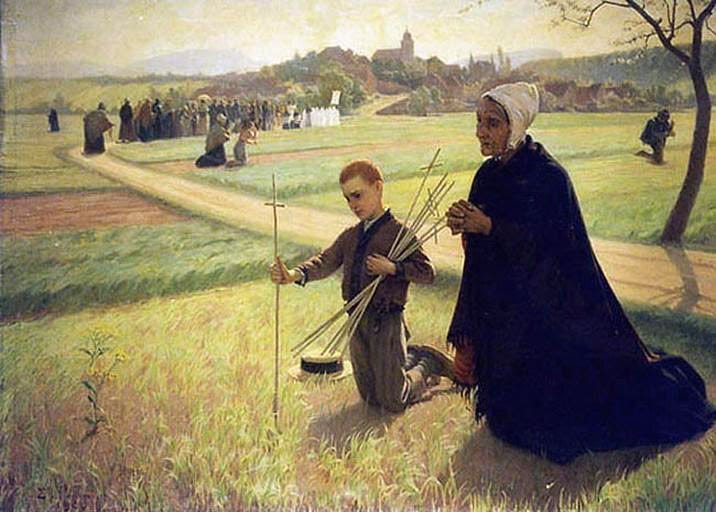
It happened every year, in the same season, in the same places, for centuries without interruption…
In the spring of 470, the city of Vienne in southern Gaul was in crisis.
Earthquakes shook the ground. Fires broke out unpredictably. Crops failed, and volcanic ash drifted across fields. The population interpreted this as the breakdown of the natural order.
The bishop, Mamertus, responded with a procession.
He led the entire city beyond its walls and into the surrounding countryside. They walked while fasting, singing, and praying for deliverance. They traced the edges of the world they depended on and asked that it be held together.
Then the tremors ceased. Whether that was providence or coincidence is not the point. The practice spread.
By 511, the Council of Orléans had formalised it. And by the ninth century it was universal in the Latin Church. For the next 1,500 years, European communities returned each spring to the same basic act: walking the boundaries of their shared world.
Then, in the 1960s, the practice disappeared from ordinary Catholic life.
Not simply a liturgical custom vanished, but one of the oldest mechanisms Europe possessed for teaching ordinary people where their world ended, and what that implied.
The moment something changed
The disappearance did not feel like an event. There was no announcement in daily life, no clear rupture, no sense that something essential had been removed.
But over time, something became harder to name. People still had places they lived. But fewer people had places they belonged.
The neighbourhood became a location rather than a shared world. The street became a corridor of private lives rather than a structure of mutual recognition.
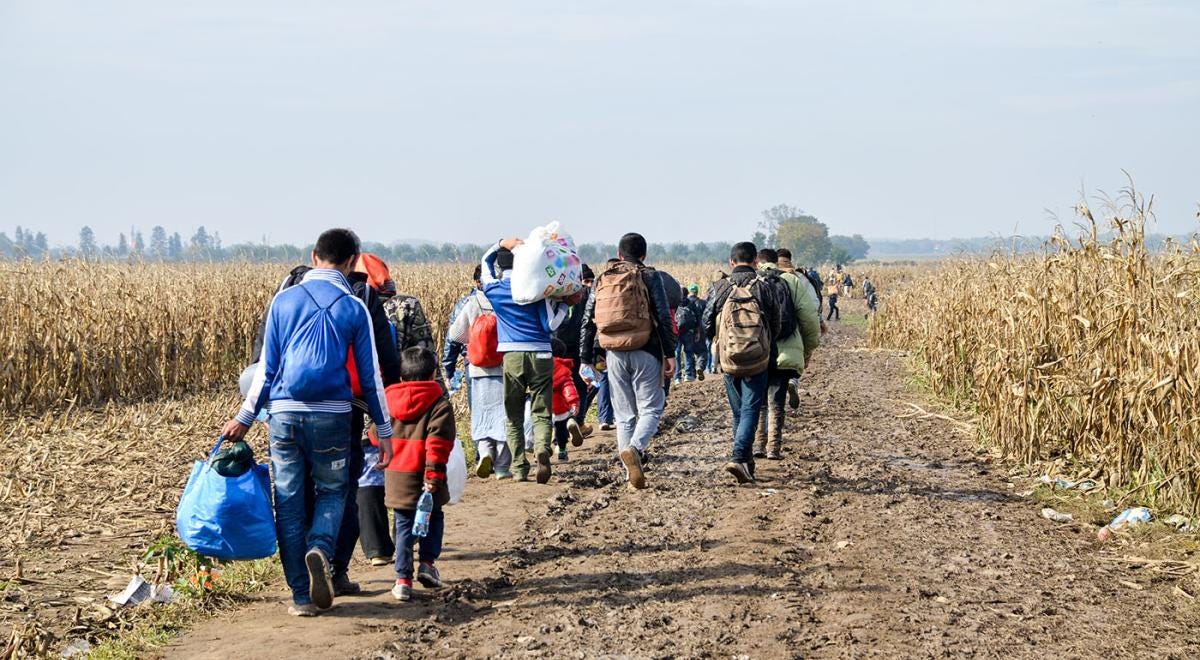
Expats, asylum seekers, and internal movers alike formed lives that were real, but lightly anchored.
Present everywhere, but rooted nowhere.
What the Rogation procession actually did
he Rogation procession is described as symbolic, but it was not.
It was functional, because it did several things at once, none of which modern institutions have successfully replaced.
First, it made the boundary physical.
A parish was not an abstract unit. It was a walked perimeter: A sequence of fields, streams, stones, gates, and roads that existed in the memory of those who moved through it together.
A person who had walked the boundary twenty times did not know it as information. He knew it as a route carried in the body.
Second, it made repetition cumulative.
The procession did not change each year. It returned. The same season, the same order, the same stopping points.
Each year added another layer to the same memory.
A man of fifty had walked the same land perhaps thirty or forty times. The result was not familiarity in the modern sense, but formation.
Third, it made belonging communal rather than voluntary.
You did not choose the Rogation procession. You walked it because you belonged to the parish.
The slow walked with the fast. The important with the ordinary. The elderly with the young.
Belonging was produced by shared movement through shared space.
Fourth, it made dependence visible.
The harvest blessing was not decorative. It was an acknowledgement that the community depended on forces it did not control.
Rain, soil, seasons, weather, fertility. These were not background conditions. They were the structure within which life took place.
Taken together, these four elements formed a coherent system: physical boundary, repeated action, communal participation, and an acknowledged dependence.
Remove any one and the structure weakens. Remove all four and you arrive at something recognisably modern: people who share a coordinate but not a world.
The four practices that recover the Rogation logic
Remove any one and the structure weakens. Remove all four and you arrive at something recognisably modern: people who share a coordinate but not a world.
For Heritage Standard members only.
