


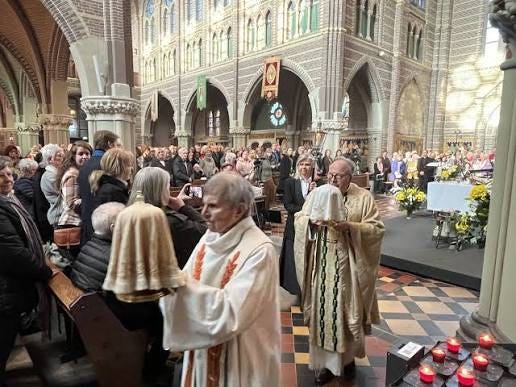
The Blessed Sacrament left the Sint Urbanuskerk in Ouderkerk aan de Amstel on the 25 of January this. Bishop Hendriks had written a letter for that Mass. A man from the parish board had read the decree in the nave: ‘withdrawal from worship on the first of March’. On the Sunday itself the Paschal candle was extinguished. The sanctuary lamp was put out. The tabernacle emptied. And the altar stone with the relics left under drumbeat in a procession the mayor of Ouder-Amstel later described as ‘a closing of doors’.
What is left is a building with Cuypers brick, its Stations in tile, its Marian chapel, and its smell of cold wax.
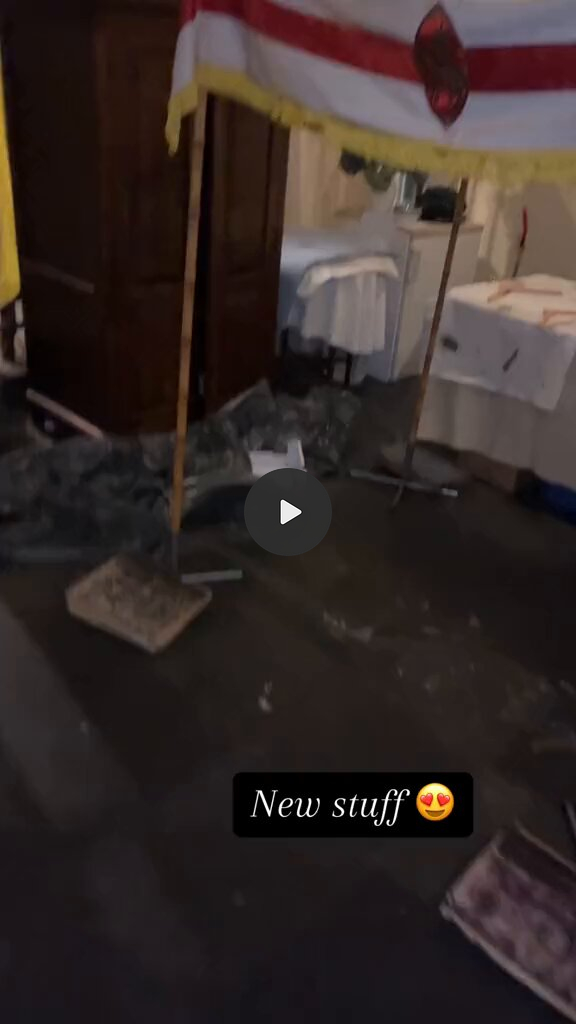
I asked for vestments and other things I could repurpose, but never got a response besides: ‘we have to discuss.’
The Netherlands is a great country in terms of infrastucture and we seem to organise a lot good, except for heritage, inheritances etc.
A lot goes to waste through omission, receiving a quick buck and a ‘we don’t care’ attitude.
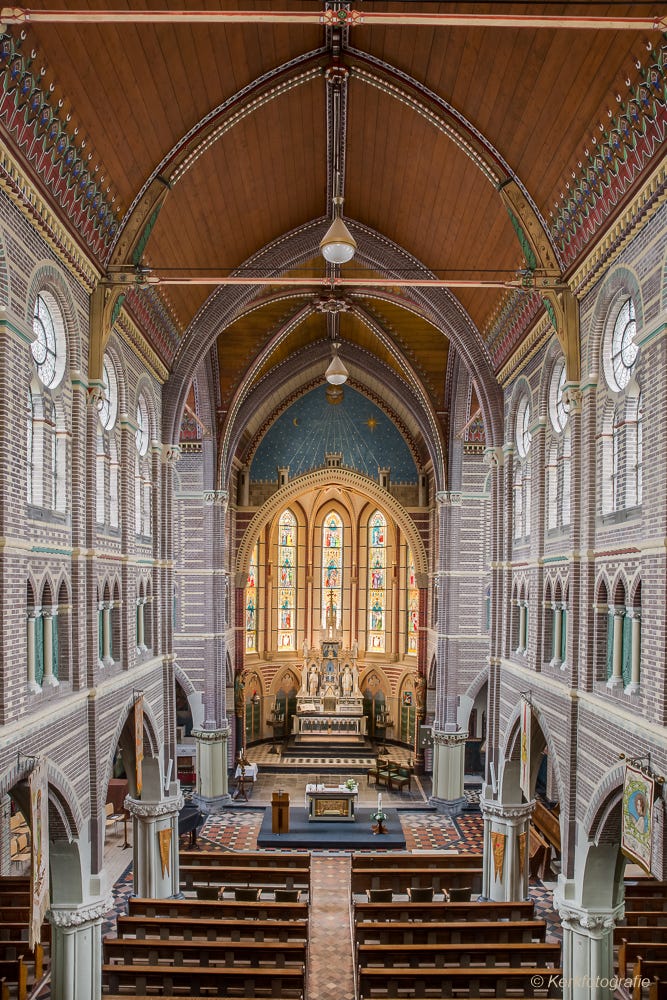
So, as we concluded: on the first of March the Diocese of Haarlem-Amsterdam withdrew the Urbanus from worship. From that hour this Cuypers church became, in the language of the chancery, a building like any other. The stone remained a ‘rijksmonument’ (National Monument), and the city began to speak of cultural heritage.
It is the sad reality of parishes in the Netherlands: a slow process of deconsecration: through laymen (and women) replacing the priest, dual use of the Church building (venue rental), and finally: the last Mohicans (seniors) being buried under the ground.
How Dutch parishes get deconstructed reminds me of how they tore the garment of Our Lord: everyone got an unequal share. Statues go to random parishes in Asia, Poland, etc., more often to antique dealers who sell them with 99% margins or they end up in a warehouse for decay.
The worst offender is Catharijneconvent: which is a secular Museum, receiving government funding, attached to the Cathedral of the Archdiocese of Utrecht.
It is criminal, yet even ‘conservative’ bishops like Eijk let this happen: a government funded museum stealing the Church’s artifacts under the assumption of stewardship.

Maybe you have uncountered any of this yourself. The closed Church you drive past on the way to the one remaining Sunday Mass. The Church your grandparents built that now holds offices, a restaurant, flats, or a bookshop.
The sense that the faith in your house is a private remainder, while the public form of the faith has been catalogued and sold. Buildings are only retained for their ‘cultural heritage’ listing. Your grandpa could spot a Church and just walk in there. You can do the same, but today you never know if it actually is a Church still.
The force that produces this condition is not decline as a weather. Decline is the weather. The force killing your parish is a procedure.
A parish board, facing heat and slate and a Sunday count that can fall as low as to fifteen souls. Often they invite local entrepreneurs or real estate developers in the parish board, and then ask the bishop for reduction to profane use.
The bishop (a weak figure 9.9 out of 10 times) consults, and issues a decree. A liquidation committee writes an inventory with four values for each object: religious, historical, artistic, economic.
Museum Catharijneconvent has registered hundreds of thousands of such objects. The sacred vessels go first to another church in the fusion parish. The rest go to a list.
And what finds no church and no museum meets a sentence in the handbook: discrete destruction, or a pawn shop.


We inherited a country where an old church building is treated as valuable for the public, while keeping the Church open for worship is treated as an expensive problem.
Your great-grandparents may have spent their whole lives saving money to build the church. But today, the diocese still has to pay for the roof, heating, repairs, and insurance. So when there is not enough money, the Church will be sold.
The municipality may be willing to help pay for a protected historic building, called a rijksmonument. But that does not necessarily mean it will help keep the building functioning as a Church. The government often wants something in return.
Then the diocese has to decide what should happen to the building. Sometimes it has rules about what the new owner may do. For example, a contract might say that the building cannot become a café, theatre, or supermarket, and breaking the rule could result in a large fine.
But there is another problem… Some people inside the parish board may prefer to turn churches into houses because housing is financially attractive (and they could live there themselves). The result can be that the building survives, but the purpose dies.
So we end up saving the shape of the church while losing the heartbeat of the church. Remember: Christ is in all the Tabernacles, His presence alone is worthy to keep.
A closed parish creates a strange situation. Someone who wants to keep a church as a living parish may be told that they are simply nostalgic. And do not try to contact the diocese if you are SSPX: they rather make it into a junky squat house then give it to actual faithful.


But a church was never just a building filled with objects.
It is a sacred place where people did the same important things week after week. The priest wore different colours because the Church year had different seasons. The bell was rung because it helped give the village its rhythm. Families sat in particular pews. The altar contained a relic because Mass was celebrated there.
None of these things were random.
The building, the objects, and the people formed one whole organism. The Church mattered because something happened there.
When people could no longer continue that life, the old Church could become a practical headache. Who will pay for the heating? Who will repair the roof? Who will buy insurance? Who will organise the volunteers? Eventually, people might start fighting about these questions… since many boomers are self-righteous and uncompromising (except when it is about money, they are addicted to it).
In the past, when a Church could no longer be used, important religious objects might be moved to another church or treated with religious respect. The building itself might simply cease to be used as a church.
Today, however, we often try to preserve the building at almost any cost by giving it a completely different purpose.
And that raises an uncomfortable question:
If we save the walls but remove everything that made the building a church, have we really saved the Church? What have we saved at all, besides a pile of bricks?
It is honest to admit that a building has lost its original purpose than to turn it into something completely unrelated. In that sense it is more respectful to demolish it, then to ridicule it with profane uses.
Our great-grandparents built these churches for God and for their communities. They did not build them so that, a hundred years later, a padel company could buy one, keep the historic façade, and celebrate itself for having “saved the heritage.”


This is what has been lost: people who lived with a rhytm, a faith, and accountability to their neighbours.
