


Everything around you has gotten technically better, yet substantively worse at the same time…
The coffee nowadays is excellent, but music is forgettable. Buildings are engineered to millimetre tolerances, but will not be mourned when they come down. The food is photographed before it is eaten and forgotten before the bill arrives.
You are not imagining this, nor are just nostalgic. Something structural happened, and it happened to everything at once.
This is Sloppification. And while often used as a slur, it is a mechanism. Slop is the systematic replacement of originality, depth, craft, risk, and long-term heritage with quantity, speed, algorithmic safety, and bland repetition.
Every field that once needed difficult conditions and high standards to produce quality has learned to separate the appearance of quality from those conditions and sell the appearance alone.
The signal is cheap to produce, while the conditions and standards were expensive. So the market chose correctly, by its own logic. That is the problem. And that problem is best diagnosed with what is happening in our current year of 2026.
Slop is disease that now runs our entire culture: Luxury brands, architecture, art, food, publishing, design, and music.
Music always provides the clearest symptom of cultural decline, since its numbers are public, and it moves faster than any of the categories previously mentioned.
On the 10th of December 2025 Simon Cowell released a Netflix documentary attempting to manufacture the next boy band. They are known as December 10, and are desperately trying everything to make it work: Cowell uses his best connections to get high quality productions, Wembley Stadium performances and Primark clothing lines.
But his project is flopping really hard. Cowell has been launching projects like this since 2001. Once very successfully: he created The X Factor, Westlife, One Direction, the Got Talent tv-show, and produced the Teletubbies song. There are few people alive that understand the mechanics of pop music better than him.
But 2000s mechanics no longer produce the outcomes they once gave.

We are past the 1950-2000s monoculture of linear television and media. Nowadays everyone finds his or her own tribe online. And online audiences no longer accept assembled products, because an assembled product have no interior.
The ‘mystique’ around celebrities and pop stars has died completely. The formula was always visible, but once produced something interesting enough that people accepted the scaffolding.
Now scaffolding is all there is left.
We do see a ‘grass-roots’ musicians like Sombr releasing variations of the same track. He is seen as very ‘talented’ and ‘indie-pop’. But the slop-system has captured his talent and converted it into background music, since deviations are punished.
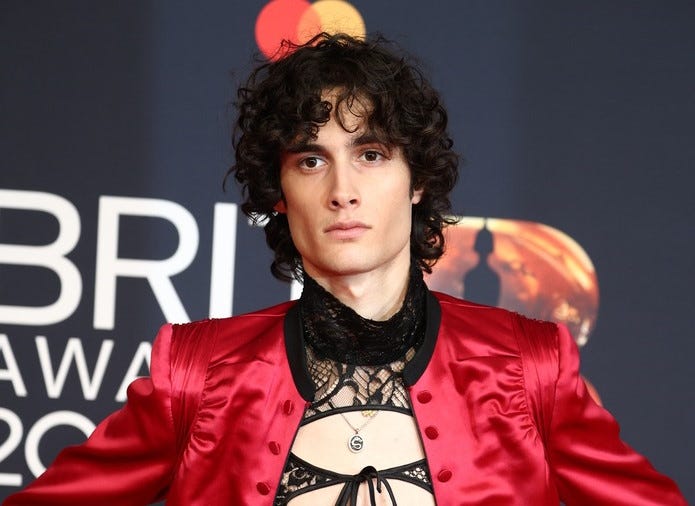
A different sound will break the algorithmic chain. And his listeners, who found him through TikTok recommendations, were served his music because it matched a vibe profile. Different sounds will not match that profile, and as a cause the algorithm will stop pushing it. Artists like him are structurally prevented from being creative. His formula: dropping a new variety of the same song every few months.
Both cases are part of the same problem. Cowell’s December 10 is a failed attempt to fake organic growth using slop-mechanisms. And Sombr is someone who probably has genuine creative talent, but is captured by a system that does not reward creative depth.
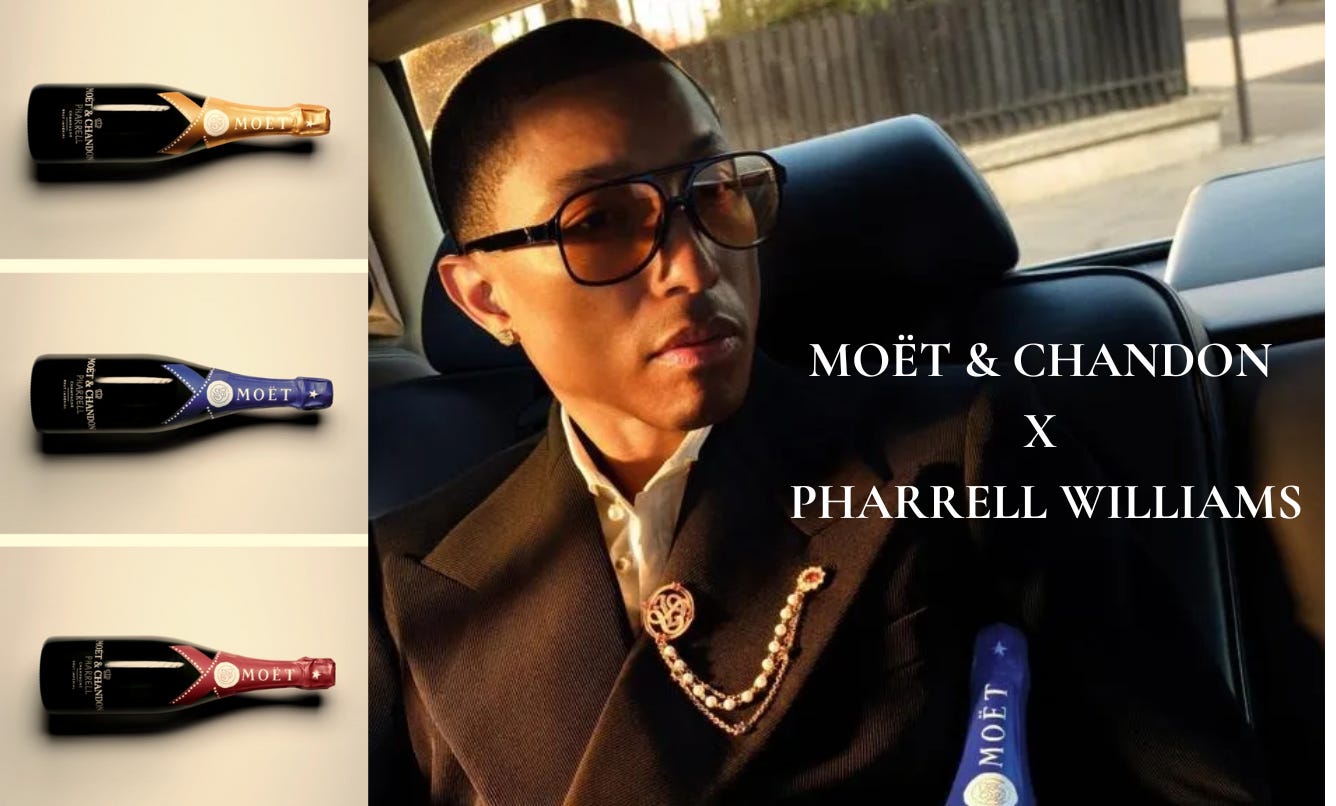
The luxury industry is in a similar position: Moët & Chandon hired Pharrell Williams, a ‘celebrity’ from 2010s everyone forgot about. Between 2000-2020 celebrity collabs were cash cows, but LVMH now runs Instagram ads because the inventory did not sell through.
One of the most recognised champagne brands in the world, part of one of the 10 biggest companies worldwide, with a history running back to 1743, could not move its own product without paid social and C-Tier celebrity collaboration.
The collaboration did not add reignite Pharrell, it only removed further removed prestige from Moët. Partnerships like these are liability for every brand.
But the mechanism is identical to Sombr’s situation, inverted. Sombr is renting the credibility of an established vibe. Moët is renting the credibility of an established(?) celebrity because its own credibility has eroded.
Both are substituting a borrowed signal for an earned one. And are doing this because the conditions that once produced the earned signal no longer exist inside their operating environment.
Last week in London I passed the office of Binghatti, a real estate agency. Kensington has become completely ‘Dubaified’. since it is full of these kitsch wealth-signalling businesses. (With Harrods being the worst)

Binghatti was promoting their Mercedes-Benz residential tower in Dubai, which makes the same point at architectural scale. The building has no architectural argument. The brand is the architecture. You are not purchasing a home with particular structural qualities, particular materials, a particular relationship to light or space or the street.
You are purchasing the right to tell people you live in a Mercedes-Benz Tower. The logo does the work the building cannot. The Prada Café operates identically at smaller scale. It is a parody of luxury.

These are not failures of execution. The Moët campaign was competently executed. The Dubai tower will be competently built. Sombr’s production quality is high. The problem is not incompetence per se. The problem is that competence without conditions produces technically accomplished work that means nothing and lasts nowhere.

These are not failures of execution. The Moët campaign was competently executed. The Dubai tower will be competently built. Sombr’s production quality is high. The problem is not incompetence. The problem is that competence without conditions produces technically accomplished work that means nothing and lasts nowhere.
Every age has its version of this pressure. The obligation to produce on the market’s terms, at the market’s speed, inside the market’s approved forms. The people who refused it were not more talented. They built different conditions instead. Think: Bach, Trollope, Gould and Ozu. None of them were trying to be creative. They were shaping the conditions. And their creativity arrived as a consequence.
Our society did not run out of talent. But it did ran out of the conditions that forced talent to become something lasting. And it replaced them with something cheaper: the signal of those conditions, sold at volume, optimised for the algorithm, forgotten in six months.
As a Heritage Standard reader you feel this, and navigate in a world where signal and substance are permanently separated. You have become skilled at reading slop signals. But skill at reading those signals is not the same as knowing what the thing itself feels like.
In this Saturday I tell you the specific conditions 4 men built, named precisely and applied to your own week.
You will learn how they handled their creativity.
-Robbert
I haven’t followed popular music for a long time. When I stopped doing so, not that I was ever loyal to it, it was already in a dire state. I see it’s ongoing degradation and slide into irrelevance is not only assured but has been achieved.
Never heard of Sombr. Anyone that attends Saint Laurent fashion shows wearing lace, enjoys mocking masculinity, much in the same way that femininity has been belittled. Simon Cowell is not a music impresario. He is a marketer, in the same way a box of cereal is marketed. Cereal is useful, what Cowell is foisting on the public is not.
As this shall be my final post, I had quite enough of the Musk article, I hope you represent Ozu, Bach & Gould well. Ozu was one of my favourite directors.
All the best.