


Poland spent two centuries insisting it was Catholic before anything else. In 2026 it will ordain the fewest priests in its modern history, and the country is still pretending not to notice.
This is a 4-part series taking that myth apart with the actual numbers, the actual branding campaign, and the actual theology behind it.
Part I: what the 2021 census really said
Part II: how Poland turned a pope into a brand
Part III: the 1980 speech that moved a dogma nobody noticed move
Part IV: the parishes that survived without any of it
On 2 June 1979, in a square in Warsaw, John Paul II asked God to send his Holy Ghost down and renew the face of Poland. He meant that land specifically, and everyone listening understood he meant Poland, at that moment still ten years away from sovereignty.
The Roman Catholic Church was the only national institution the communists never managed to fully absorb, and its head standing in front of a million Poles that morning was proof Poland could produce a figure the whole world had to take seriously.
Pope John Paul II’s promise was not a subtle suggestion. He asked to renew this land, meaning: make it Catholic again… or make it Catholic finally… in a way the partitions and the communists never quite managed to destroy.
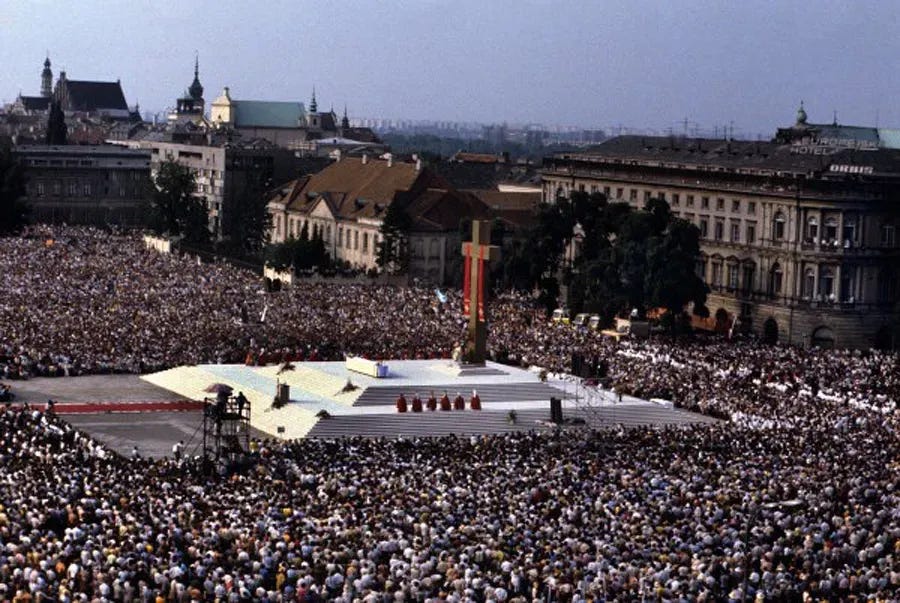
Forty-two years later, Poland ran a census that answered how effective his prayer has been. The results show nothing close to a renewal of Catholicism one Polish lands.
But the self-reported census was not the most honest number. In 2022, 29.5 percent of Poland’s Catholics went to Sunday Mass. Of those, only 13.9 percent received communion. Which is less than half the people still attending that took the sacrament Holy Mass was built around.
In 2011, 87.6 percent of Poles told the state they identified as Roman Catholic. By 2021, that figure had dropped to 71.3 percent. Sixteen percent is a huge change, a drift from the renewal that should have happened, in the same lifetime of people who were adults when the Pope made his request in 1979.
But the drop is not even the strangest number here: In 2011, 7.1 percent of Poles declined to even answer what religion identified with. Ten years later, 20.5 percent declined to do so. That means that one in five Poles, when asked directly, chose not to say no, but to not chose anything at all…
A country can fall out of love with an institution and still argue about it. We see that in Italy or Spain: aesthetically they look very Catholic with their processions and feast, while in morals and practice they do not care for what their priest says.
In Poland the arguing stopped, like in many Eastern European countries. People became indifferent, the way they did in every other formerly Catholic country in Europe, like the Netherlands.
To see why that silence (or indifference) matters, it helps us to understand what the 87.6 percent have been doing for two centuries before it started falling.
For two centuries self-reported Catholic believe functioned less as a statement of faith, but rather that of a load-bearing wall.
The Catholic Wall Poland built out of necessity
For 123 years, so from 1795 to 1918, Poland did not even exist. It was carved somewhere between the Habsburg Monarchy, Prussia, and the Russian Empire. That absence of nationhood made the Church one of the only structures still organised around a premise that a Polish nation could be real.
The scholar Geneviève Zubrzycki calls the result the country’s “national sensorium”: the visual and ritual grammar through which Poles came to feel their own nationhood.
After 1945, Poland’s borders shifted west, and its prewar religious plurality was largely deported or absorbed elsewhere. So the postwar state found itself governing one of the world’s most homogeneously Catholic countries, almost by accident.
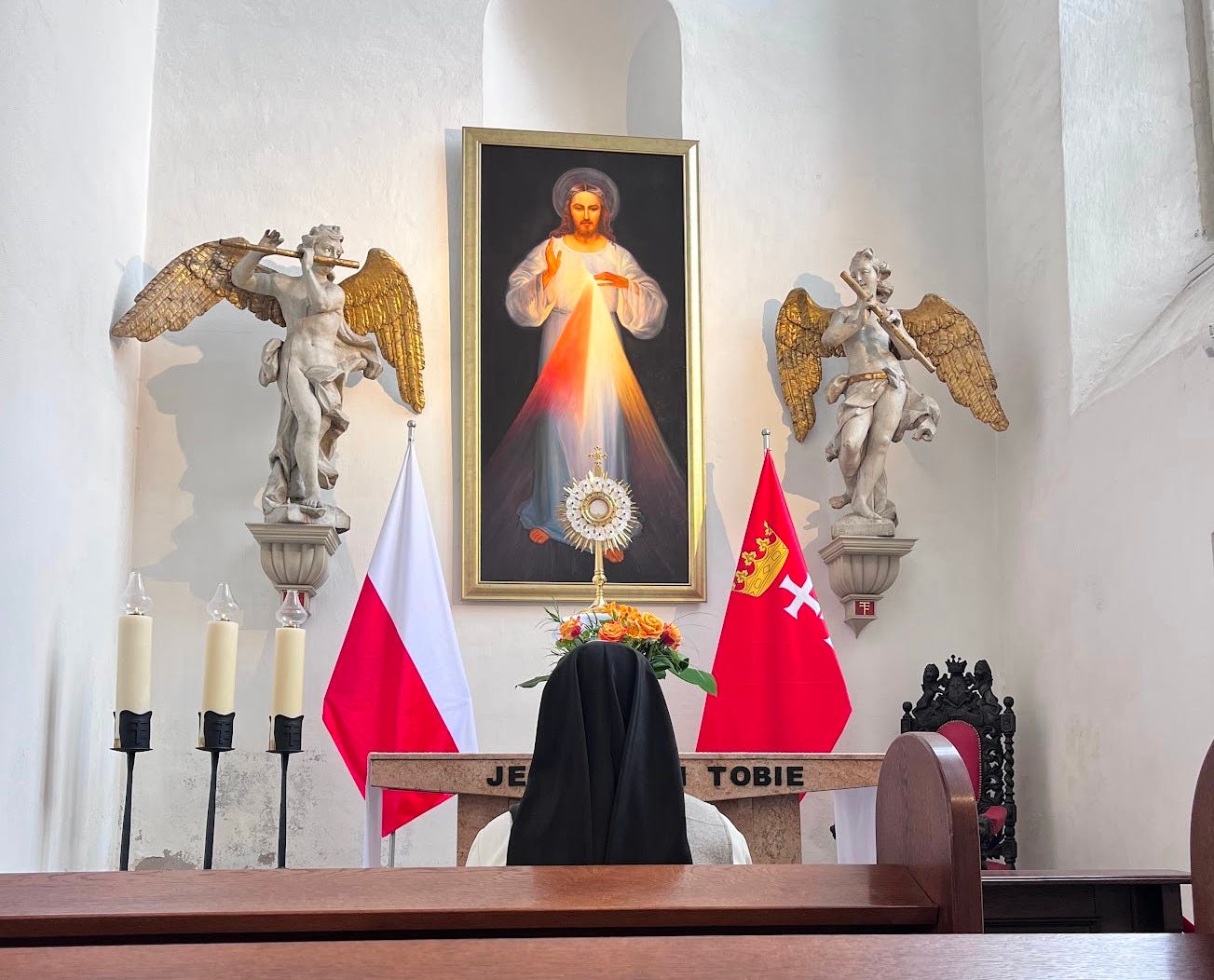
Under communism the Wall of Catholicism did its job again. The sociologist José Casanova, compared Poland’s Church to Spain’s and Brazil’s, and described it as ‘a church carrying the unfulfilled ambition of a state church, protecting a nation the state itself was not permitted to protect.’
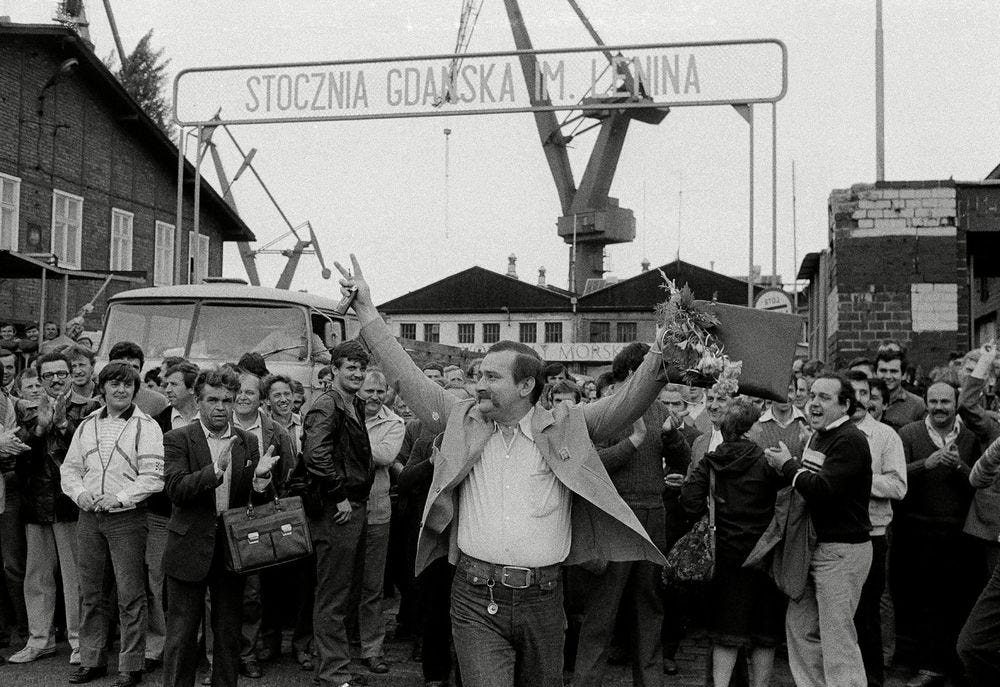
From this idea the Polish Solidarity movement rose, and began at a Gdańsk shipyard in 1980 to eventually break communist rule. The movement grew up inside a political culture the Catholic Church had spent forty years keeping alive. When Wojtyła (Pope John Paul II) stood in Warsaw in 1979 and asked for his land to be renewed... He was standing on a wall Polish people had constructed for two centuries, brick by brick, and out of a need that already had an expiry date attached to it.
Knowingly or unknowingly, the Catholic Church functioned as a vehicle to Polish nationhood.
The date when the Catholic Church became obsolete arrived around 1989. But the foundations stayed up anyway. A wall can stand for years after the weight is gone, but takes a fresh test to find out whether anything is still holding it up…
In the Polish case that wall still stands, but the interior of the house is already stripped to its bone…
So… what in fact tested the faith of the Poles?
Two things that are roughly a decade apart. And Poland’s institutions did not survive either test cleanly…
The first test was a slow accumulation of clergy sexual abuse cases. The Catholic Church’s own reporting around a 2021 census named them as a main factor in the declining attachment of the Polish people. Alongside a second complaint that had been building for years: an episcopate had made itself a political actor instead of a moral one. (If you want to understand more about the mechanism of politicisation and psycholisation of the Catholic faith, read this.)
The second test was on the 22nd of October in 2020, when Poland’s Constitutional Court ruled that permitting abortion on grounds of foetal impairment was itself discrimination against the disabled, and struck the exception from the law. Legal scholars had already questioned the court’s composition, citing government influence over recent appointments. This court ruling produced the largest protests Poland had seen in decades. An Ipsos survey afterward found 66 percent of respondents believed a woman should be able to terminate a pregnancy up to twelve weeks: a complete drift from Catholic moral teaching.
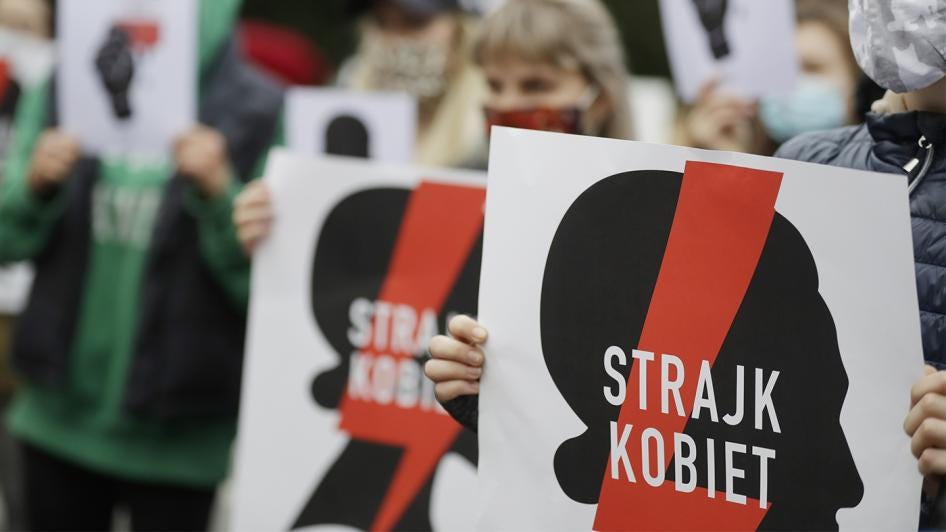
In the several publicised cases, doctors delayed treating pregnancy complications. They cited their fear of the new law, and the women involved died (this is what the news source says). Supporters of the ruling called these ‘failures of medical practice and communication’, but ignored the Catholic principle behind it. The opponents called them ‘the law working exactly as written.’
But neither the abuse scandal nor the abortion ruling created the decline… Weekly Mass was already optional years earlier. These two events only made it officialy optional.
A thinly formed generation of Catholics can keep the census box out of inertia. But they cannot keep it once the Polish Catholic Church spent a decade looking like a political actor with compromised moral claims. One reported controversy was then enough for an individual to turn their quiet drift into a formal exit.
A 2023 Ipsos study found the generational gap in religious commitment in Poland to be the widest recorded anywhere in their survey: Young Poles were leaving Catholicism faster than their peers almost everywhere else on the planet. The decline was sharpest exactly in the places a country’s self-image is written first: among the educated, and in its largest cities.
The census did not create a crisis in 2021, but only reported what already happened… and made it official. That is why this part is called: ‘Catholic Poland stopped existing in 2021’. Because it now did on paper.
Religious habit outlasts the reason, but that expires eventually
Poland’s own polling agency, CBOS, has been measuring religion for three decades. So their census only summarised what those surveys had already recorded.
The numbers: In 1992, 94 percent of Poles called themselves ‘religious believers.’
By 2021 that had fallen only to 87 percent, a soft drop that, on its own, would suggest not much had changed. Yet… belief and paper and actual practice are not the same question. So CBOS asked both, and saw that regular religious practice fell from 70 percent in 1992 to 43 percent in 2021.
Poland held its Catholic belief (on paper), but the practice nearly halved.
Among the young Poles this gap stopped being a gap, and morphed into a cliff. Sixty-nine percent of young Poles still practised regularly in 1992, by 2021 that figure was only 23 percent.
Archbishop Wojciech Polak, the Catholic Primate of Poland, called the decline among the young ‘devastating’, a word senior clergy do not reach for lightly when talking about their own institution.
The Catholic Church’s statistics office recorded the same collapse from their own pews. Mass attendance among those obligated to attend fell from 37 percent in 2019 to 28 percent in 2021. The Church attributed the fall partly to Covid-19 and partly, in its own bureaucratic phrase, to ‘socio-cultural factors.’ The type of language one would use when you do not want to name the obvious wound.
It is sad to see a growing number of Poles that stopped attending quietly and started leaving formally, through apostasy. Which is a step well past simply not showing up anymore…
The number that finally answers the question: Is Poland still a Catholic nation?
The figures I mentioned above measure those who still call themselves Catholic, or those that still walk into a church on a Sunday. But the number that measures the real state of parish-life is known: in 2022, 29.5 percent of Poland’s Catholics went to Sunday Mass, and of those only 13.9 percent received communion.
The communion figure is the one figure that actually matters. It is visible for priests and by faithful in the pews before the census made it official. Less than half the people still who attend still take the sacrament the Mass was built around…
What differentiates a Catholic from a non-Catholic at Mass? Taking communion, since that is reserved for Catholics only. If 86.1 percent of attendees decide not to take communion, how are they still ‘in communion’ = practicing the Catholic faith?
This is what I often call zombification. In its early phase people will still often visit Sunday Masses, then only for Christmas, Easter, a wedding, or a baptism. These people keep the shape of a parish life, but no longer inhabit it. In its last phase the building outlives the rite, and the country will call the empty Church its ‘cultural heritage.’
The sacraments that used to be a default to being Catholic tell the same story from any other direction. It is not just the communion people are skipping: by 2024, only 50.4 percent of Polish marriages were conducted as a Catholic sacrament. Down from just over 70 percent a decade earlier. A country in which a Catholic wedding was once simply what a wedding was. Now it is closer to a coin flip.
Baptism has held up slightly better: 87 percent of newborns were baptised in 2024, against 93 percent a decade before. It is the one sacrament still functioning as something close to a default. But even that is eroding, just more slowly than the rest…
This has happened in every European country after World War II and Vatican II: the practice of baptism still remains as an initiation ritual, yet regular Church visit and taking part in parish-life fades away really quickly.
Churches end up being party locations for lavish gypsy weddings and a sacrament shop for the lukewarm faithful.
(VIDEO: First Holy Communion in Gdańsk)
Back to Poland: religion classes, taught in state schools but staffed and set by the Church, follow the same downward curve. Attendance to them was at 88 percent in the 2018–2019 school year, and dropped to 75.6 percent by 2024–2025. A decline of almost 12.5 percent in less than 10 year, and a decline spreading for the first time from secondary schools into elementary ones.
This happened because in 2023, Poland’s newly elected liberal government halved the teaching hours allocated to religion, and stripped religion grades from year-end averages.
The Catholic Church opposed the change loudly, but could do nothing to stop it. For thirty years the state made room for the Catholic Church inside its schools without much hassle. But that room is now being taken back, and the Church no longer has the societal standing to insist otherwise.
Two dioceses, two different countries
Neither the religion-class figure, nor any of the numbers above, describes a single country. Each one only describes an average, but that is a number no actual parish in Poland experiences.
The differences are gigantic:
In the diocese of Tarnów, in the southeast, religion-class attendance stands at a whopping 96.1 percent. While in Szczecin-Kamień, in the northwest, it has fallen to 59.1 percent: a 37-point gap!
And Mass attendance splits are wider still. In Tarnów an average of 62.3 percent of registered Catholic attended Mass in 2024, which is closes to the national figure of 1982 than to the national figure of 2021.
While in Szczecin-Kamień, on the Baltic coast, only 17.59 percent attended Mass in that same year. And Koszalin-Kołobrzeg, further along the same Baltic coast, sat at 17.53, which below one in five!
All three dioceses have to answer to the same bishops’ conference. They are all folded into the same 29.6 percent every time a headline runs the national Mass-attendance figure. But they function like completely different countries.
If one bases their claim of ‘Poland is a Catholic country’ while visiting only Tarnów that might seem true. But that is no different from the anecdotal evidence I have from my own parish. My own parish grows really fast, so in my experience there is a Catholic renewal, while in the grand scheme of things our parish with 150ish attendees is statistically irrelevant in a country of 18.17 million people.
A Catholic from Tarnów can read every number in this essay and feel like it describes another country. Simultaneously a Catholic in Szczecin-Kamień or Koszalin-Kołobrzeg can read the national headline and feel it describes a fairytale of 100 years ago. Yet all are counted in that same 29.6 percent national average.


What remains of the Catholic foundations of the Polish nation-state?
The numbers are painful. Poland will ordain 196 new priests in 2026, which is higher than most European countries, but its lowest total this century, down from 208 last year and 235 the year before (according to diocesan announcements compiled by The Pillar.)
Seven of its dioceses will ordain no one at all. A diocese that ordains no one for a single year have absorbed a gap, because with retiring clergy the burden of the future generations will become heavier. In The Netherlands it is normal for one priest to serve 10+ churches a week.
But a diocese without ordinations at all is watching its own succession stop, one empty seminary class at a time… happening in the the same country whose Pope asked God to renew its face. Is this the promised miracle of Saint(?) John Paul II?
None of these stats are being kept secret from the people who run the institution. Fr. Andrzej Kobyliński, when interviewed on the state of Polish Catholicism in 2018, was already calling the change structural rather than cyclical: ‘a genuine transformation, not a trough the next generation would quietly correct.’
Every figure published since has confirmed his diagnosis rather than debunked it.
A 2017 Pew Research report found that the majority of Poles viewed religious institutions too focused on money, too focused on rules, and too entangled in politics. Poles are now more inclined to criticise than to praise the Church: in a country where most people still, on paper, called themselves Catholic.
In some of these questions, Poles were equally critical of religious institutions as the Czechs are, the most secular country in Europe. Secularism is a comparison Poland has spent a century insisting it could never apply to it.
But it applies now. The Catholic Wall built to survive partition and communism, is still standing in the sense that the census box still exists and most Poles still vaguely identify with it.
It only has stopped doing what Wojtyła asked it to do in 1979. It holds its shape, but the face underneath it has changed. There is no renewal, only a managed decline.
That is the gap this series is about: between the Poland still performing its Catholic reputation and the Poland that has stopped practising the Catholic faith.
The next essay is about what Poland built to keep the Catholic performance going once the substance had already withered.
To be continued…
Poland still identifies with its Catholic past. Part I was all about the census and real numbers. Part II will be about the substitute: the shell that remained.
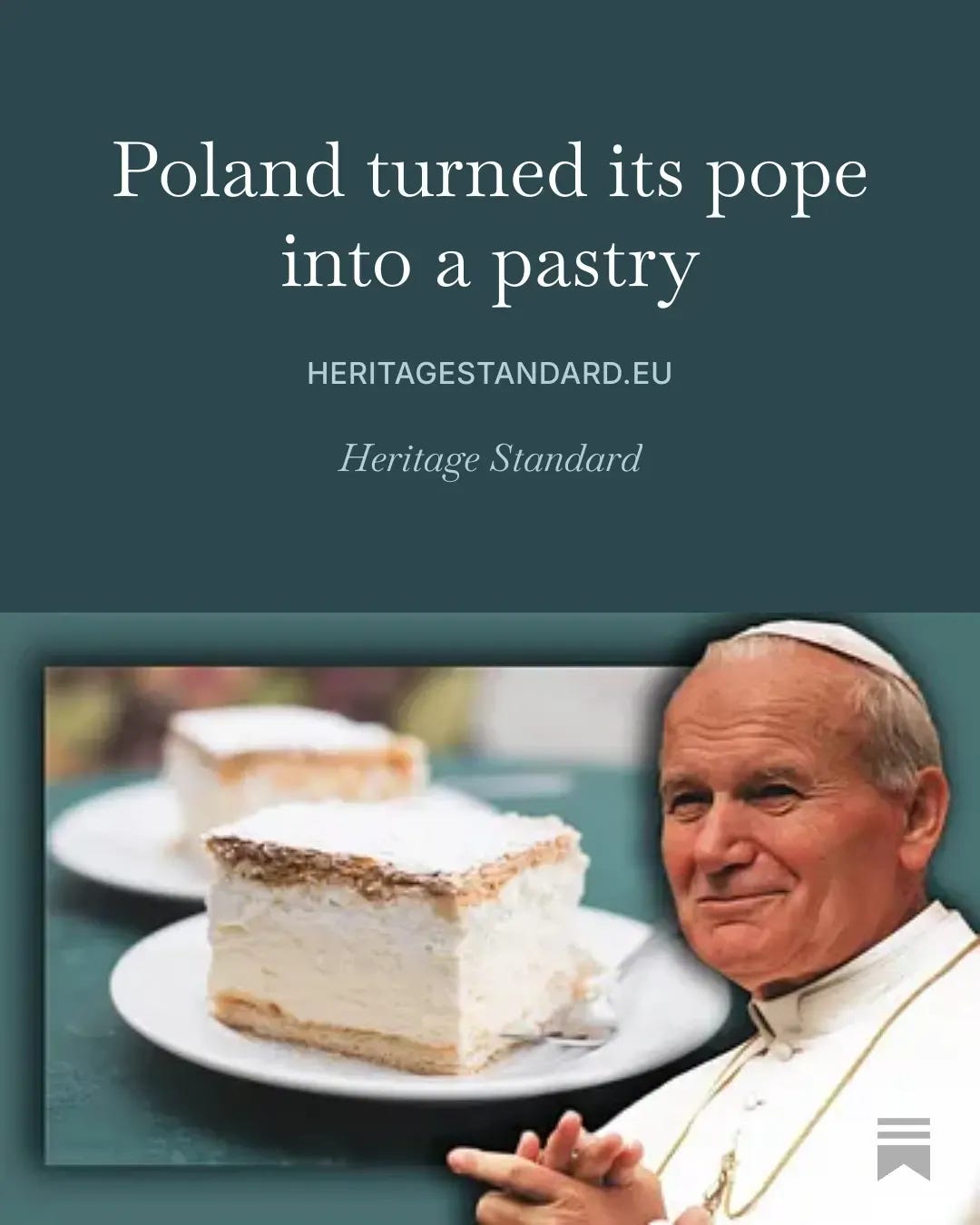
When belief thinned, the country could not argue an theology anymore. So it sold a cream cake from Wadowice, then filled the roundabouts with stone, and then watched the next generation turn its ‘Holy’ Pope into a meme. Pope John Paul II is rarely read, but he is deployed as a symbol of Polish nationalism.
Next week: how Poland turned its pope into a pastry
Part III will be the 1980 speech by the Polish Pope that moved a dogma.
Part IV, will be about the flourishing Polish parishes that survived the storm.
Sources used
Niechciał, P. (2025). Is Poland still Catholic? Glimpses of the changing cultural and religious environment. The Skalny Center Newsletter, University of Rochester.
Reporting on Institute for Catholic Church Statistics (ISKK) data, church attendance and sacramental participation figures, 2024 to 2025 reporting year.
Coppen, L. (2026, June 16). Priestly ordinations still declining in Poland. The Pillar.
Gospodarek, D. (2018, August 13). W Kościele odbywa się rewolucja. “Trudno powiedzieć, w jakich krajach katolicyzm przetrwa.” Aleteia.
p.s. My claim is not that nobody in Poland is Catholic. It is that the 71% Catholics on paper, and only 14% communicants are not the same country.