


This is a new category on Heritage Standard: LOST TRADITIONS
On occassional Sundays I will pick one or two local, cultural or Catholic tradition that used to be ordinary and is now mostly gone.
Our civilisation was held together by the collection of these small and grand ideas. Vestments, processions, customs, recipes, crafts, feast days observed in one place and nowhere else. Most of them faded or stopped being taught.
Not everything will come back. Some things ended for pragmatic reason. But you cannot decide what to want to keep or let go if you have never even heard of it.
-Robbert
Today, we start with the falda and subcinctorium. Two papal vestments that vanished within a single pontificate of each other.
The Falda
Until the middle of the 20th century a pope could not walk into his own Mass unaided.
When he wore the falda, which is a long skirt of cream silk under the alb, the train ran so far in front and behind that four attendants had to carry it. Two at the front, two at the back.
This was not bad tailoring... A garment that stops you from walking on your own is making a claim about who is wearing it. The falda showed that the Pope not as a private person who happens to hold an office, but as the office itself. A body that no longer belongs to itself, surrounded and supported the way a monarch is, because what it represents is too large to carry alone. (Even though some claim they can…)
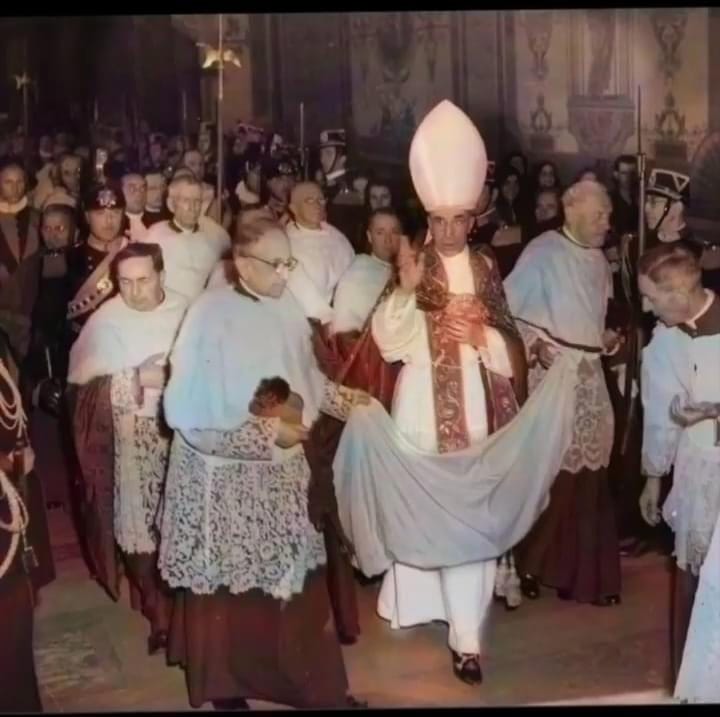
The same logic explains why the Patriarch of Lisbon alone among all bishops of the Latin Church was granted the falda.The Patriarchate of Lisbon was one of the few sees in the Latin Church granted privileges that deliberately mirrored the papal court.
The falda was part of his vestments. It marked the patriarch not simply as a senior bishop, but as the holder of a dignity the Holy See itself had chosen to set apart.
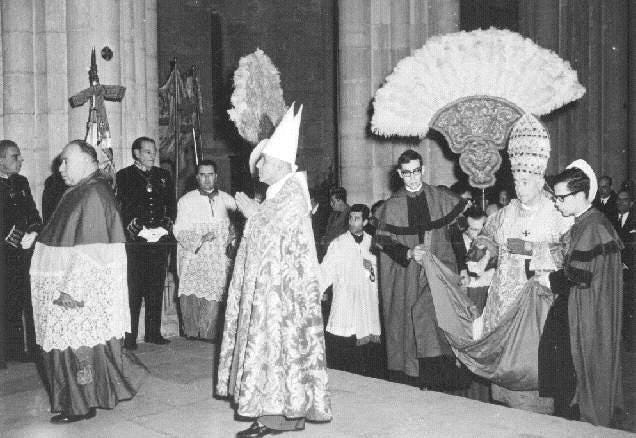
The falda survived the loss of the Papal States and every other stripping of temporal power of the Pope. But it did not survive the 1950-1960s renewals: which brought a complete change in how the Church wanted its power to look.
After the Second Vatican Council the papacy chose to look less like a royal court and more like a pastoral ministry. The same drive simplified language, architecture, music and gesture in the name of closeness and accessibility. A garment whose whole purpose was to show that this man cannot move without help because he is more than a man had no place in that picture.


Pope John XXIII (top left) was the last one to wear the falda.
The cost of loss of a vestment is easy to underestimate… because… who cares about a piece of fabric? But when the signs that made the office larger than a single man are removed, the office itself becomes harder to see. Just like the current Catholic hierarchy, the office became more abstract, more authoritarian, more distant, people trust it less and have contempt for it… while the reforms should wanted to do the opposite.
What once had to be carried by others starts to look like just another interchagable role a man can put on and take off. Just like how Bergoglio became Pope when Ratzinger was still alive.
The Subcinctorium
The subcinctorium was easy to miss even in photographs: it is a short band of embroidered cloth, about the length of a forearm, worn at the Pope’s right hip and only at a Solemn Pontifical Mass. One end carries a small Agnus Dei, the other carries a cross.
And between them sits, in miniature, the logic of the Mass itself: the Lamb who is slain and the instrument of his death, held at the waist by the successor of His Apostle Peter. The man who is about to represent that sacrifice at the altar.
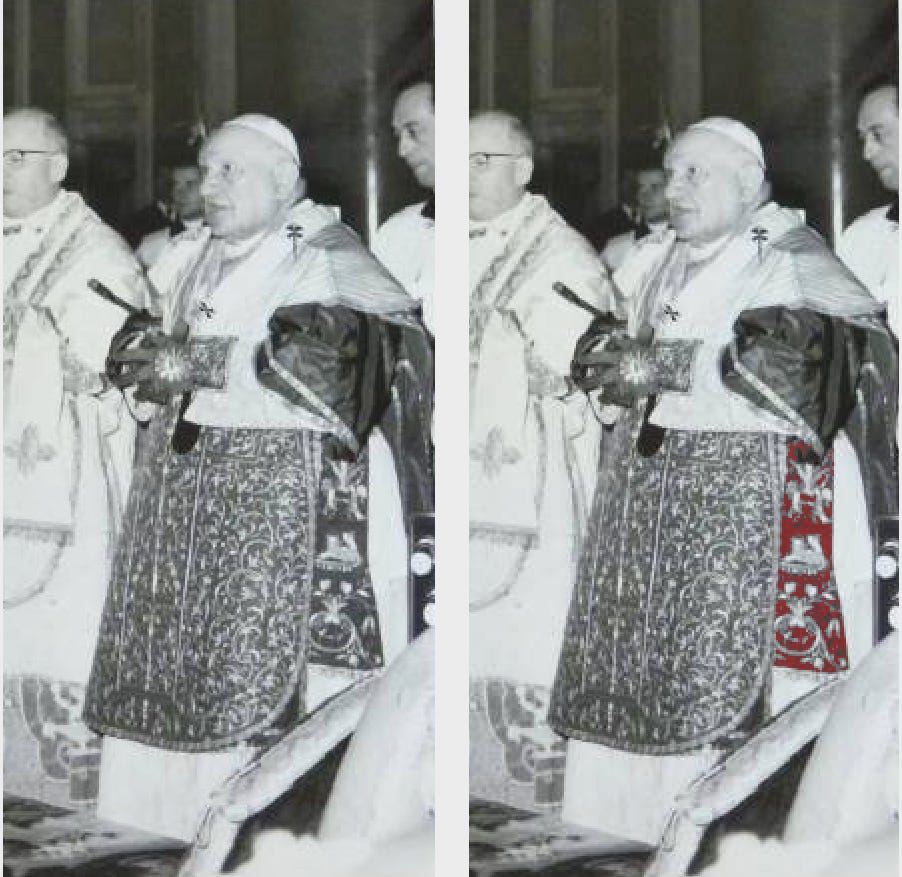
Saint Thomas Aquinas records that the use began as something purely practical, a strip of cloth that kept the stole from slipping free of the cincture. By the end of the 13th century that problem was already solved. But what the Church did next is the interesting part… instead of letting a garment with no remaining function disappear, it kept the subcinctorium because of its meaning.
Some saw in it a survival of the vestments of the Jewish high priest, binding the Pope’s ministry to that older priesthood. Others read it as a memory of the almspurse Popes once wore for the poor, or as an echo of the towel Christ tied around his waist the night before he died.
The Church let it carry all three: sacrifice, service, and the poor, worn quite literally at the Pope’s side every time he offered Mass.
For a time the privilege spread beyond the papacy, to bishops and in places even to priests. But by the 16th century it had narrowed again, largely to the pope. The Eastern Church kept its own related form in the epigonation, still worn by Orthodox bishops. In Rome the subcinctorium went the same quiet way as the falda. No decree ended it. The will to keep dressing a pope in a doctrine simply thinned out until it stopped.
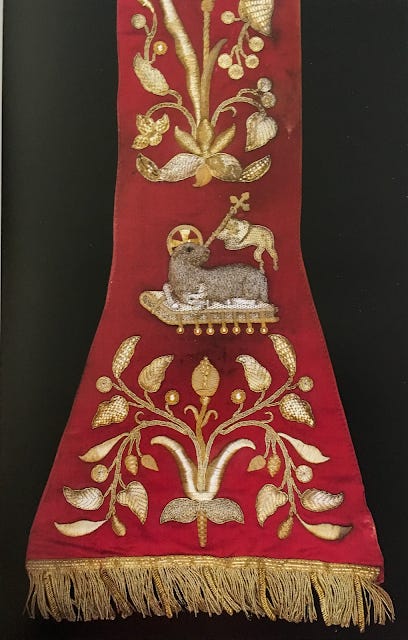
What both garments share is the an argument made in fabric about what the Papacy is and what a Pope is ought to do. Clothing is never neutral. It says what the man standing there is and what he is doing.
When we lose either local dress, or vestments we did not just lose cloth. We lose one more sentence of a language our culture and Church once spoke fluently and now no longer does.
Less is not a bore, as the postmodernists would say it, but it is quite literally cultural and theological genocide.
Have a blessed Sunday,
-Robbert


This is /was so very interesting…. And such a shame to loose this tradition…. Than you, Robert.
Mr. Leusink,
I am sorry I cannot reply to your email because it was rejected - 3 times.
Cannot confirm to start the 5-day programme.
…..???